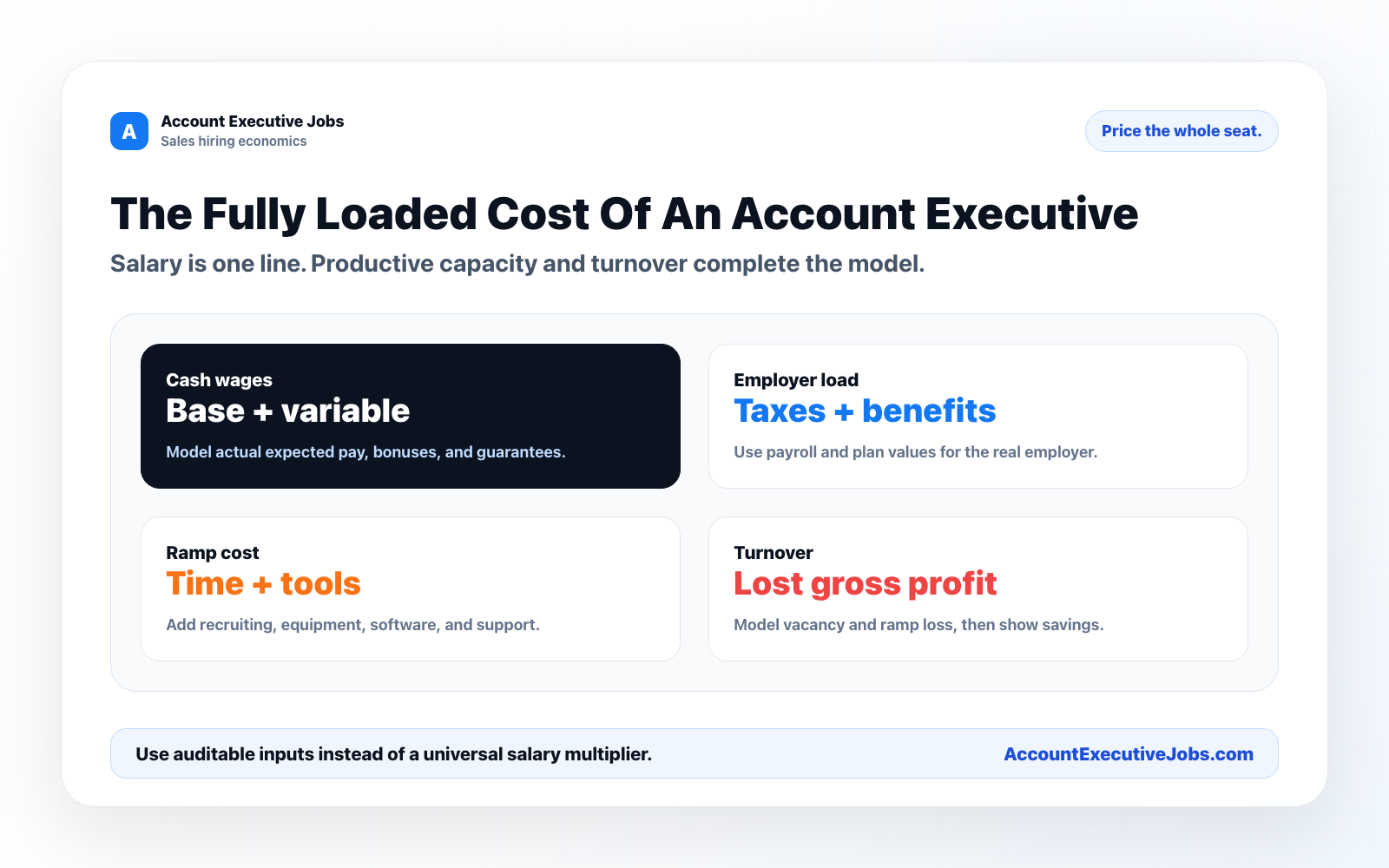
A $120,000 base salary does not make an account executive a $120,000 hire.
The company also carries variable pay, employer payroll taxes, benefits, recruiting, equipment, software, and manager time. If the hire replaces a departed rep, vacancy and ramp can erase far more gross profit than recruiting ever costs.
The useful question is not, "What salary did we approve?"
It is:
What cash will this seat consume, what productive capacity will it create,
and what changes when the seat turns over?
This guide builds that model without using a universal salary multiplier. Use the free Sales Hiring Cost Calculator for a new hire and the Sales Rep Turnover Cost Calculator for a replacement.
The Short Answer
Model a first-year AE hire like this:
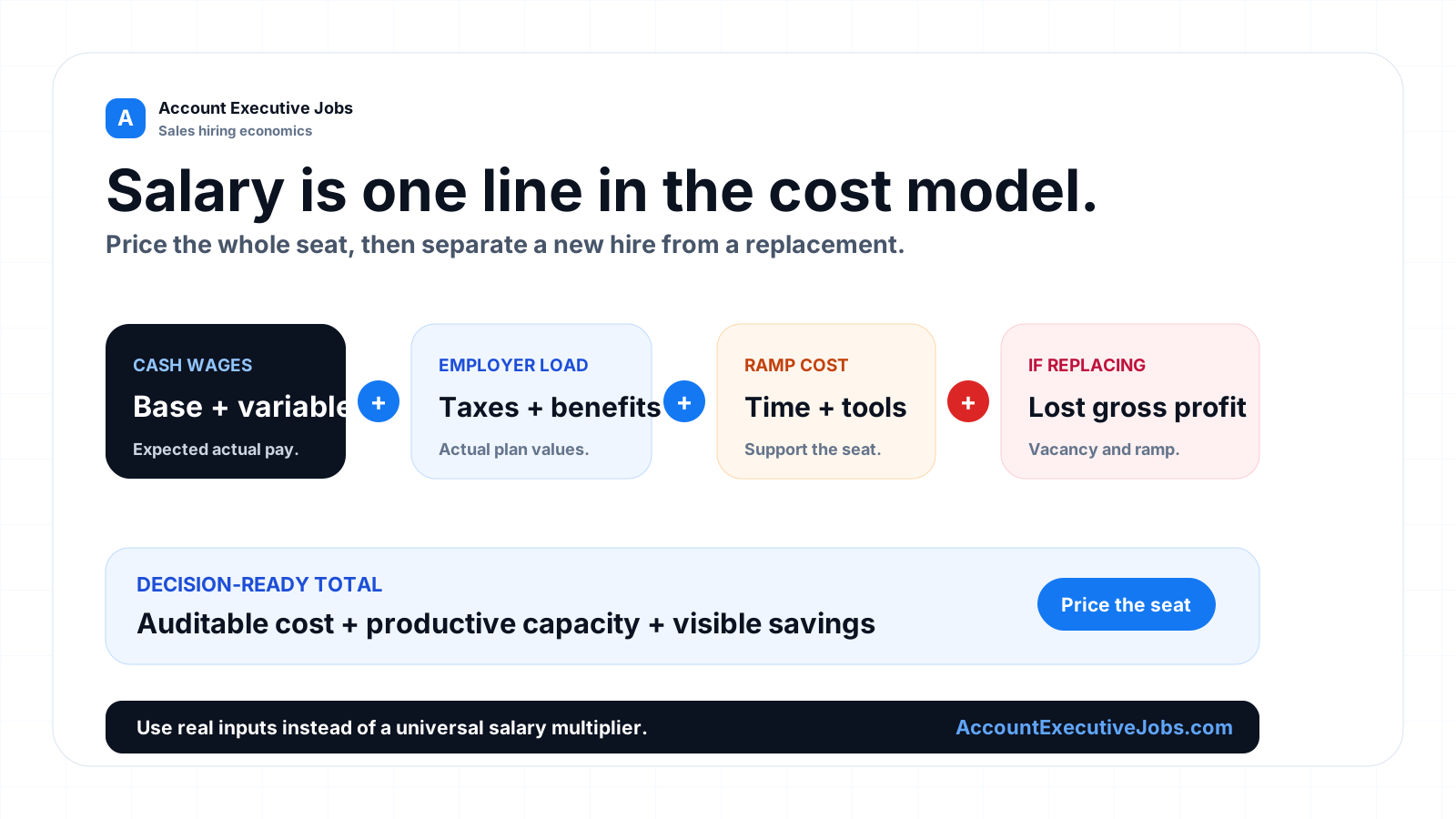
First-year hiring cost =
cash wages
+ employer payroll taxes
+ benefits and retirement
+ recruiting
+ equipment and software
+ manager ramp time
Model turnover separately:
Net turnover cost =
direct replacement cost
+ lost gross profit during vacancy
+ lost gross profit during ramp
- vacancy payroll savings
The second formula is incremental. Do not add the replacement rep's ordinary salary twice.
Copy embed code
<a href="https://accountexecutivejobs.com/blog/hiring-salespeople/cost-of-hiring-and-replacing-an-account-executive">
  <img src="https://accountexecutivejobs.com/static-images/blog/cost-of-hiring-and-replacing-an-account-executive-cost-stack-motion.svg" alt="Animated cost model adding cash wages, employer costs, ramp costs, and turnover disruption." width="1600" height="900">
</a>
What Does Fully Loaded Cost Mean?
Fully loaded cost means the employer's total modeled cost for the employee, not just salary.
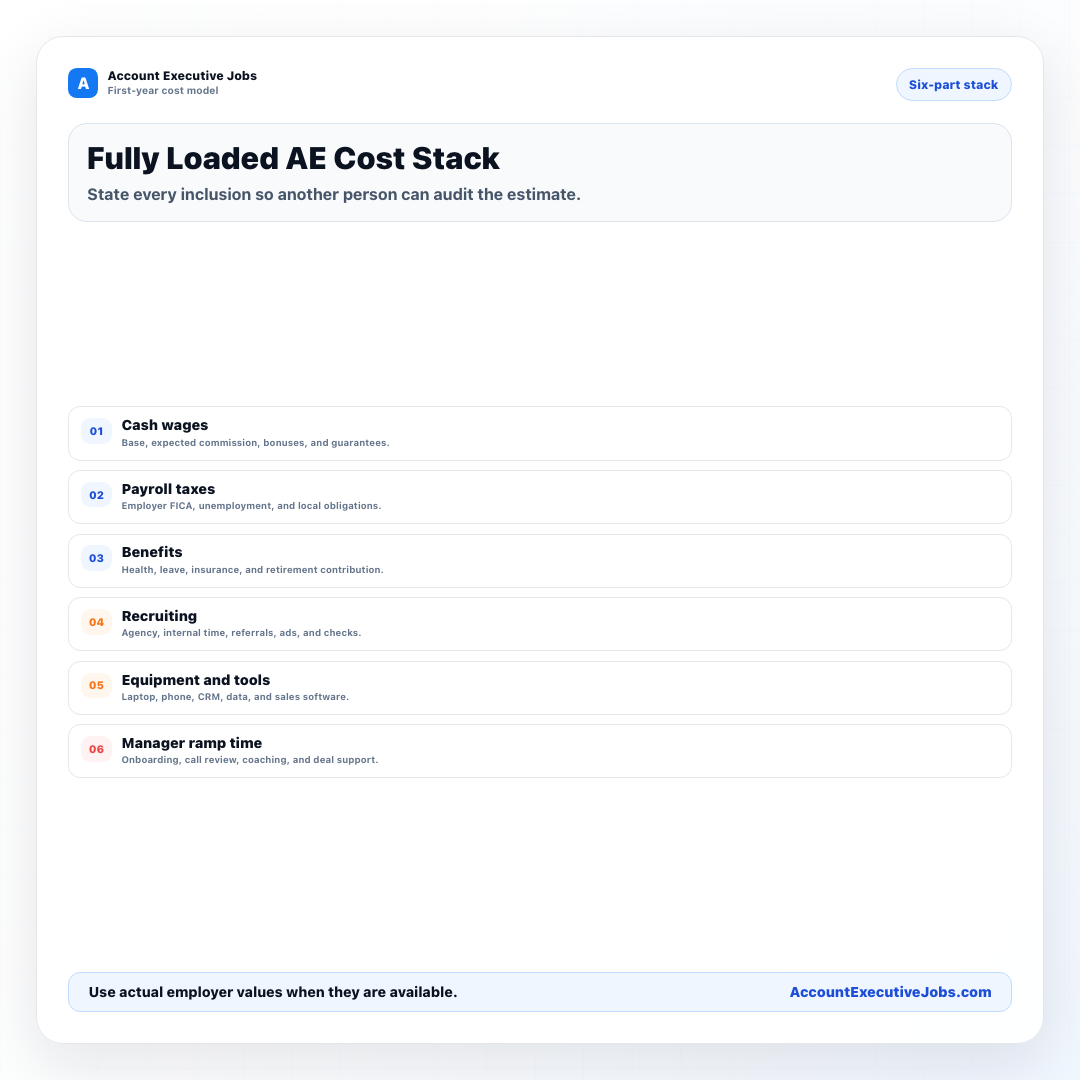
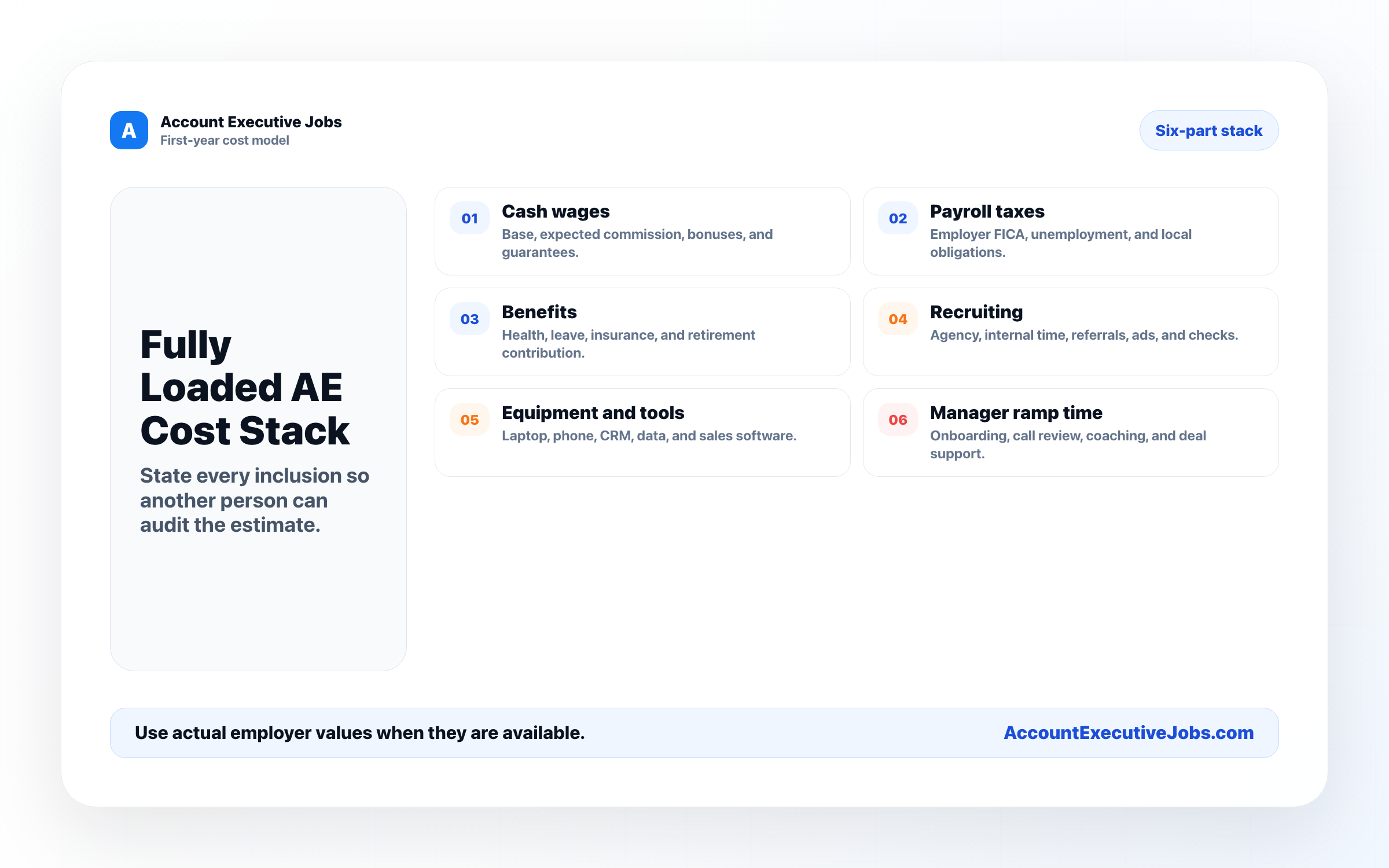
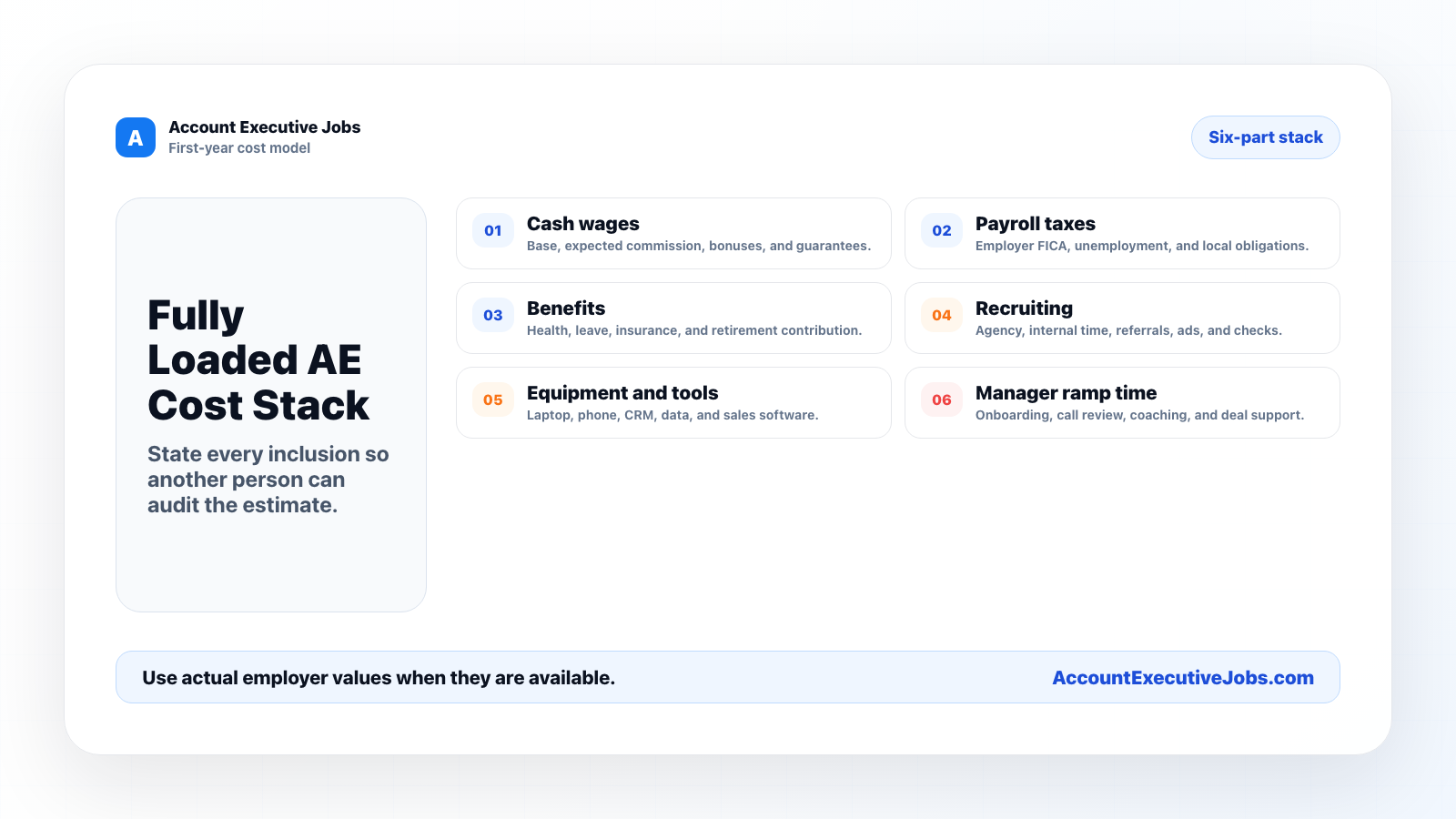
For an AE, the stack usually includes:
| Cost category | Typical inputs |
|---|---|
| Cash wages | Base salary, earned commission, bonuses, signing bonus, ramp guarantee |
| Employer payroll taxes | Social Security, Medicare, federal and state unemployment, local requirements |
| Benefits | Health coverage, paid leave, insurance, retirement contribution |
| Acquisition | Recruiter, agency, referral, advertising, interview time |
| Work setup | Laptop, phone, travel setup, CRM seat, sales tools, enablement |
| Ramp support | Manager, enablement, sales engineering, shadowing, certification |
The phrase does not have one mandatory formula. Finance teams may allocate overhead, office space, or shared systems differently.
State the inclusions. An auditable estimate is more useful than a larger number with a vague multiplier.
Start With Cash Wages, Not OTE Alone
OTE is base salary plus target variable compensation at 100% attainment.
OTE = base salary + target variable payFor a first-year cost model, actual expected cash wages may differ from OTE because of:
- Ramp guarantees.
- Reduced ramp quota.
- Below-quota decelerators.
- Above-quota accelerators.
- Signing bonuses.
- Draws.
- Team bonuses.
- The hire date.
If you model an AE at 80% post-ramp attainment, calculate expected commission from the actual plan. Do not simply multiply target variable pay by 80% if the plan has cliffs or tiers.
The guide to sales commission tiers, cliffs, and accelerators explains that payout curve in detail.
Add Employer Payroll Taxes Correctly
Employers do not pay the employee's federal or state income tax. They do have their own employment-tax obligations.
For 2026, IRS Publication 15 states:
- Employer Social Security tax is 6.2% up to the annual Social Security wage base.
- Employer Medicare tax is 1.45%, with no equivalent wage cap.
- Commissions and signing bonuses can be wages subject to employment taxes.
The Social Security Administration lists the 2026 contribution and benefit base as $184,500.
A simple federal FICA estimate is:
Employer Social Security =
6.2% × the lower of covered wages or $184,500

Employer Medicare =
1.45% × covered wages
Additional Medicare withholding applies to the employee, not as a matching employer tax.
Federal unemployment tax, state unemployment tax, workers compensation, and local obligations require employer-specific inputs. State wage bases and experience rates vary. Keep them editable.
This article is a planning model, not payroll or tax advice. Payroll should confirm the treatment of each pay type and jurisdiction.
Benefits Are A Cost Stack, Not One Percentage
The Bureau of Labor Statistics Employer Costs for Employee Compensation program separates wages and salaries from benefit categories including paid leave, supplemental pay, insurance, retirement, and legally required benefits.
For March 2026, BLS reported broad private-industry averages of $32.60 per hour for wages and $14.01 for benefits, or $46.60 in total compensation.
That is useful context. It is not an AE benchmark.
Benefits vary by employer, location, plan tier, family coverage, tenure, and compensation level. Use actual employer values when available:
- Annual medical, dental, and vision contribution.
- Retirement match or contribution.
- Life and disability coverage.
- Paid leave policy.
- Payroll and benefits administration.
- Any employer-paid allowance.
Do not take a broad national ratio and present it as a precise sales-hiring rule.
Recruiting Cost Includes More Than The Agency Fee
Acquisition cost can include:
- Agency or retained-search fees.
- Internal recruiter time.
- Employee referral payments.
- Job advertising.
- Background checks.
- Assessment tools.
- Hiring-manager interviews.
- Sales-leader and cross-functional interviews.
- Candidate travel.
Interview time is easy to ignore because it already sits inside payroll. It is still capacity consumed by the hire.
Keep internal time separate if finance does not want it included in the cash total. The point is to see it, not force every company into the same accounting policy.
Equipment And Software Should Follow The Seat
An AE may need:
- Laptop and accessories.
- Phone or phone allowance.
- CRM access.
- Sales engagement software.
- Conversation intelligence.
- Data and prospecting tools.
- Proposal and e-signature software.
- Travel and expense setup.
- Training or certification.
Some are incremental per seat. Others are annual contracts the company would pay anyway.
Use incremental cost for a hiring decision. Use allocated cost when evaluating the economics of the full sales function. Label the choice.
Copy embed code
<a href="https://accountexecutivejobs.com/blog/hiring-salespeople/cost-of-hiring-and-replacing-an-account-executive">
  <img src="https://accountexecutivejobs.com/static-images/blog/cost-of-hiring-and-replacing-an-account-executive-fully-loaded-cost-stack-inline.png" alt="Fully loaded account executive cost stack covering wages, payroll taxes, benefits, recruiting, tools, and manager ramp time." width="1600" height="900">
</a>
Manager Ramp Time Is Real Capacity
Managers spend time on:
- Onboarding plans.
- Product and market instruction.
- Call reviews.
- Deal strategy.
- Pipeline inspection.
- Role-play.
- Internal introductions.
- Tool and process training.
Model it with a loaded hourly cost:
Manager ramp cost =
hours per week × 52 ÷ 12 × ramp months × loaded hourly cost
At 5 hours per week, 7 months of vacancy plus ramp support, and a $100 loaded hourly cost:
5 × 52 ÷ 12 × 7 × $100 = $15,166.67You may choose a shorter manager-cost period for a new seat or separate recruiting time from onboarding time. Preserve the assumptions.
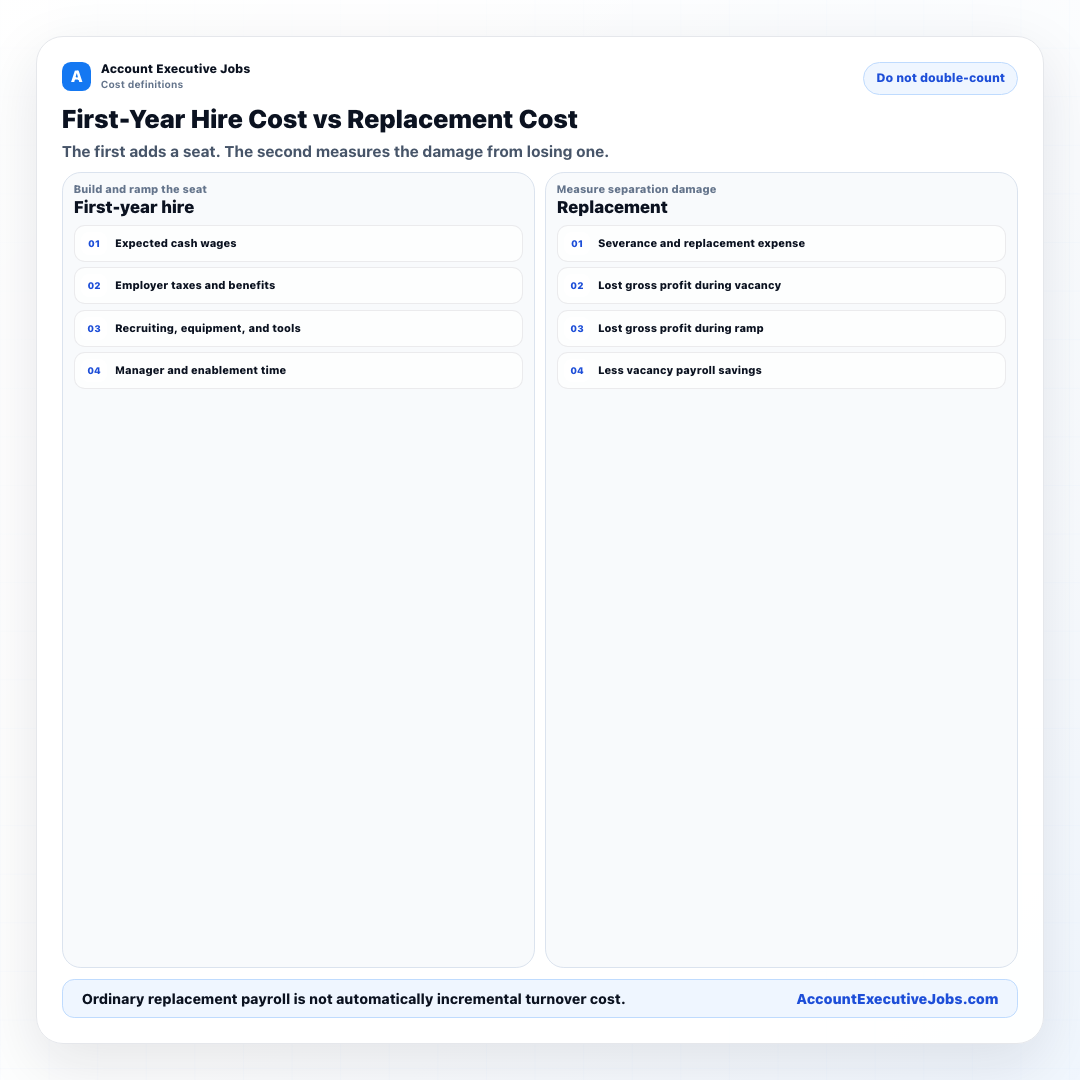
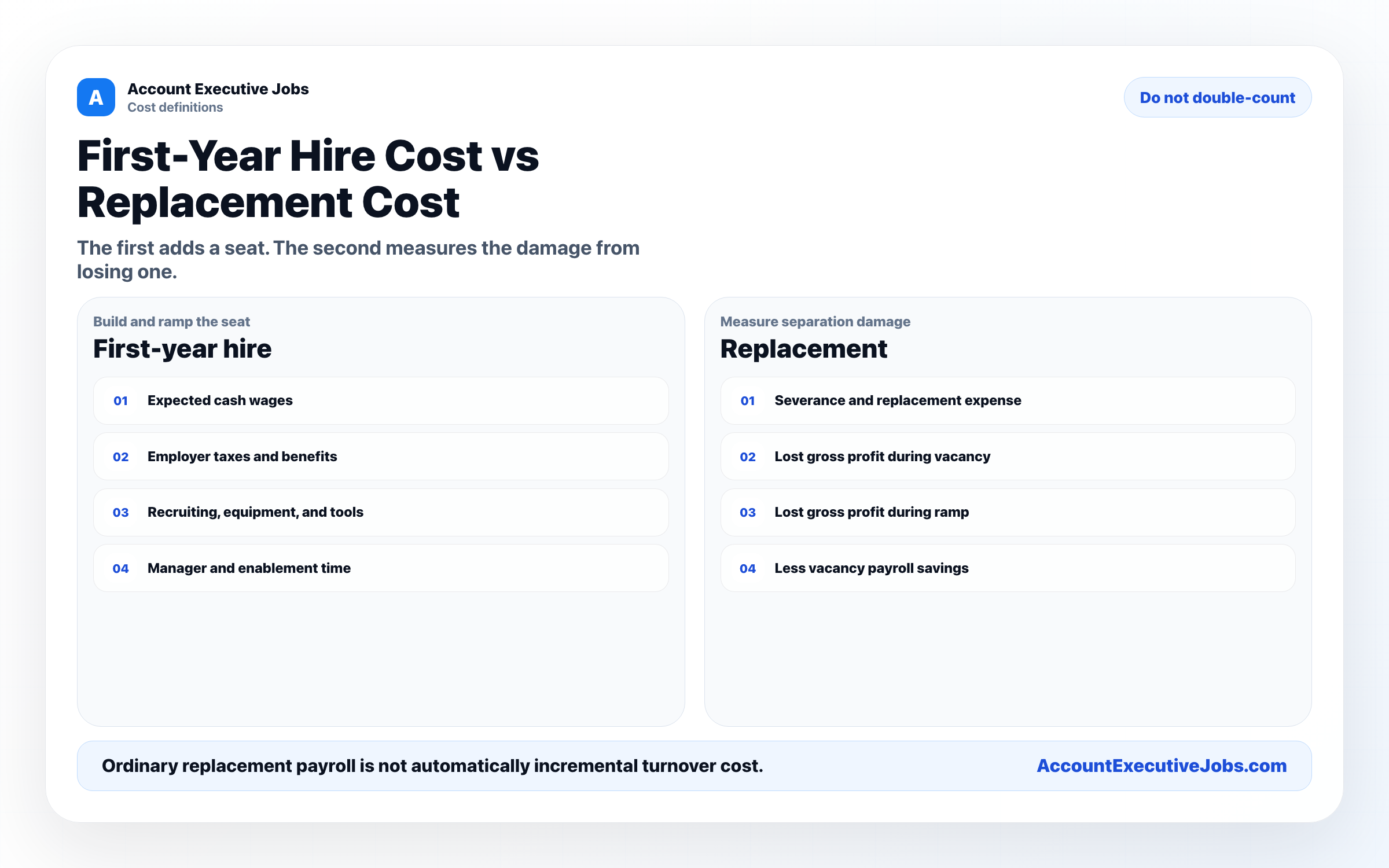
First-Year Hiring Cost Is Not The Same As Turnover Cost
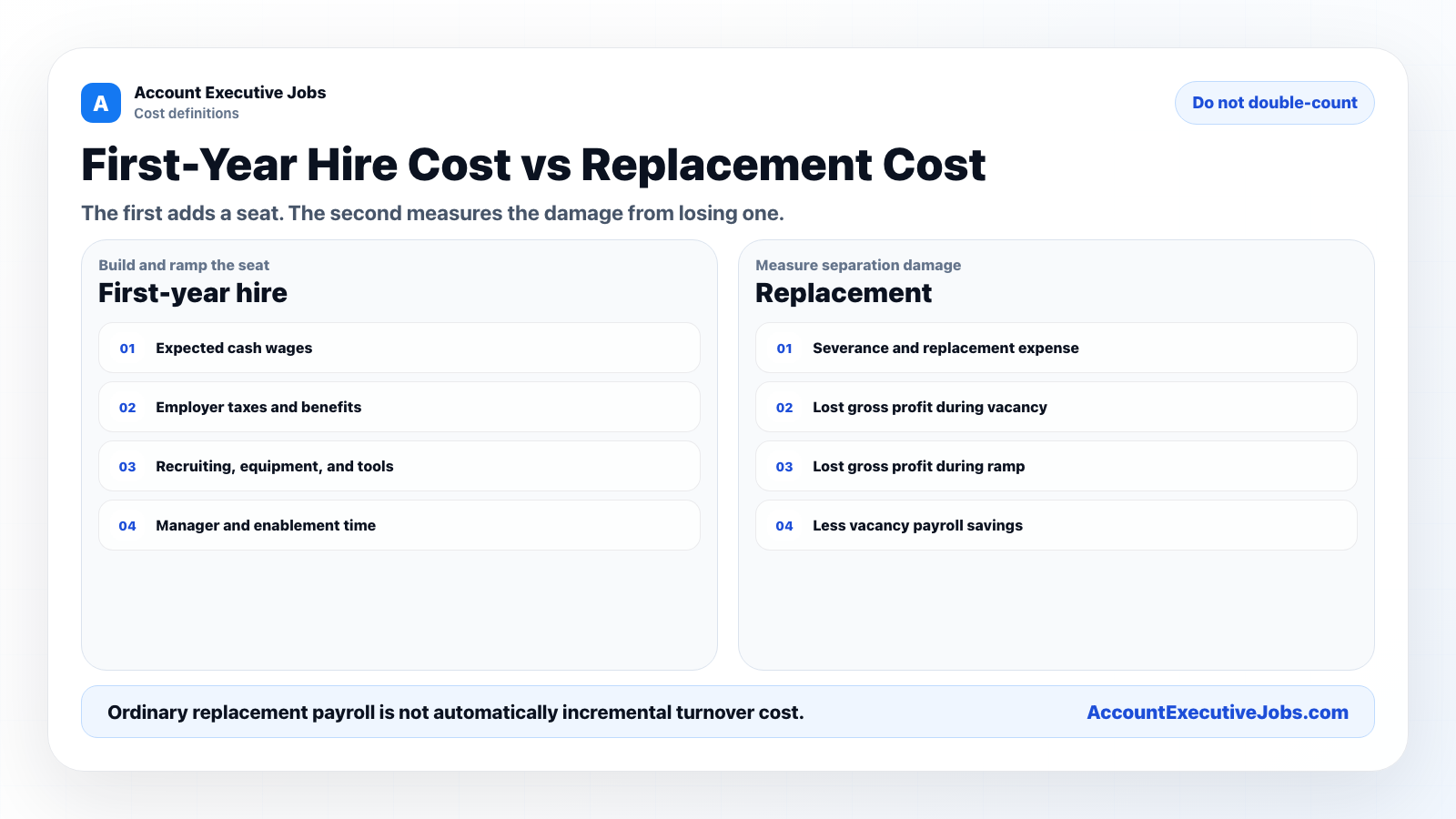
A new headcount decision asks:
What will this seat cost in year one?A replacement decision asks:
What incremental damage and expense did the separation create?The replacement rep's salary is part of operating the restored seat. It is not automatically incremental turnover cost. Counting a full year of replacement payroll on top of vacancy and ramp losses can double-count the same period.
Turnover commonly adds:
- Severance or separation administration.
- Recruiting.
- Onboarding and equipment.
- Manager time.
- Lost gross profit during vacancy.
- Lost gross profit during replacement ramp.
It can also create vacancy payroll savings. Show the savings, even when the net result remains expensive.
Copy embed code
<a href="https://accountexecutivejobs.com/blog/hiring-salespeople/cost-of-hiring-and-replacing-an-account-executive">
  <img src="https://accountexecutivejobs.com/static-images/blog/cost-of-hiring-and-replacing-an-account-executive-hire-vs-replacement-cost-inline.png" alt="Comparison of first-year account executive hiring cost and incremental sales rep replacement cost." width="1600" height="900">
</a>
Convert Lost Bookings Into Lost Gross Profit
Bookings are not profit.
If turnover causes $380,000 in lost bookings and gross margin is 80%:
$380,000 × 80% = $304,000 lost gross profitAdding the full $380,000 to recruiting and severance would mix revenue with cash cost. Gross profit puts the production loss on a more comparable basis.
Contribution margin may be better for some businesses. Use the metric finance trusts, then state it.
A Worked Sales Rep Turnover Cost Example
Consider an incumbent AE with:
- $1.2 million annual quota.
- 80% expected attainment.
- 80% gross margin.
- 3-month vacancy.
- 25% coverage from the remaining team.
- 4-month replacement ramp.
- First productive month in month 2.
- Ramp-end attainment of 60%.
- Post-ramp attainment of 80%.
- $100,000 base salary.
- $100,000 target variable pay.
- $20,000 annual benefits.
- $25,000 recruiting cost.
- $10,000 severance.
- $8,000 onboarding and equipment.
- 5 manager hours per week at $100 loaded cost for 7 months.
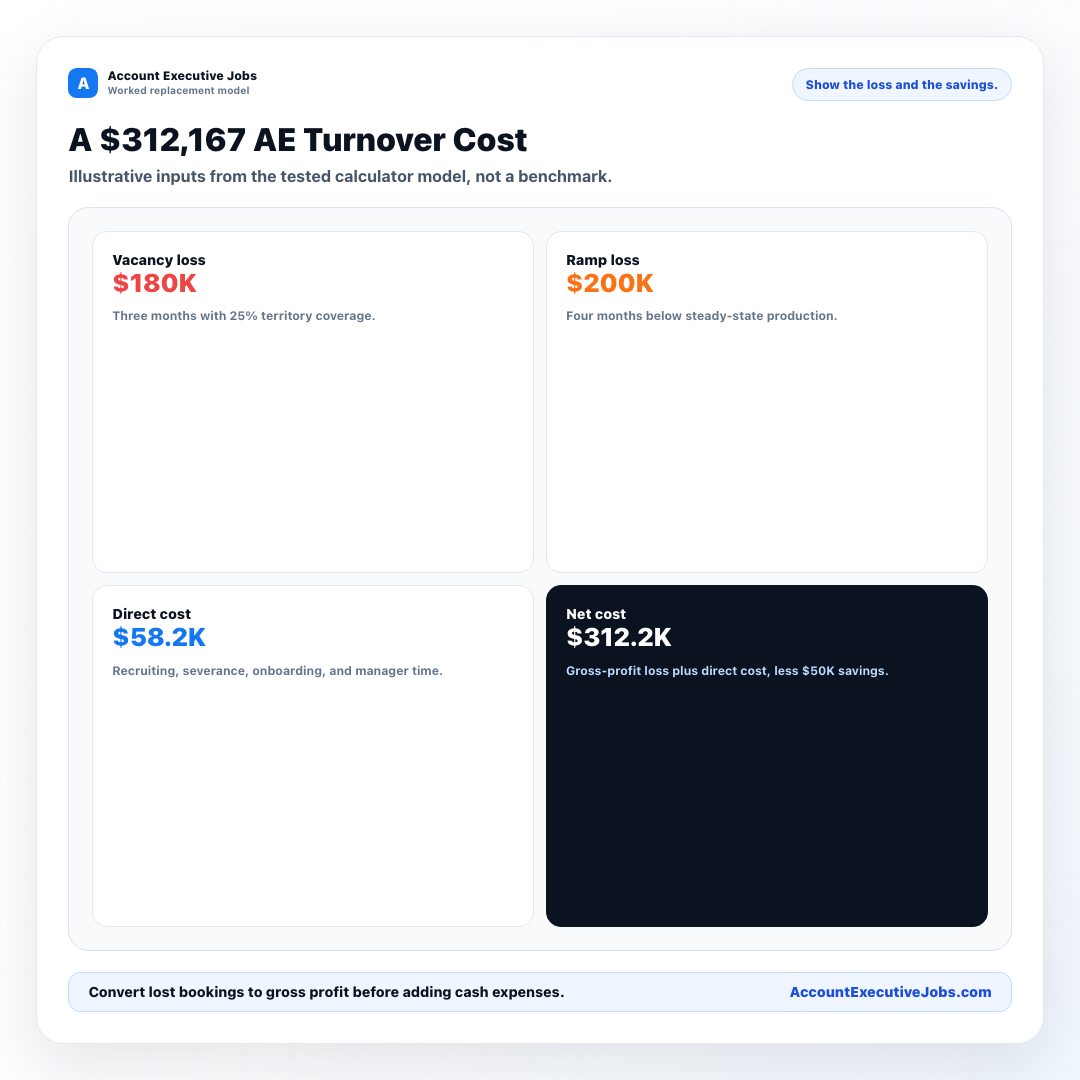
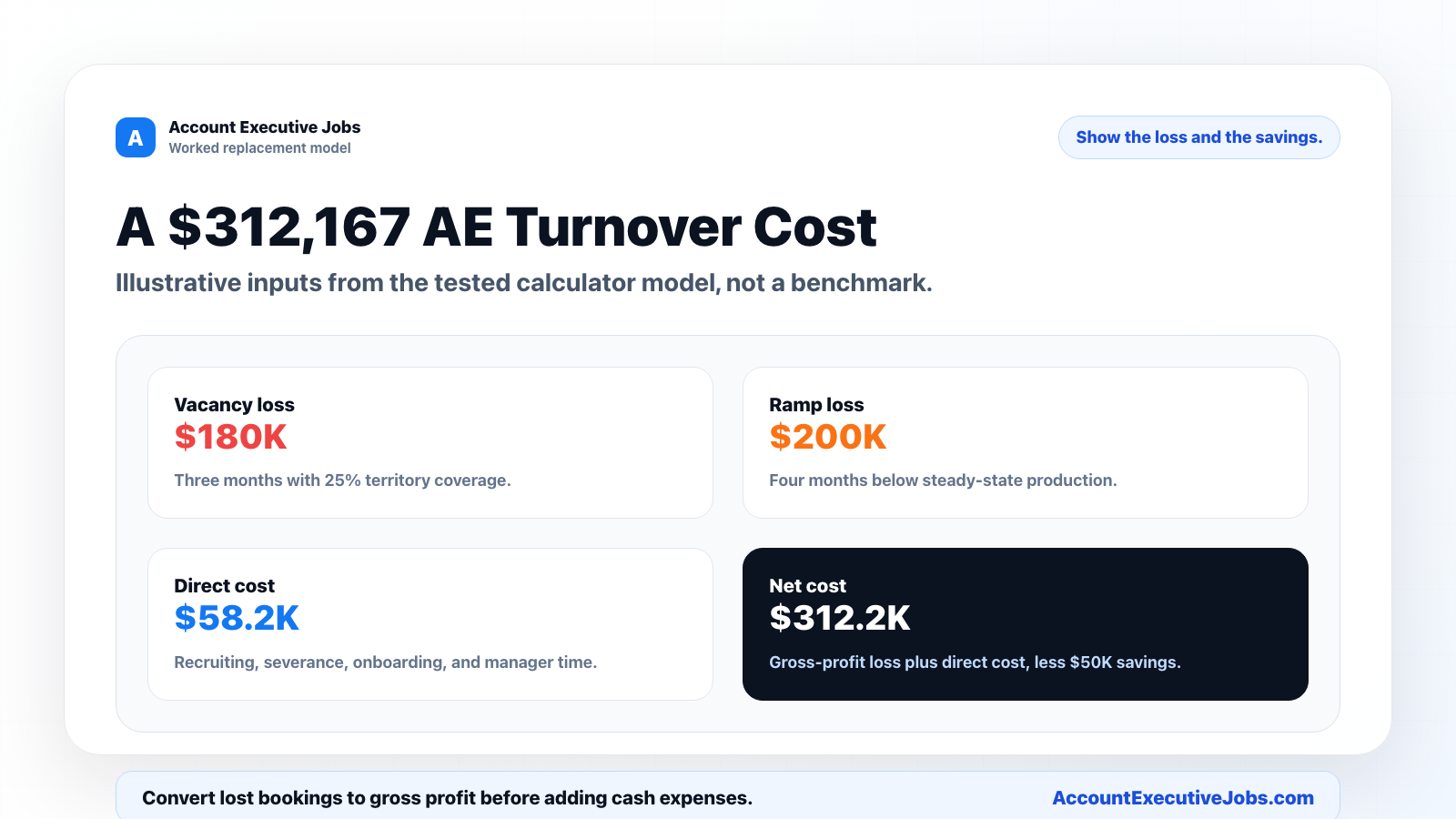
The tested model produces:
| Cost or offset | Amount |
|---|---|
| Lost bookings during vacancy | $180,000 |
| Lost bookings during replacement ramp | $200,000 |
| Lost gross profit at 80% margin | $304,000 |
| Direct replacement cost | $58,166.67 |
| Gross disruption cost | $362,166.67 |
| Vacancy payroll savings | ($50,000) |
| Net turnover cost | $312,166.67 |
The direct cost includes recruiting, severance, onboarding, and modeled manager time.
The vacancy loss assumes the departed rep would have produced $80,000 per month in bookings at 80% attainment, with the team preserving 25% during the three-month vacancy.
The ramp loss compares the replacement's modeled production with the steady-state 80% attainment baseline.
Every number is an illustrative input, not an AE benchmark.
Copy embed code
<a href="https://accountexecutivejobs.com/blog/hiring-salespeople/cost-of-hiring-and-replacing-an-account-executive">
  <img src="https://accountexecutivejobs.com/static-images/blog/cost-of-hiring-and-replacing-an-account-executive-turnover-cost-example-inline.png" alt="Worked sales rep turnover cost example showing vacancy loss, ramp loss, direct cost, savings, and net turnover cost." width="1600" height="900">
</a>
Model Vacancy Coverage Honestly
A vacant territory does not always fall to zero. It rarely stays at full production.
Coverage may come from:
- A manager.
- Another AE.
- An account manager.
- A founder.
- A partner.
- Existing late-stage pipeline.
Coverage also has a cost. Another rep protecting the territory may slow their own pipeline. The manager may stop coaching the rest of the team.
Use an explicit coverage percentage and test more than one case.
For the worked example:
Expected monthly bookings = $1.2m × 80% ÷ 12 = $80,000

Monthly bookings preserved at 25% coverage = $20,000

Monthly bookings lost = $60,000

Three-month vacancy loss = $180,000
Ramp Should Be Monthly
One average ramp percentage hides the shape of the loss.
An enterprise AE may produce no closed revenue for several months, then move sharply. A high-velocity transactional rep may begin producing in month one. Territory inheritance changes the curve again.
Use a month-by-month schedule:
| Ramp month | Example attainment |
|---|---|
| 1 | 0% |
| 2 | 20% |
| 3 | 40% |
| 4 | 60% |
| Post-ramp | 80% |
The Sales Ramp Plan Builder supports a dated monthly model. Replace the starting inputs with the actual hiring plan when you have it.
Calculate Payback From Gross Profit, Not Bookings
Payback asks how long the restored rep's contribution takes to recover the modeled cost.
In the worked example, steady-state monthly gross profit is:
$1.2m quota × 80% attainment × 80% gross margin ÷ 12
= $64,000 per month
The tested model estimates five months of post-ramp gross profit to recover the $312,166.67 net turnover cost, with 12 months from the original vacancy through recovery.
That is a simplified payback measure. It does not discount cash flow or allocate every operating expense. It is still useful because it makes the recovery clock visible.
Avoid These Double-Counting Errors
Adding Bookings Directly To Cash Cost
Convert lost bookings to gross profit or contribution margin first.
Charging Full Replacement Payroll As Turnover
Ordinary payroll after the seat is restored is not automatically an incremental turnover expense.
Counting Benefits Twice
If a loaded wage rate already includes benefits and payroll taxes, do not add them again.
Ignoring Vacancy Payroll Savings
The company may save salary and benefits while the seat is open. Show the offset.
Treating Shared Software As Incremental
An unused annual license may not change because one rep leaves. State whether the model uses cash, incremental, or allocated cost.
Counting Manager Time At Salary Alone
Use a loaded hourly cost if the model is intended to capture employer cost.
Using A Universal Replacement Multiplier
The BLS Job Openings and Labor Turnover Survey measures hires and separations across the economy. It does not establish one universal AE replacement-cost multiple. Model the actual vacancy, margin, ramp, and direct expenses.
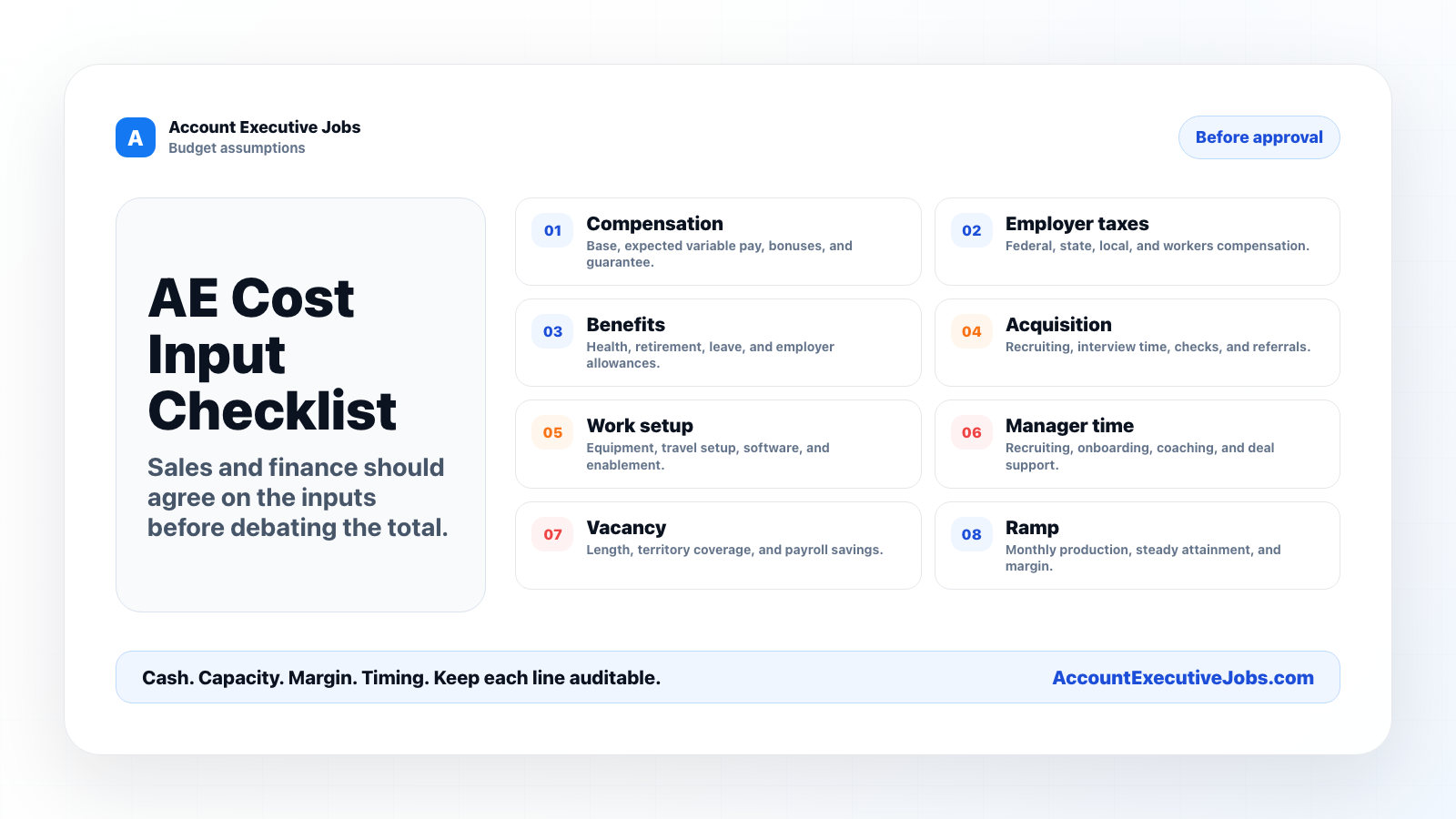
The Inputs Finance And Sales Should Agree On
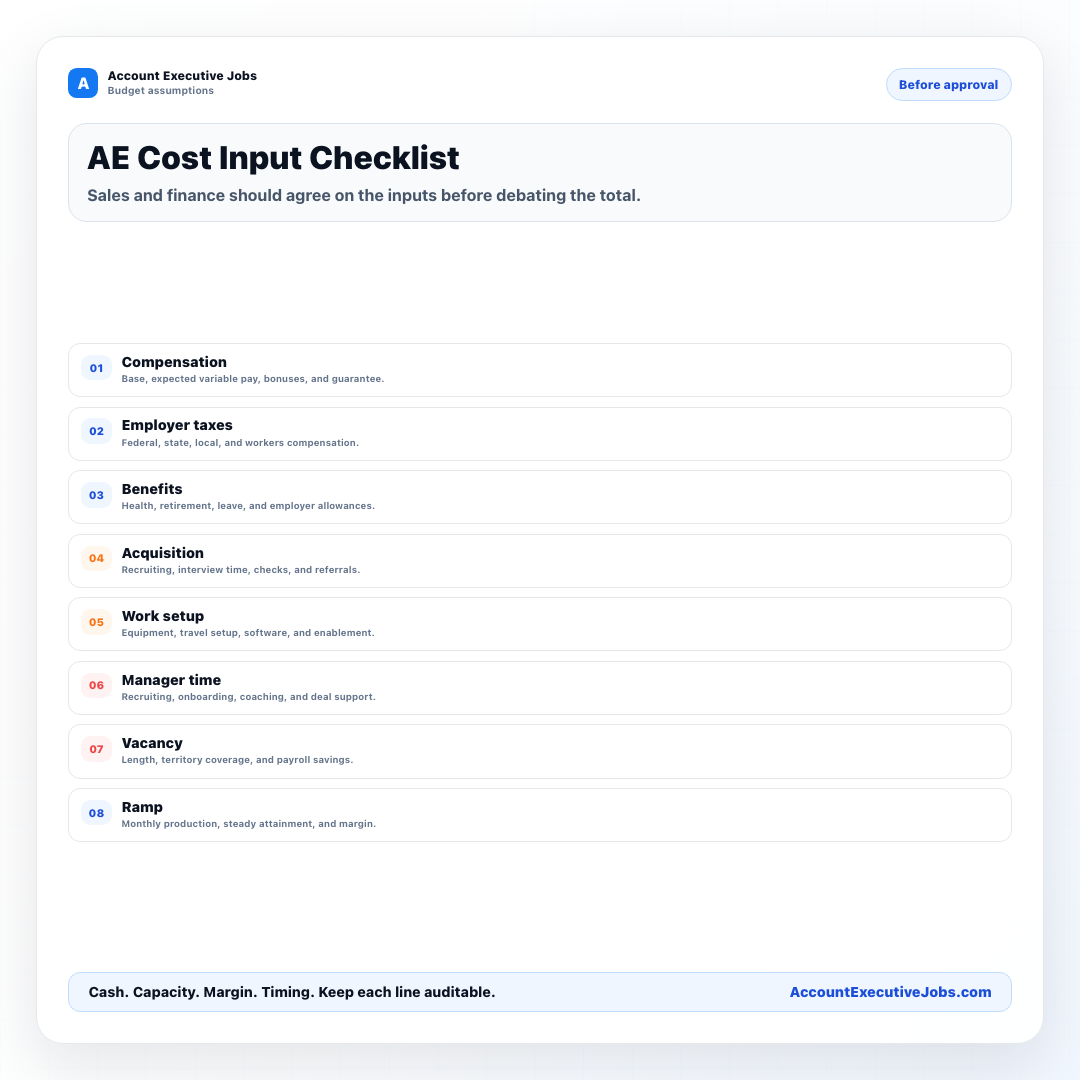
Before approving headcount or diagnosing turnover, agree on:
- Base salary and expected variable pay.
- Employer payroll-tax assumptions.
- Benefits and retirement contribution.
- Recruiting and interview cost.
- Equipment and incremental software.
- Manager and enablement time.
- Expected quota attainment.
- Gross margin or contribution margin.
- Vacancy length and coverage.
- Monthly replacement ramp.
Copy embed code
<a href="https://accountexecutivejobs.com/blog/hiring-salespeople/cost-of-hiring-and-replacing-an-account-executive">
  <img src="https://accountexecutivejobs.com/static-images/blog/cost-of-hiring-and-replacing-an-account-executive-cost-input-checklist-inline.png" alt="Account executive cost checklist covering compensation, employer taxes, benefits, recruiting, equipment, manager time, vacancy, and ramp." width="1600" height="900">
</a>
How Employers Can Use The Model
Before Opening A Role
Compare first-year cost with ramp-adjusted bookings and gross profit. Make sure the quota itself passes a sales quota feasibility test.
Before Choosing A Recruiter
Place the fee beside vacancy cost. A slower, cheaper search can cost more overall if the territory is productive and coverage is weak.
During Onboarding
Track productive milestones, not just training completion. The cost model should connect to a real sales ramp plan.
During Retention Reviews
Compare the cost of a targeted retention investment with the expected cost of vacancy and replacement. Do not use the turnover estimate to excuse a poor performance-management decision. Use it to see the economic consequence clearly.
After A Departure
Replace planned assumptions with actual vacancy, recruiting, and ramp data. That creates a better model for the next hire.
Frequently Asked Questions
How Much Does It Cost To Hire An Account Executive?
It depends on compensation, employer taxes, benefits, recruiting, tools, manager time, ramp, quota, attainment, and margin. Build the total from those inputs instead of multiplying salary by a universal percentage.
Are Commissions Included In Employer Payroll Taxes?
Commissions can be wages subject to employment taxes. IRS Publication 15 treats commissions as supplemental wages for federal withholding purposes. Payroll should confirm treatment for the specific plan and jurisdiction.
Should OTE Be Used As The Wage Cost?
Use expected actual cash wages. OTE is a useful starting point at 100% quota attainment, but ramp guarantees, attainment, tiers, caps, bonuses, and timing can change first-year pay.
What Is The Difference Between Hiring Cost And Turnover Cost?
Hiring cost measures the cost to add and ramp a seat. Turnover cost measures the incremental direct expense and lost gross profit caused by a separation, reduced by relevant savings.
Should Lost Sales Be Counted At Revenue Or Gross Profit?
Use gross profit or contribution margin when combining production loss with cash expenses. Bookings alone do not account for the cost of delivering the product or service.
How Long Does It Take For A Replacement AE To Pay Back?
Divide net turnover cost by the replacement's steady-state monthly gross profit, then add vacancy and ramp time. Use a monthly model because production rarely moves from zero to full capacity at once.
Does A Vacant Sales Seat Save Money?
It can save payroll and benefits while open. It may also lose gross profit and consume coverage capacity. Show both sides.
Save The Model With The Hiring Decision
The best estimate is not the one with the most decimal places.
It is the one another person can audit:
Cash wages
+ employer load
+ acquisition
+ ramp support
+ vacancy and ramp loss
- real savings
= decision-ready cost
Save the input definitions, dates, sources, and scenario ranges. Then revisit the estimate after the rep ramps or the replacement closes their first deals.
Start with the Sales Hiring Cost Calculator or Sales Rep Turnover Cost Calculator. If the model supports a new hire, use the Account Executive Hiring Scorecard to define the evidence the interview process needs to collect.
Sources And Review Note
This guide uses the U.S. Bureau of Labor Statistics Employer Costs for Employee Compensation categories and March 2026 context, IRS Publication 15 for 2026, the Social Security Administration's 2026 contribution and benefit base, and the BLS Job Openings and Labor Turnover program. The worked replacement example follows the tested logic in the Account Executive Jobs turnover calculator.
The examples are planning estimates, not compensation, tax, legal, or accounting advice. Replace broad context with the employer's actual payroll, benefit, margin, recruiting, territory, and ramp inputs.
Written and reviewed by Will Gordon. Last reviewed July 29, 2026.
Account Executive Jobs publishes practical sales hiring research, compensation-forward account executive jobs, and employer job-posting options.