A commission plan can show a clean $200,000 OTE and still leave the most important number unanswered:
What will this plan pay at 49%, 80%, 100%, 125%, and 150% of quota?That question exposes the plan.
A cliff can turn 49% attainment into no commission. A decelerator can reduce the rate below quota. An accelerator can make the next dollar above quota worth more than the dollar before it. A cap can stop the upside. A clawback can reverse money you thought was earned.
None of those rules is automatically good or bad. The problem is ambiguity.
Use the free Tiered Sales Commission Calculator while you read. Enter the actual thresholds from the written plan and compare the payout curve with the examples below.
The Short Answer
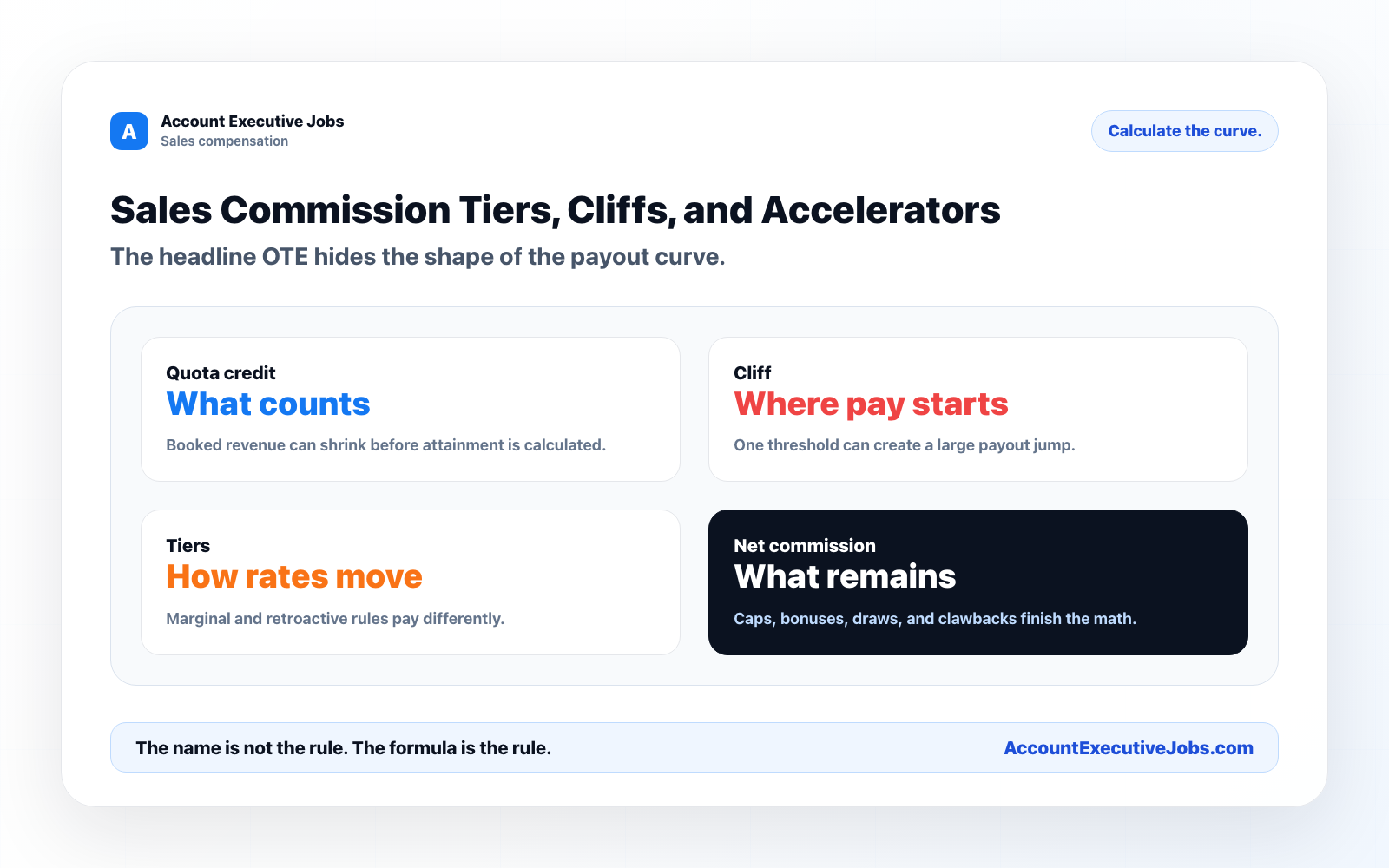
Sales commission tiers change the commission rate or multiplier when credited sales cross defined performance thresholds.
Here is the language that matters:
| Plan term | What it changes | Question to ask |
|---|---|---|
| Quota credit | How much booked revenue counts toward attainment | Does the rep receive 100% credit for every deal? |
| Cliff | Whether payout begins before a threshold | Is commission zero below the cliff? |
| Decelerator | The rate paid below quota | Does it apply to all below-quota revenue or only one band? |
| Accelerator | The rate paid after a threshold | Does the higher rate apply only to new revenue or reprice earlier revenue? |
| Cap | The maximum commission allowed | Does the cap include bonuses or only tiered commission? |
| Draw | An advance against future commission | Is it recoverable, and when is it reconciled? |
| Clawback | A reversal after a stated event | What event triggers it, and how long does the risk remain? |
The written plan should define every row.
Do not rely on the word tiered alone. Salesforce Trailhead distinguishes a tier payout that applies the highest achieved rate across the period from a marginal payout that applies each rate only inside its range. Other companies use different labels for the same mechanics.
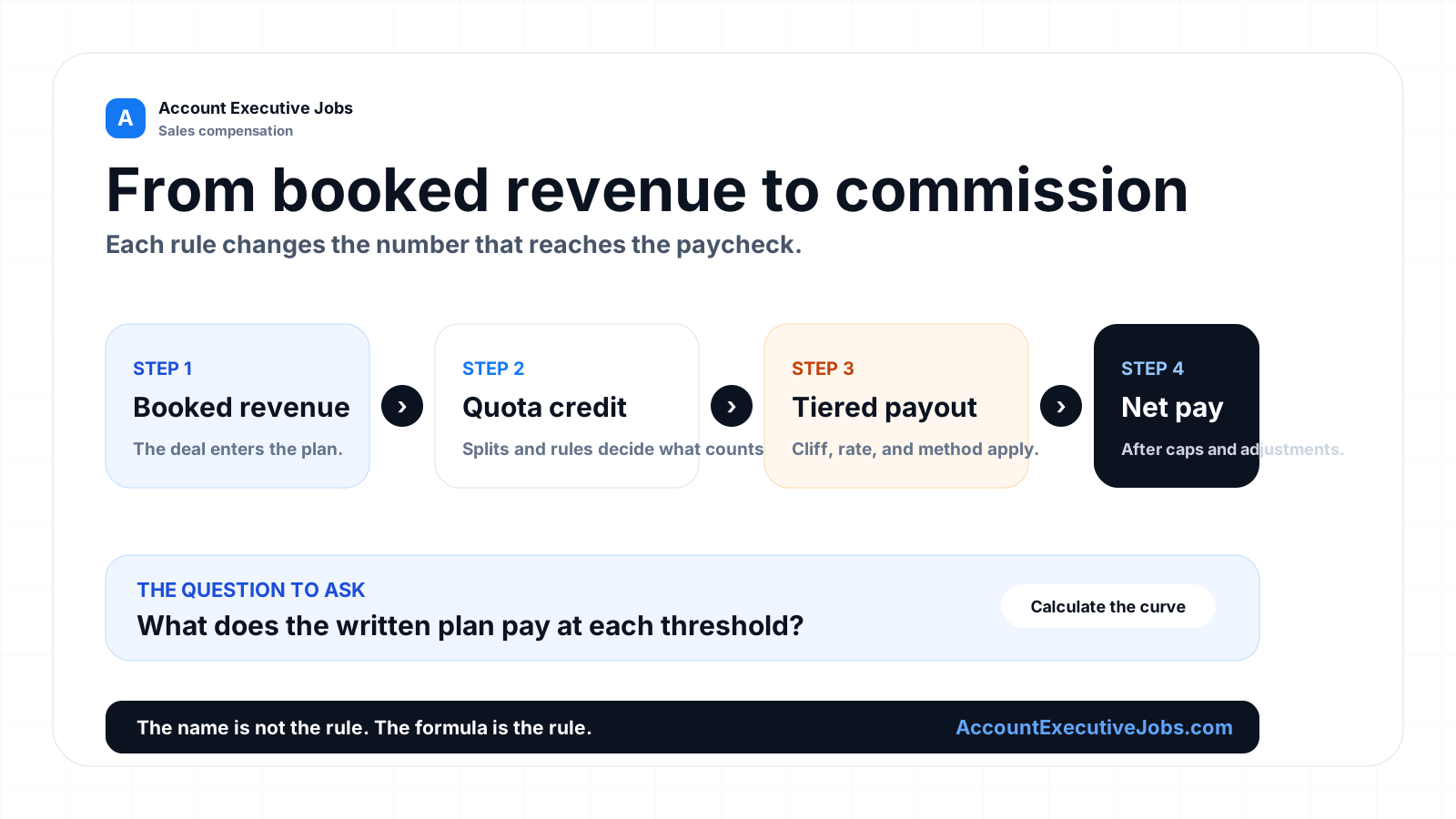
The name is not the rule. The formula is the rule.
Copy embed code
<a href="https://accountexecutivejobs.com/blog/sales-compensation/sales-commission-tiers-cliffs-accelerators">
  <img src="https://accountexecutivejobs.com/static-images/blog/sales-commission-tiers-cliffs-accelerators-payout-motion.svg" alt="Animated sales commission explainer showing booked revenue becoming quota credit, attainment, tiered payout, and net commission." width="1600" height="900">
</a>
What Is A Tiered Sales Commission Plan?
A tiered sales commission plan changes payout at defined levels of sales performance.
The performance measure might be:
- Revenue.
- Annual recurring revenue.
- Gross profit.
- Units sold.
- New logos.
- Collected cash.
- Quota attainment.
- A weighted mix of products or goals.
For an account executive, quota attainment is common. If annual quota is $1 million and credited revenue is $800,000, attainment is 80%.
Quota attainment = credited revenue ÷ quotaThe plan then checks which rule applies at 80%.
That sounds simple until the definitions begin to move. Booked revenue may not equal credited revenue. A multiyear contract may receive one year of credit, the full contract value, or a weighted amount. An AE may split credit with another seller. Services may count toward cash commission but not quota. A cancellation may reverse both.
The first calculation is not the rate.
It is credit.
Start With The Standard Commission Rate
When a plan gives you quota and target variable pay, you can calculate the reference rate:
Standard commission rate = target variable pay ÷ quotaSuppose the plan has:
- $1,000,000 annual quota.
- $100,000 target variable pay.
- 100% quota credit.
The standard rate is 10%.
$100,000 ÷ $1,000,000 = 10%That does not mean every dollar always pays 10%.
The standard rate is the anchor. Cliffs, decelerators, accelerators, product rates, split credit, caps, and clawbacks can move the actual rate far away from it.
This is why account executive OTE is not enough information. OTE tells you the target earnings at quota. It does not show the shape of the payout curve on either side.
Commission Cliffs Create A Hard Threshold
A commission cliff blocks or changes payout until the rep crosses a stated threshold.
One plan might pay no tiered commission below 50% attainment. Another might pay a lower rate from the first dollar but withhold a quarterly bonus until 80%. A third might release previously held commission once the rep crosses the cliff.
Those are three different plans.
Use numbers, not labels:
At 49% attainment, what is gross commission?
At 50% attainment, what is gross commission?
If the answers are $0 and $37,500, the 50% line creates a $37,500 payout jump. A rep who understands that rule will manage quarter-end deals differently. An employer should understand the behavior the rule encourages.
Cliffs can protect a company from paying full rates for weak performance. They can also create:
- Sharp income changes around one threshold.
- Arguments over close dates.
- Pressure to discount a deal to cross the line.
- Sandbagging when the cliff looks unreachable.
- Distrust when the threshold was not obvious before the period began.
A cliff should be visible in the plan, the statement, and the recruiting conversation.
Decelerators Change The Rate Below Quota
A decelerator reduces the standard commission rate below a target.
Using the 10% standard rate, a 0.75x decelerator produces a 7.5% rate:
10% standard rate × 0.75 = 7.5%The next question is where that 7.5% applies.
Retroactive Below-Quota Band
If the rep finishes at 60% attainment and the active 50% to 79.99% band uses a 0.75x multiplier, a retroactive model can apply 7.5% to all $600,000 of credited revenue.
$600,000 × 10% × 0.75 = $45,000Marginal Below-Quota Band
A marginal model would calculate each range separately. Revenue inside one band keeps that band's rate even after the rep enters the next band.
Neither convention should be assumed.
The calculator used by this site models retroactive below-quota bands and labels that choice. If your plan uses marginal bands below quota, calculate each segment separately.
Accelerators Reward Revenue Above A Threshold
An accelerator increases the commission rate after the rep crosses quota or another target.
Suppose the 10% standard rate changes like this:
| Attainment | Multiplier | Rate on revenue in the band |
|---|---|---|
| 100% to 124.99% | 1.5x | 15% |
| 125% to 149.99% | 2.0x | 20% |
| 150% and above | 2.5x | 25% |
Under a marginal plan, the higher rate applies only to revenue inside that band.
At 150% attainment:
Revenue through quota:
$1,000,000 × 10% = $100,000

Revenue from 100% to 125%:
$250,000 × 10% × 1.5 = $37,500

Revenue from 125% to 150%:
$250,000 × 10% × 2.0 = $50,000

Gross commission:
$100,000 + $37,500 + $50,000 = $187,500
The 2.5x tier begins at 150%. It has not paid anything yet because there is no revenue above the threshold.
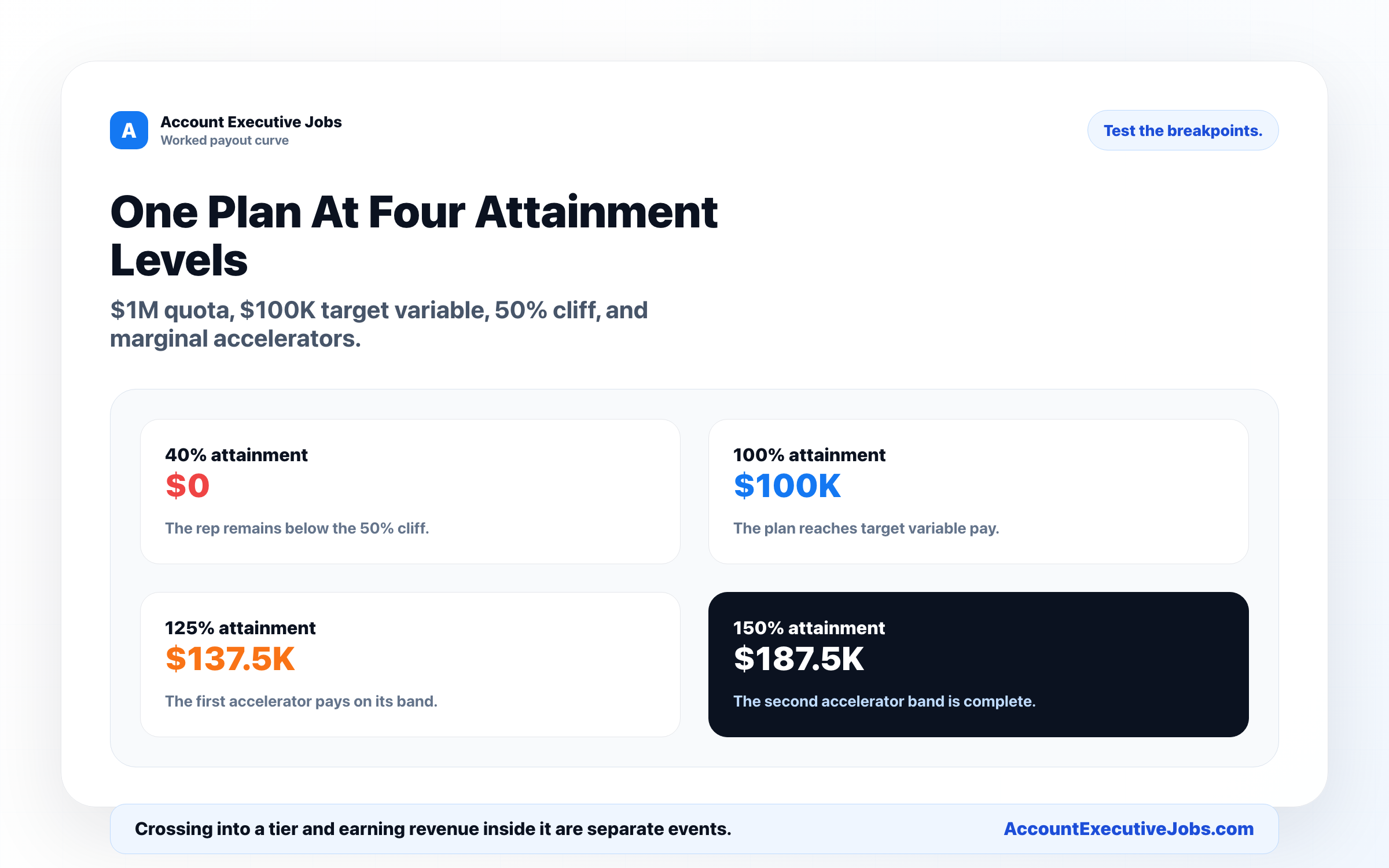
That last detail catches people. Crossing into a tier and earning revenue inside a tier are separate events.
Marginal And Retroactive Tiers Are Not The Same
This distinction can change commission by tens of thousands of dollars.
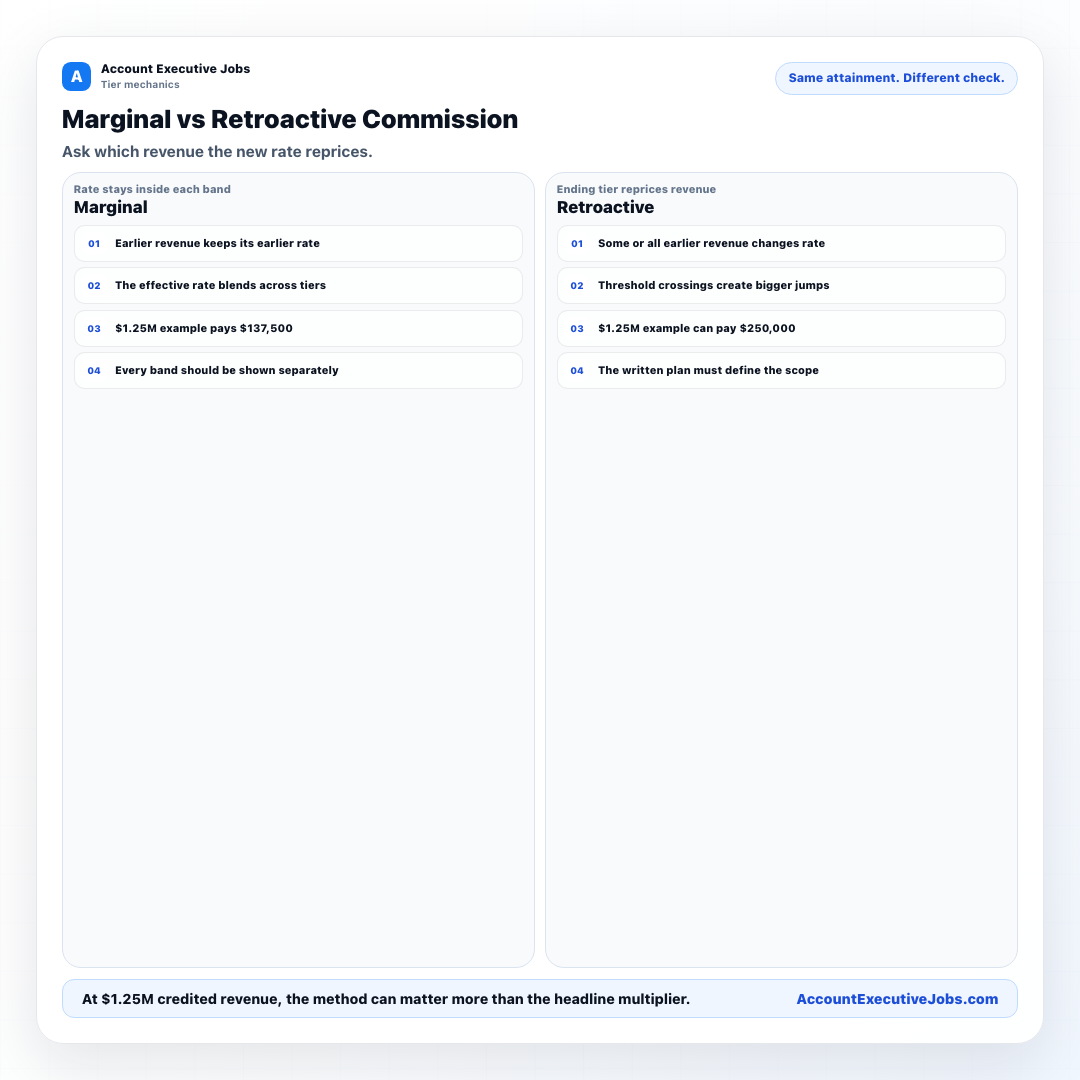
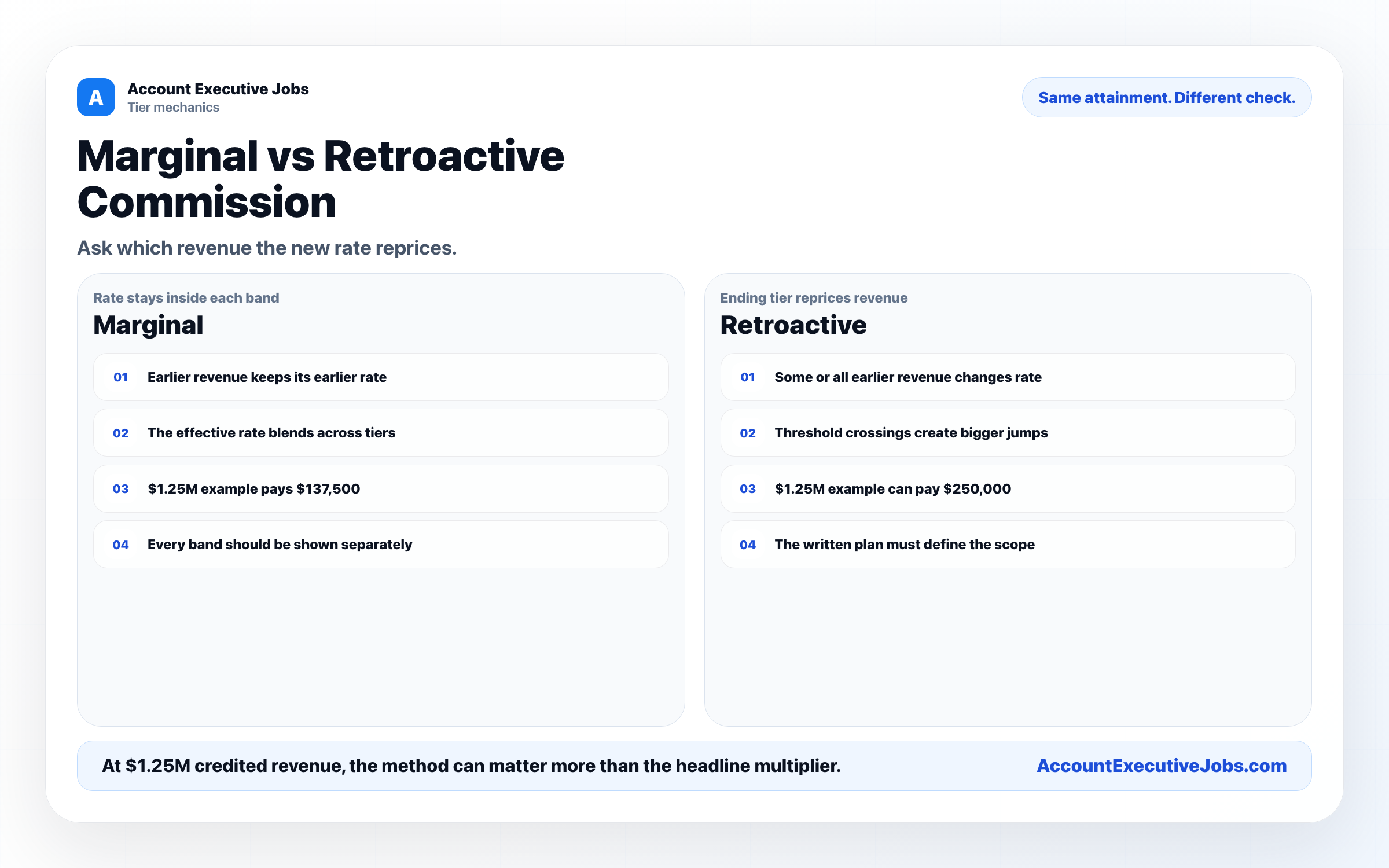
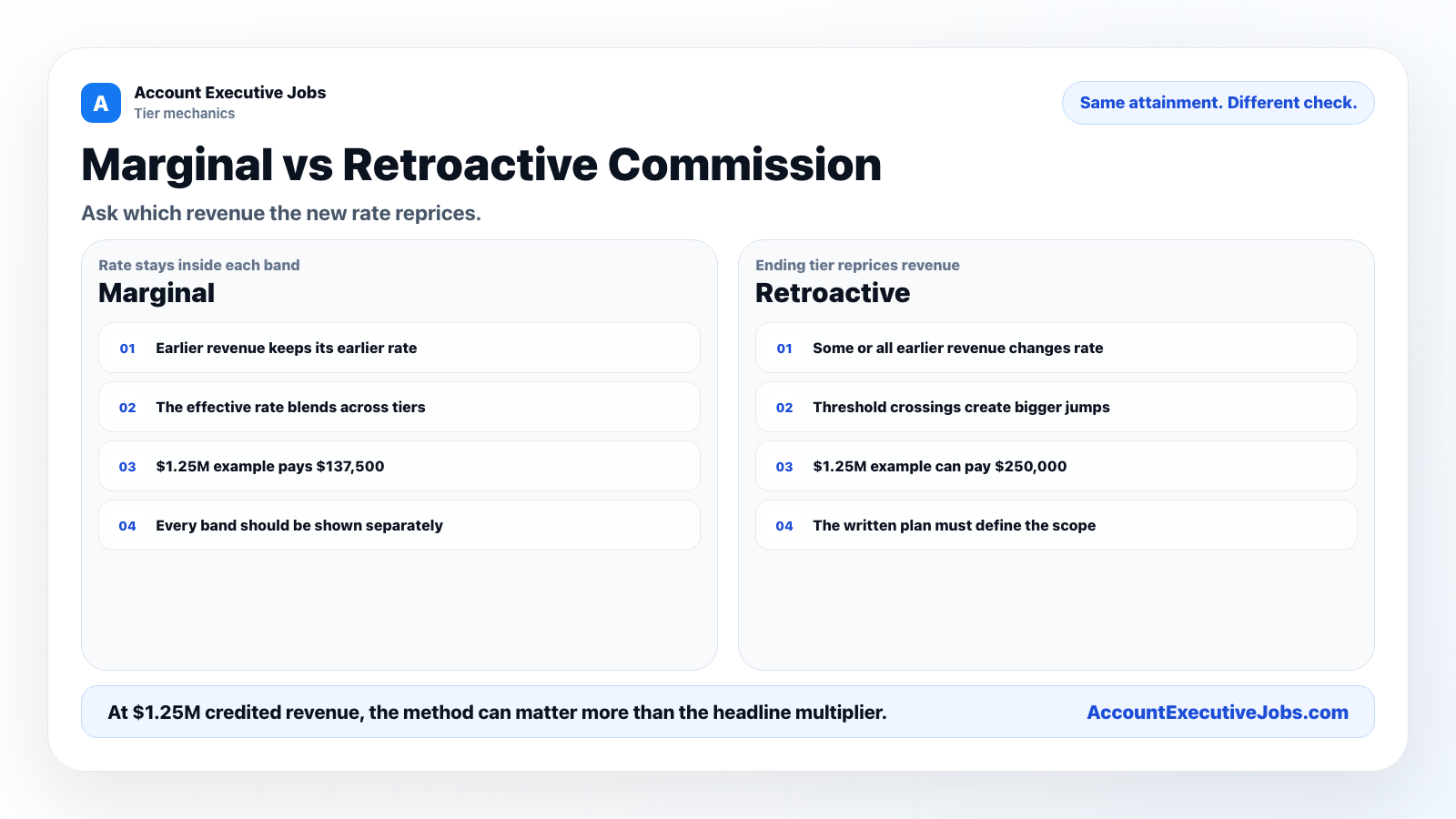
Marginal Payout
Each rate applies only to the revenue inside its range. Earlier revenue keeps its earlier rate.
This produces a blended effective commission rate.
Retroactive Payout
The rate reached at the end of the period reprices some or all earlier revenue.
At $1.25 million of credited revenue, a 2.0x retroactive rate applied to the full period would produce:
$1,250,000 × 10% × 2.0 = $250,000The marginal plan above would produce:
$100,000 through quota
+ $37,500 from 100% to 125%
= $137,500
Same quota. Same target variable. Same ending attainment.
Very different check.
Copy embed code
<a href="https://accountexecutivejobs.com/blog/sales-compensation/sales-commission-tiers-cliffs-accelerators">
  <img src="https://accountexecutivejobs.com/static-images/blog/sales-commission-tiers-cliffs-accelerators-marginal-vs-retroactive-inline.png" alt="Comparison of marginal and retroactive sales commission tiers." width="1600" height="900">
</a>
A Worked Commission Payout Curve
Now put the rules together.
Assume:
- $1,000,000 quota.
- $100,000 target variable.
- 10% standard rate.
- No commission below a 50% cliff.
- 0.75x retroactive decelerator from 50% through 79.99%.
- 1.0x retroactive rate from 80% through 99.99%.
- 1.5x marginal accelerator from 100% through 124.99%.
- 2.0x marginal accelerator from 125% through 149.99%.
- 2.5x marginal accelerator on revenue above 150%.
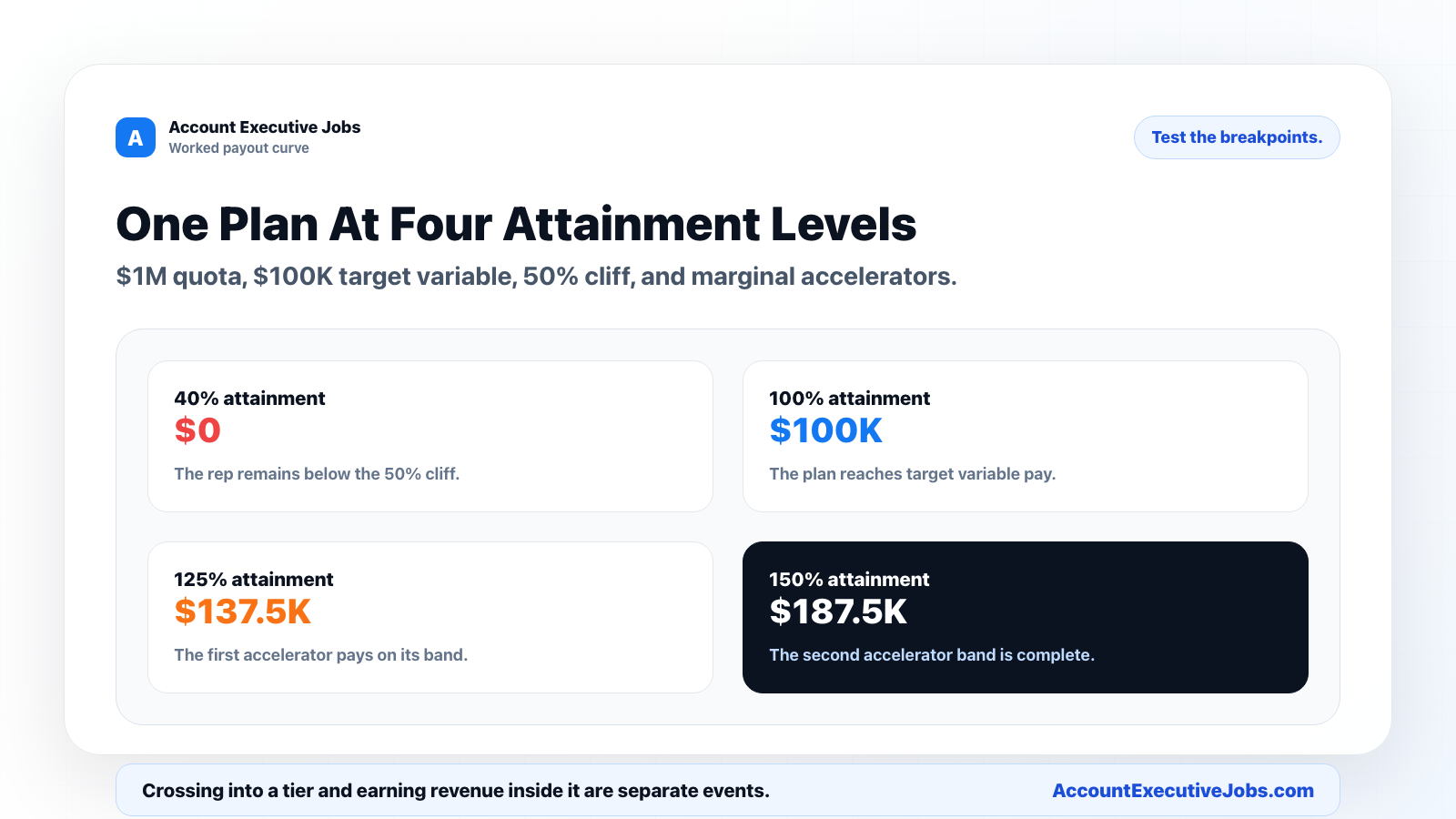
The curve looks like this:
| Attainment | Credited revenue | Gross commission | What happened |
|---|---|---|---|
| 40% | $400,000 | $0 | Below the 50% cliff |
| 60% | $600,000 | $45,000 | 0.75x applies to all below-quota revenue |
| 80% | $800,000 | $80,000 | Standard rate applies below quota |
| 100% | $1,000,000 | $100,000 | Target variable is earned |
| 125% | $1,250,000 | $137,500 | First marginal accelerator pays on $250,000 |
| 150% | $1,500,000 | $187,500 | Two marginal accelerator bands have paid |
This table is more useful than the phrase uncapped commission.
It shows the economic experience of the plan.
Copy embed code
<a href="https://accountexecutivejobs.com/blog/sales-compensation/sales-commission-tiers-cliffs-accelerators">
  <img src="https://accountexecutivejobs.com/static-images/blog/sales-commission-tiers-cliffs-accelerators-payout-curve-inline.png" alt="Commission payout curve showing how a cliff, decelerator, quota, and accelerator tiers change earnings." width="1600" height="900">
</a>
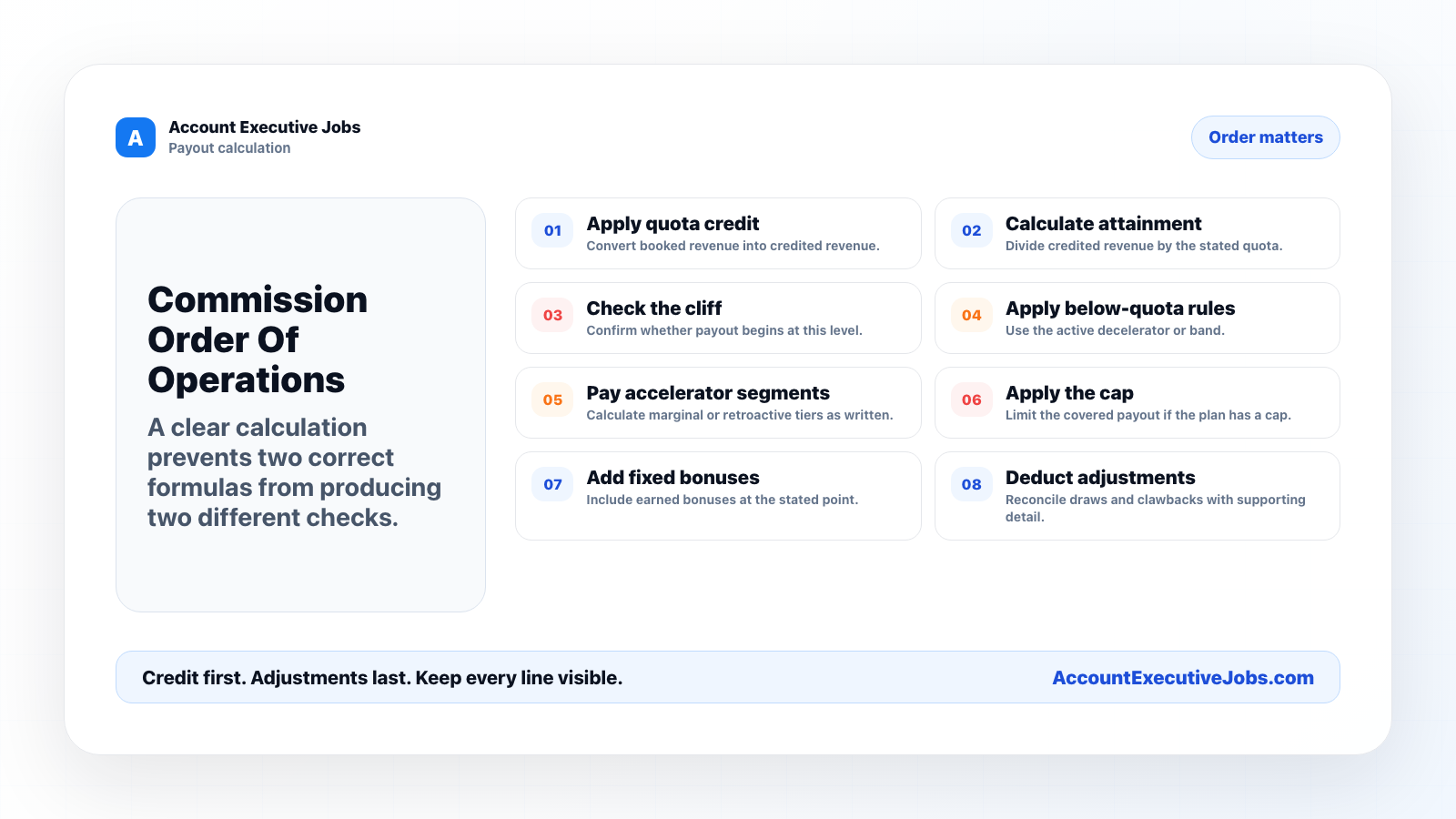
Apply The Rules In The Right Order
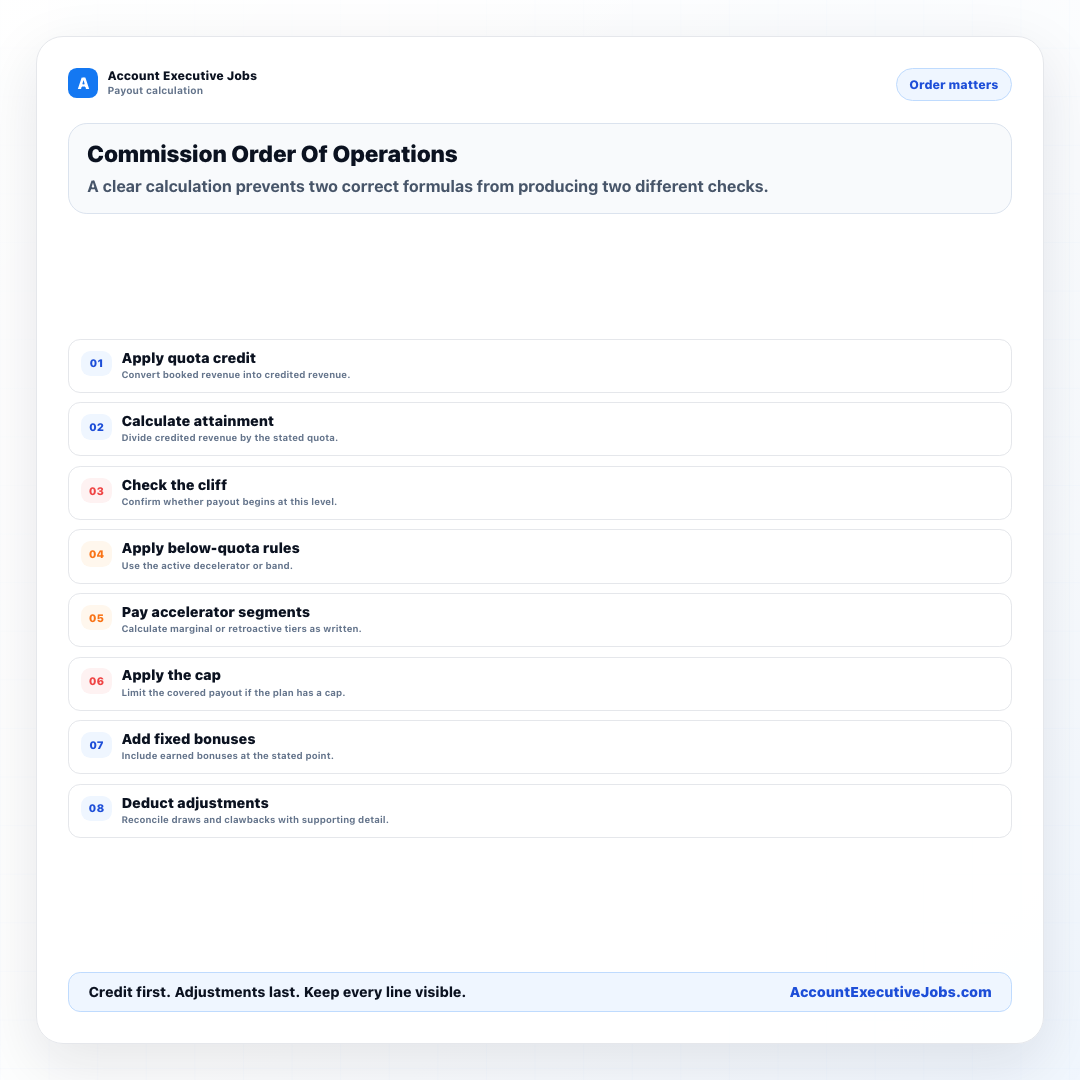
A commission plan is an order-of-operations problem.
Changing the order changes the answer.
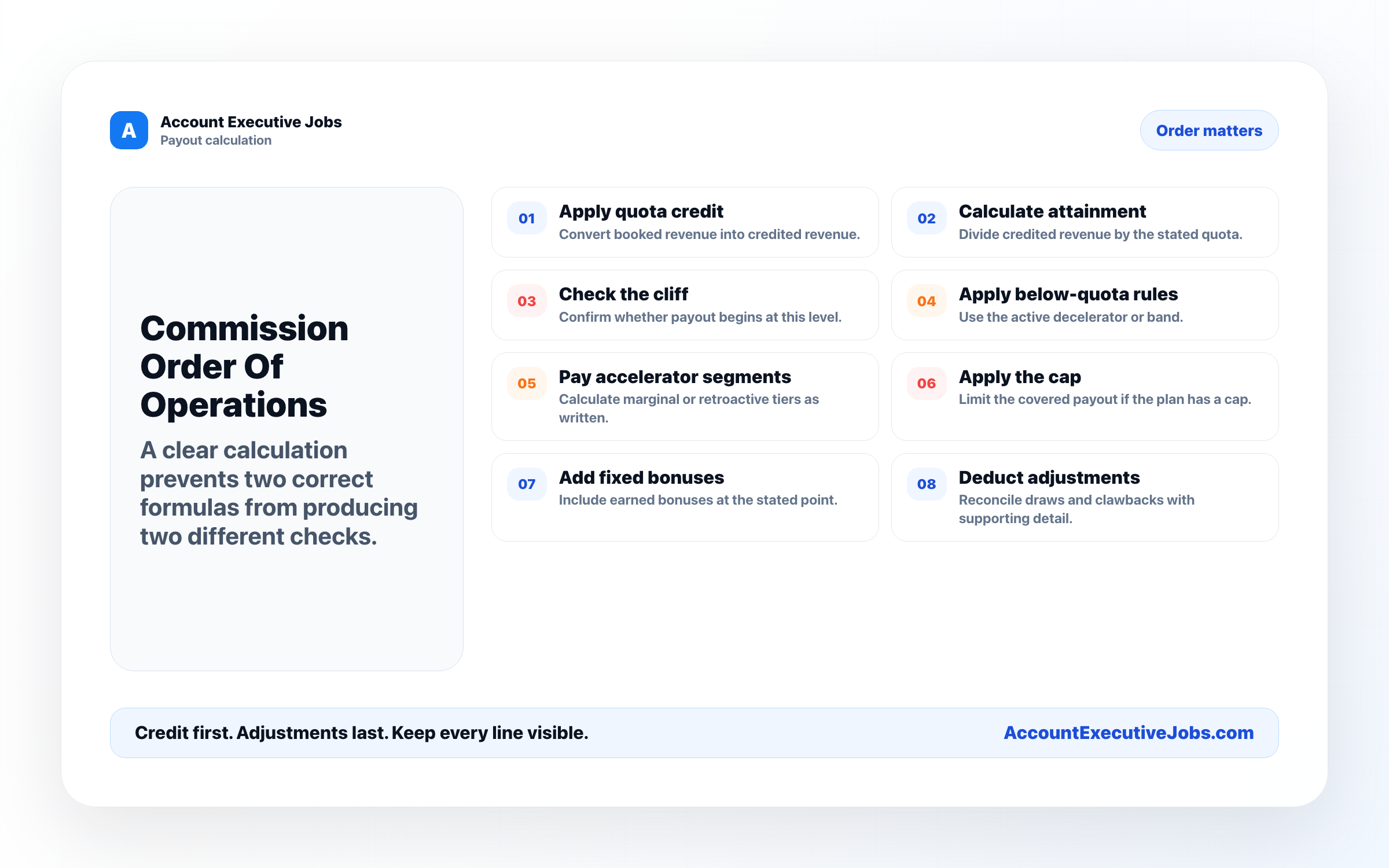
Use this sequence:
- Start with booked revenue.
- Apply split credit and excluded products.
- Calculate credited attainment against quota.
- Check whether the cliff was cleared.
- Apply the active below-quota rule or the quota payout.
- Calculate each accelerator segment.
- Apply the commission cap.
- Add any fixed bonus.
- Deduct recoverable draw.
- Deduct clawbacks or reversals.
Suppose a rep books $2 million but receives 75% quota credit. Credited revenue is $1.5 million.
If the tier formula produces $187,500, a $170,000 cap reduces it by $17,500. Add a $10,000 fixed bonus, subtract a $15,000 recoverable draw, then subtract a $5,000 clawback.
$170,000 capped commission
+ $10,000 fixed bonus
- $15,000 draw recovery
- $5,000 clawback
= $160,000 net commission
If the bonus is also subject to the cap, the result changes. If the clawback is carried into the next period instead of deducted now, the result changes again.
Write the sequence down.
Copy embed code
<a href="https://accountexecutivejobs.com/blog/sales-compensation/sales-commission-tiers-cliffs-accelerators">
  <img src="https://accountexecutivejobs.com/static-images/blog/sales-commission-tiers-cliffs-accelerators-order-of-operations-inline.png" alt="Commission order of operations from quota credit through tiers, caps, bonuses, draws, and clawbacks." width="1600" height="900">
</a>
Split Credit Can Move The Rep Into A Different Tier
Split credit does more than divide cash.
If an AE receives 75% quota credit on a $1 million deal, only $750,000 may count toward attainment. That can keep the AE below quota even when the company booked the full contract.
The Deal Commission Split Calculator keeps cash commission and quota credit separate because they answer different questions:
- Cash split decides how the commission pool is divided.
- Quota credit decides how much revenue moves each participant toward target.
Do not assume the columns match.
Ask how the plan handles:
- AE and SDR splits.
- Sales engineer influence.
- Channel partners.
- Overlay sellers.
- Account transitions.
- Team selling.
- Renewals and expansion.
The plan should also say who decides a disputed split and when the decision becomes final.
Caps, Draws, And Clawbacks Change The Advertised Upside
Commission Cap
A cap limits commission, credited revenue, or both.
If a role advertises uncapped commission, ask whether product-level caps, deal-level caps, windfall rules, or management discretion create a cap under another name.
Recoverable Draw
A recoverable draw advances commission before enough commission has been earned. Future commission repays the advance.
Ask:
- How much is advanced?
- How long does the draw last?
- When does recovery begin?
- Can the balance become negative?
- What happens if employment ends with a balance?
Do not confuse a recoverable draw with a nonrecoverable ramp guarantee.
Clawback
A clawback reverses commission after a defined event, often cancellation, refund, nonpayment, or early churn.
Ask what event triggers the reversal, how much is reversed, and how long the deal remains exposed.
If the answer is it depends, ask who decides.
The Written Plan Matters More Than The Recruiting Slide
The U.S. Department of Labor describes commissions as payments tied to completing a task, usually selling a stated amount of goods or services. It does not supply one universal formula for private sales plans.
State rules can add requirements. California Labor Code Section 2751, for example, requires covered commission agreements to be in writing and to state how commissions are computed and paid.
That does not mean every state follows California or every plan dispute has the same answer. It means a serious employer should know which law applies and put the economic rules in writing.
Candidates should receive the plan before signing when possible.
Employers should have payroll and employment counsel review plan language, especially for:
- When commission is earned.
- When commission is paid.
- Post-termination payments.
- Chargebacks and clawbacks.
- Plan amendments.
- State-specific written-agreement rules.
This guide explains plan math. It is not legal advice.
Commission Withholding Is Not A Separate Final Tax
IRS Publication 15 treats commissions as supplemental wages for federal withholding purposes.
That affects how an employer may withhold from the check. It does not create a special final income-tax rate for commission. Final tax depends on the employee's full taxable income, filing situation, deductions, credits, and applicable state and local rules.
If a commission check looks taxed more, the immediate issue may be withholding.
The actual annual tax result is a different calculation.
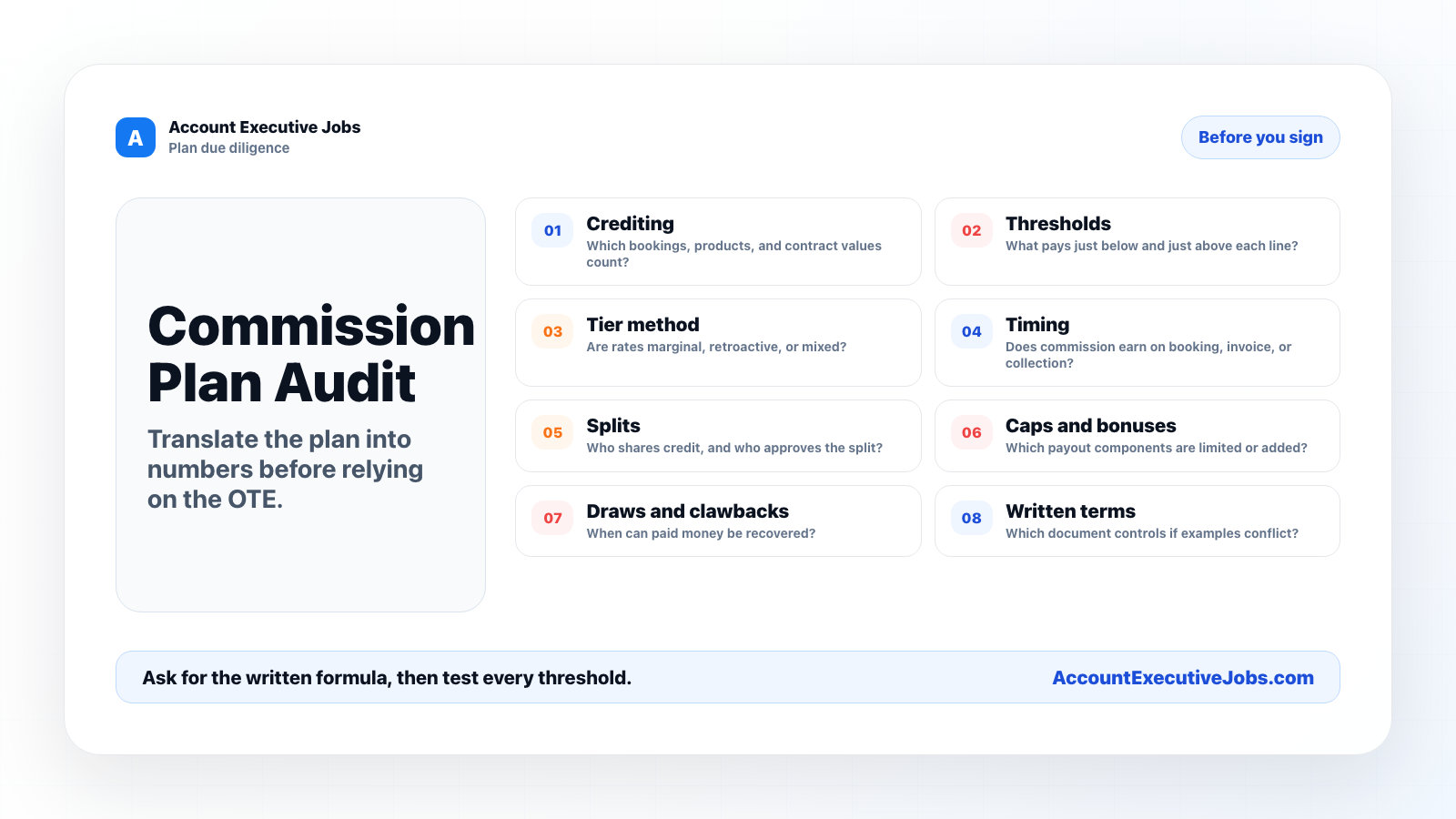
Questions Candidates Should Ask Before Accepting
Ask these with the plan open:
What revenue receives quota credit?What does the plan pay at 50%, 80%, 100%, 125%, and 150% attainment?Are tiers marginal or retroactive?When is commission earned, and when is it paid?Can a cancellation, refund, or nonpayment reverse commission?Can the company change the plan during the period?What happens to commission after termination?If the answers stay vague, use the sales job red flags guide before you treat the OTE as real.
Copy embed code
<a href="https://accountexecutivejobs.com/blog/sales-compensation/sales-commission-tiers-cliffs-accelerators">
  <img src="https://accountexecutivejobs.com/static-images/blog/sales-commission-tiers-cliffs-accelerators-plan-audit-inline.png" alt="Commission plan audit checklist covering credit, thresholds, timing, caps, draws, clawbacks, and written terms." width="1600" height="900">
</a>
Questions Employers Should Answer Before Launching The Plan
A plan should be easy to calculate with a pencil and a few rows of data.
Before launch, test:
- One deal that crosses the cliff.
- One deal that crosses quota.
- One deal that spans two accelerator tiers.
- A split-credit deal.
- A canceled deal.
- A capped payout.
- A rep who leaves before payment.
- A plan amendment in the middle of a period.
Then give the same examples to sales, finance, payroll, and the compensation system.
If four groups produce four answers, the plan is not ready.
FAQ
What is a sales commission tier?
A sales commission tier is a performance range with a defined rate or multiplier. The range may be based on revenue, gross profit, units, or quota attainment.
What is a commission cliff?
A commission cliff is a threshold that blocks or changes payout until the rep crosses it. The written plan should show the exact payout immediately below and above the threshold.
How does a sales commission accelerator work?
An accelerator increases the commission rate after a stated target, often quota. It may apply only to revenue inside the new tier or reprice earlier revenue, depending on the plan.
Are commission tiers marginal or retroactive?
They can be either. A marginal plan pays each rate only within its range. A retroactive plan reprices some or all earlier revenue after a threshold is reached. Do not infer the rule from the word tiered.
What is a commission decelerator?
A decelerator reduces the standard commission rate below a target. Plans may apply it to all below-quota revenue or only the revenue inside one band.
Can a commission plan have accelerators and a cap?
Yes. The plan can advertise higher rates above quota and still limit total commission with a cap. Ask where the cap applies and whether fixed bonuses are included.
Sources And Review Notes
This guide uses official federal and California sources for commission-pay context, Salesforce Trailhead for the marginal-versus-retroactive mechanics, and the tested Account Executive Jobs commission model for worked examples. Plan labels vary between employers and compensation systems, so the signed formula controls.
Reviewed by Will Gordon, founder of Account Executive Jobs. Will has worked as a sales rep, managed sales teams, was the #1 recruiter for a national staffing agency, and started Search Partners, a recruiting firm in San Francisco. Read more about Will and the editorial approach.
If you are comparing a plan, model the exact rules in the Tiered Sales Commission Calculator, then compare active account executive jobs with the same level of scrutiny. If you are hiring, post a compensation-forward AE role and make the payout rules clear before the first interview.