
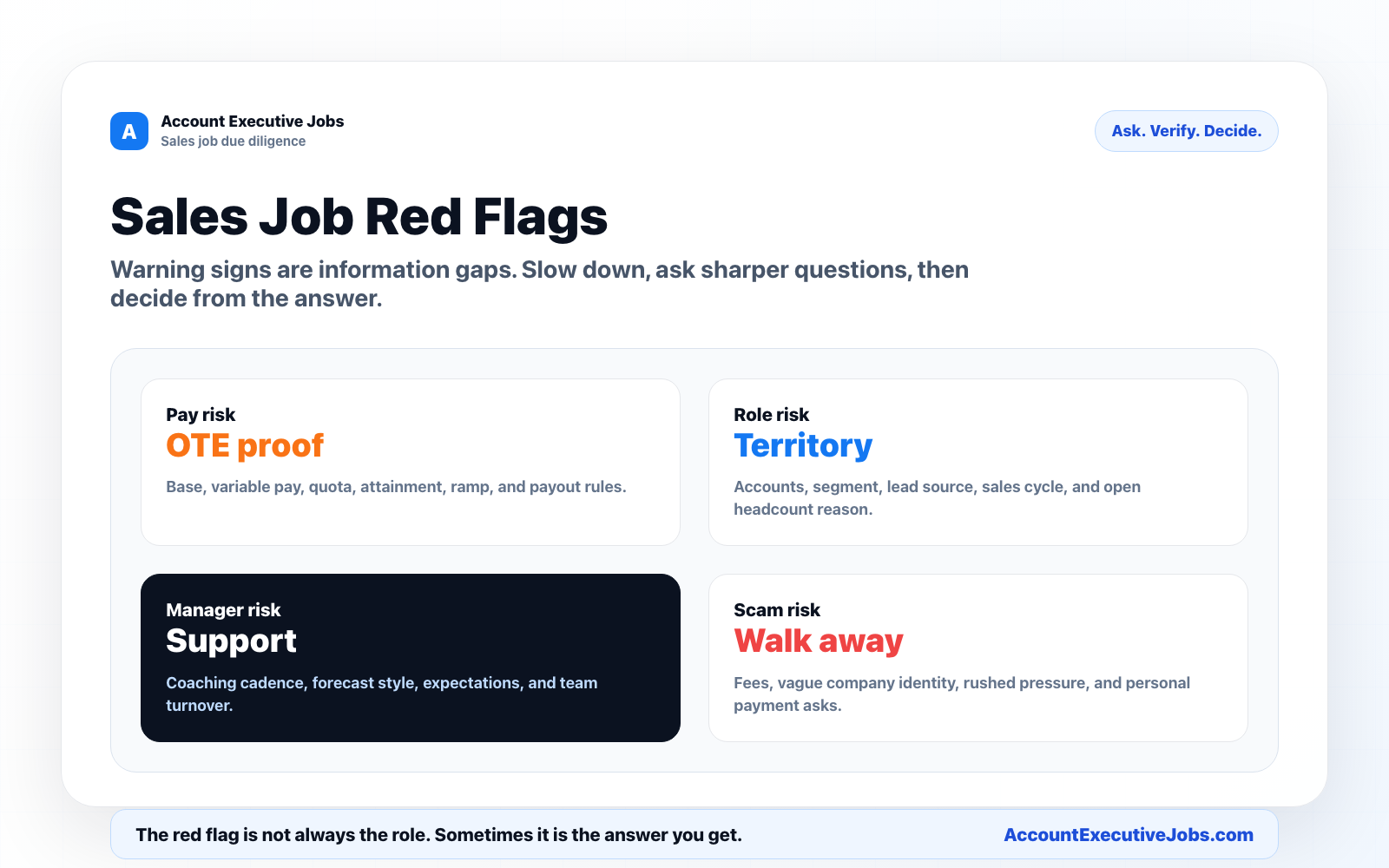
Sales job red flags are not a reason to complain about every imperfect role.
They are a reason to run discovery on the job before you accept it.
A good sales candidate should ask about quota, territory, ramp, lead source, manager support, team attainment, and commission rules. That is not negative. That is the same discipline you would use with a buyer.
The simple rule:
A red flag means pause, ask a sharper question, and decide based on the answer.Some warnings are dealbreakers. Most are not. Most are signals that the company has not explained the role well enough yet.
If you have two written offers, use the free Sales Job Offer Comparison Calculator to compare realistic take-home, quota pressure, benefits, and state taxes before working through the qualitative checklist below.
The Short Version
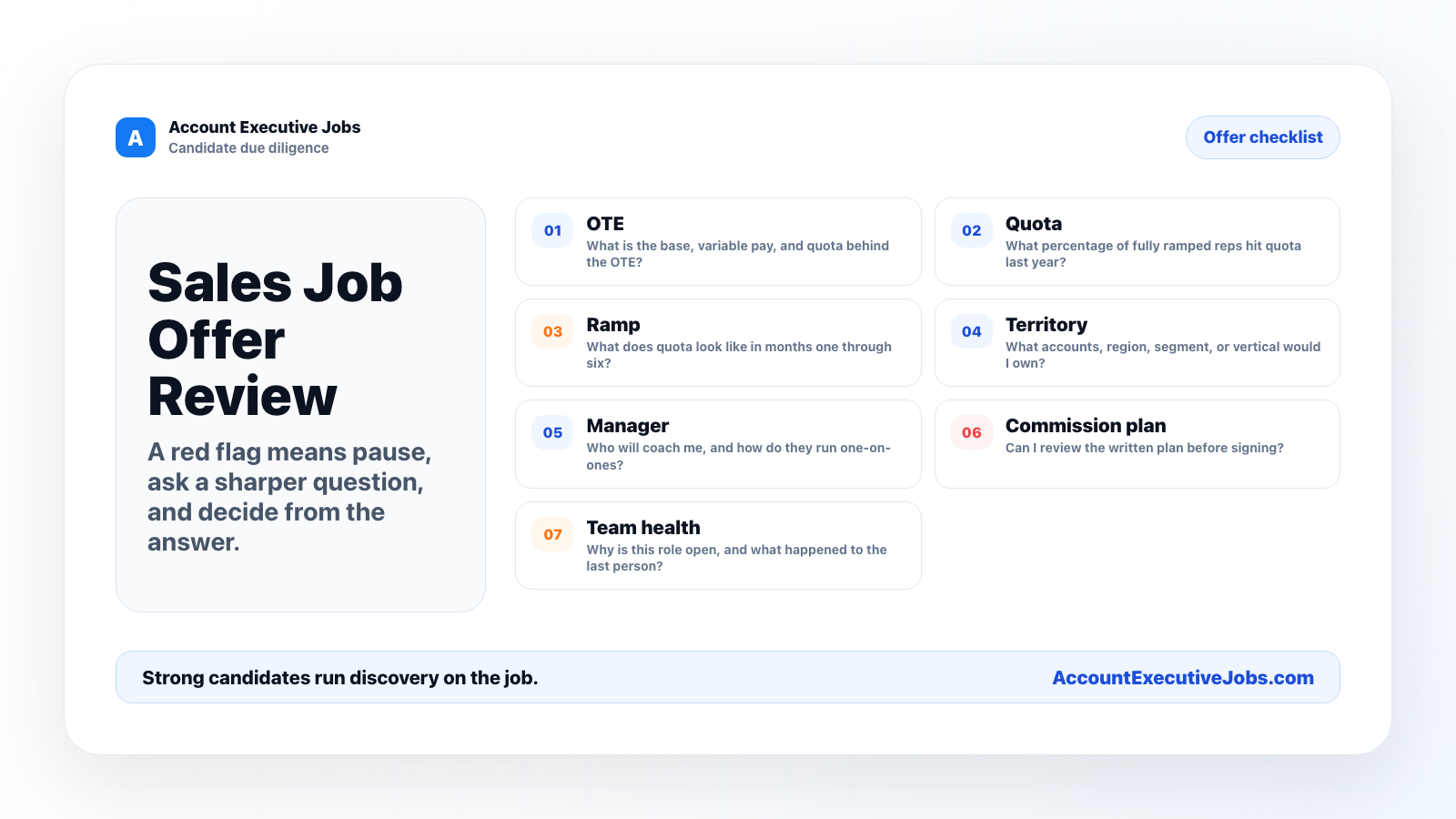
Before you accept a sales job, get clear answers on these areas:
| Area | What can go wrong | Ask this |
|---|---|---|
| OTE | The number is used as bait, not a real earning target. | What is the base, variable pay, and quota behind the OTE? |
| Quota | The target does not match the market, ramp, or territory. | What percentage of fully ramped reps hit quota last year? |
| Ramp | You carry full quota before you have pipeline. | What does quota and commission look like in months one through six? |
| Territory | The account list is weak, overworked, or undefined. | What accounts, region, segment, or vertical would I own? |
| Manager | The person coaching you is absent from the process. | When do I meet the direct manager and how do they run one-on-ones? |
| Commission plan | The payout rules are vague or shown after you start. | Can I review the written commission plan before signing? |
| Team health | Turnover is treated like a mystery. | Why is this role open, and what happened to the last person? |
| Scam risk | The “job” asks for money, bank details, or fake-check behavior. | Can I verify the company, recruiter, and offer through official channels? |
That is the article. The rest is how to use the checklist without sounding paranoid.
Copy embed code
<a href="https://accountexecutivejobs.com/blog/sales-job-search/sales-job-red-flags">
  <img src="https://accountexecutivejobs.com/static-images/blog/sales-job-red-flags-ask-verify-decide-motion.svg" alt="Animated infographic showing how to turn sales job red flags into decisions by noticing the gap, asking a sharper question, verifying the answer, and deciding whether to continue." width="1600" height="900">
</a>
Red Flag, Yellow Flag, Dealbreaker
Use three labels.
Yellow flag: The answer is incomplete. Ask again or ask someone closer to the work.
Red flag: The answer creates real risk. Slow the process down and verify.
Dealbreaker: The answer shows the role is not worth your time or exposes you to unacceptable risk.
I do not think salespeople should run from hard jobs. Hard jobs can be great jobs. New territory, long sales cycles, aggressive targets, and high outbound expectations are not automatically bad.
The problem is a hard job sold as an easy one.
If the job needs a hunter, say that. If the territory is new, say that. If the product is still finding its market, say that. Good candidates can handle tradeoffs. They just need the trade to be honest.
Job Post Red Flags
The job post is the first sales pitch.
Read it like a buyer would read a vendor website: what is clear, what is missing, and what sounds inflated?
The OTE Is Big, But The Pay Details Are Missing
This is the classic sales job problem.
$250K OTE. Uncapped commission. Huge upside.Maybe true. Maybe noise.
Ask:
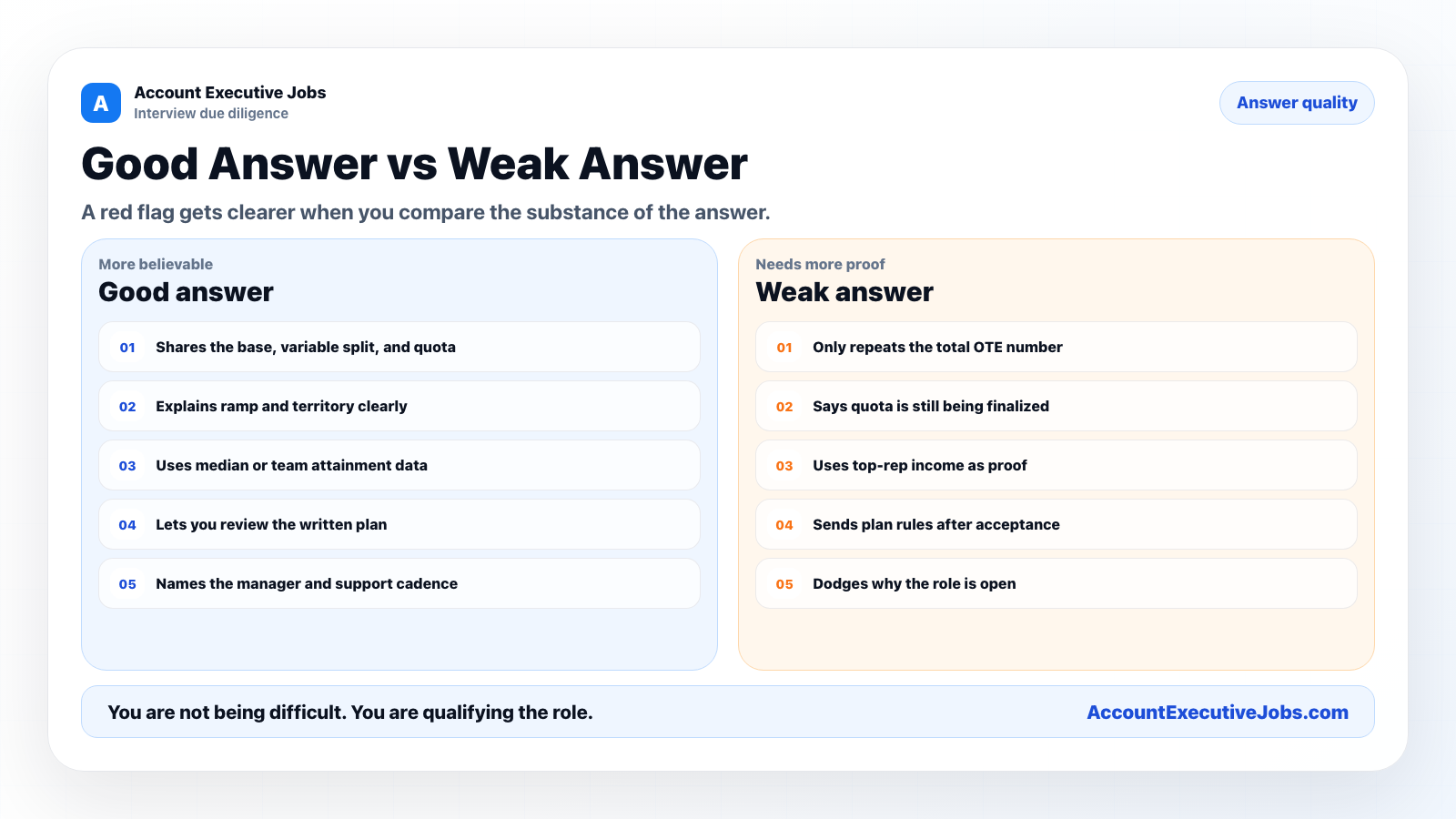
What is the base salary range, target variable pay, quota, and ramp plan?Good answer:
- Base range is stated.
- OTE range is stated.
- Quota is explained.
- Ramp is explained.
- Team attainment is discussed.
Weak answer:
- “Top reps make way more.”
- “It depends how hard you work.”
- “We can discuss comp later.”
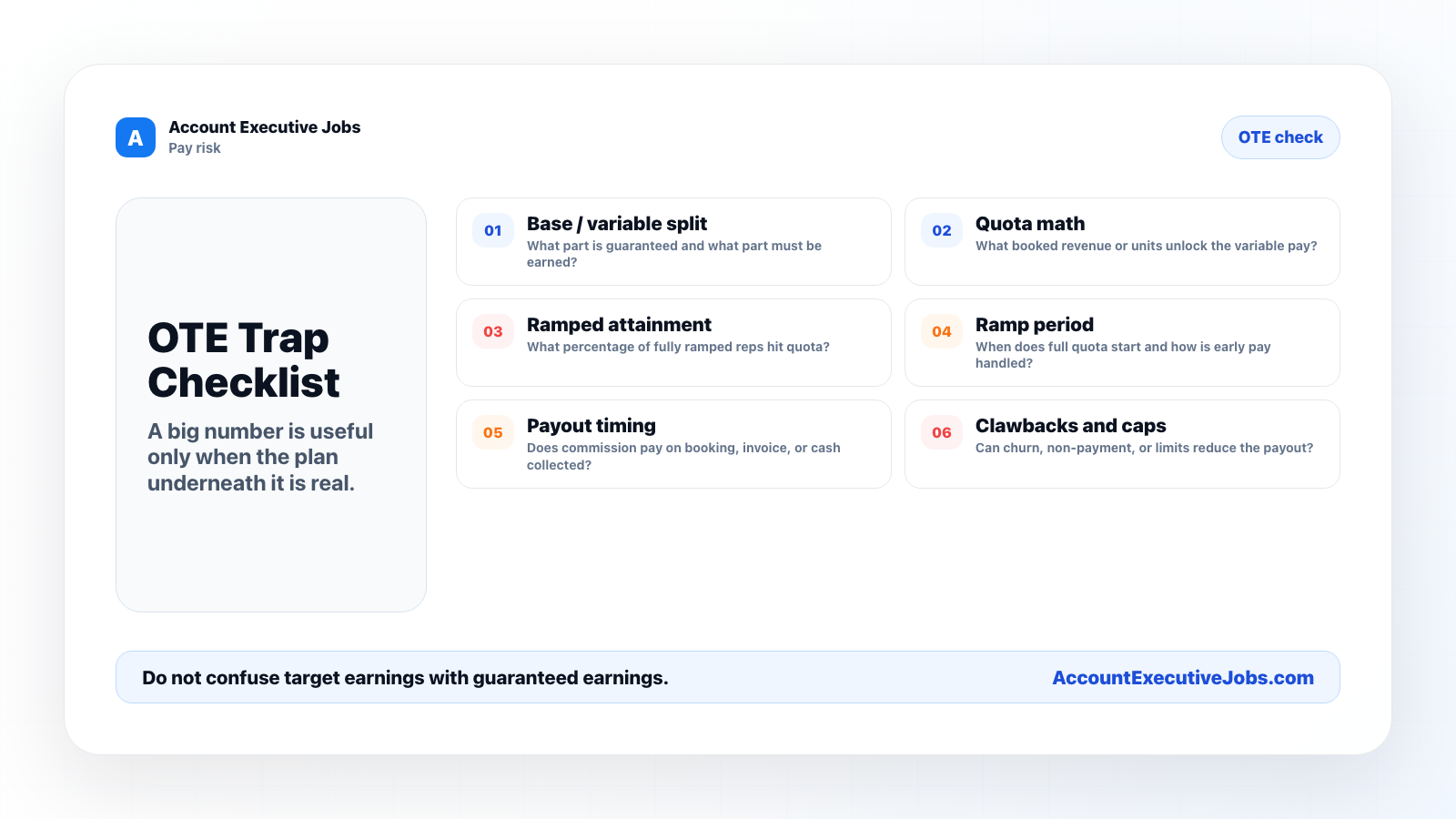
High OTE is not the warning. Unsupported OTE is the warning.
Copy embed code
<a href="https://accountexecutivejobs.com/blog/sales-job-search/sales-job-red-flags">
  <img src="https://accountexecutivejobs.com/static-images/blog/sales-job-red-flags-ote-trap-checklist-inline.png" alt="OTE trap checklist for sales jobs covering base split, quota math, ramped attainment, ramp period, payout timing, and clawbacks or caps." width="1600" height="900">
</a>
The Role Says “Hunter” But Does Not Explain The Territory
“Hunter” can mean a real new-business role. It can also mean no pipeline, no accounts, no support, and no plan.
Ask:
What territory or account list comes with the role, and how was it built?Listen for:
- Named accounts.
- Geographic region.
- Segment.
- Vertical.
- Inbound vs outbound mix.
- Partner or channel support.
- Existing pipeline.
If the answer is only “you can sell to anyone,” assume you need to build the whole book yourself until proven otherwise.
The Post Is All Upside And No Sales Process
A serious AE job post should help you picture the work.
It should tell you:
- Buyer.
- Product or service.
- Average deal size.
- Sales cycle.
- Segment.
- Lead source.
- Quota.
- Manager.
- Tools.
- Travel or territory.
The O*NET page for sales representatives of services lists real sales tasks such as contacting prospects, explaining prices, preparing agreements, negotiating details, and using customer relationship software. A job post should connect the title to actual work like that.
If the post only says “rockstar closer,” keep reading, but do not trust it yet.
Recruiter Screen Red Flags
The recruiter does not need to know every answer. They should know the basics or be willing to get them.
They Cannot Explain Why The Role Is Open
Ask:
Is this a new role, replacement role, or backfill?Then ask:
What happened to the last person in the seat?Normal answers:
- Team is growing.
- Rep was promoted.
- Rep moved territories.
- Previous rep missed and the manager can explain why.
- Role changed and they need a different profile.
Risky answers:
- “I am not sure.”
- “We are always hiring.”
- “The last few people were not a fit.”
- “Salespeople just do not want to work anymore.”
One departure means little. A pattern with no explanation means more.
The Process Is Rushed But The Answers Are Thin
Speed is fine. Pressure is different.
If a company wants you to sign quickly, they should be able to answer quickly.
Ask:
What information will I have before offer: comp plan, quota, ramp, manager interview, team attainment, and territory?If the answer is vague but the timeline is urgent, slow down.
They Avoid Base Salary
Some recruiters are coached to sell total upside first.
Bring it back to cash:
What is the base salary range for this role?Then:
What is the OTE range, and what quota supports it?If base salary is too low for your risk tolerance, better to know early. You are not doing anyone a favor by pretending the number does not matter.
Hiring Manager Interview Red Flags
The manager interview is where the role should become real.
The Manager Cannot Explain A Good First Six Months
Ask:
What would a good first six months look like in this role?Good answer:
- Learn product and buyer.
- Build account plan.
- Create pipeline.
- Advance first real opportunities.
- Hit activity and pipeline targets.
- Ramp toward full quota.
Weak answer:
- “Come in and crush it.”
- “We need someone who can figure it out.”
- “There is no ramp. We expect results.”
Some roles need self-starters. That does not excuse lazy role design.
They Cannot Tell You How Many Reps Hit Quota
Ask:
What percentage of fully ramped reps hit quota last year?If they do not know, ask:
Who would know that number?A manager may not share exact data. That can be fair. They should still be able to discuss the rough shape of team performance.
Good answer:
- “About half the fully ramped team hit. Top quartile beat target. New reps had a six-month ramp.”
- “Last year was rough after a territory change. This year we adjusted quota and coverage.”
- “Enterprise cycles are long, so we measure pipeline creation before closed revenue during ramp.”
Weak answer:
- “Everyone can hit it if they work hard.”
- “Our best rep made $400K.”
- “I do not track it that way.”
Top-rep stories do not answer your question.
The Manager Blames Reps For Everything
Sales is hard. Reps miss. Some people should not be in the role.
Still, listen to how the manager talks about misses.
If every miss is blamed on weak reps, lazy reps, bad attitudes, or “people not wanting it,” watch out.
Ask:
When reps miss here, what are the usual causes?Better answers include a mix:
- Hiring mismatch.
- Weak qualification.
- Not enough pipeline.
- Territory coverage.
- Product gaps.
- Training gaps.
- Forecast habits.
- Market changes.
Good managers can describe both rep behavior and company responsibility.
They Treat Normal Questions Like Disloyalty
This is one of the cleanest signals.
If you ask about quota, ramp, territory, or comp plan and the manager acts offended, you learned something.
Good salespeople qualify. If a company does not want to be qualified, that is not a great sign.
Copy embed code
<a href="https://accountexecutivejobs.com/blog/sales-job-search/sales-job-red-flags">
  <img src="https://accountexecutivejobs.com/static-images/blog/sales-job-red-flags-good-vs-weak-answer-inline.png" alt="Good answer versus weak answer comparison for sales job red flags." width="1600" height="900">
</a>
Commission Plan Red Flags
Sales comp is where vague language turns into real money.
The Department of Labor’s commission page gives federal context on commission pay, and DOL has a fact sheet for some commission-paid retail or service employees. This is not legal advice. It is a reminder that pay rules matter and should be written down.
You Cannot See The Plan Before Signing
Ask:
Can I review the written commission plan before I accept?If the answer is no, ask why.
A real plan should explain:
- Commission rate.
- Quota.
- Eligible revenue.
- Booking vs billing vs collection.
- Payout timing.
- Caps.
- Accelerators.
- Draws.
- Clawbacks.
- Split deals.
- Manager discretion.
- Plan-change rules.
You do not need a law degree. You need a written plan you can understand.
Use the Account Executive Salary guide to separate base pay, variable pay, and OTE. Read Sales Commission Tiers, Cliffs, and Accelerators to understand the mechanics, then use the Tiered Sales Commission Calculator on the written plan. The exact payout at 90 percent of quota can tell you more about plan risk than the advertised payout at 100 percent.
The Plan Can Change Whenever They Want
Some companies reserve plan-change rights. That can happen.
The question is how often it happens and how much notice reps get.
Ask:
How often has the plan changed in the last two years?Then:
What changed, and why?Quota and territory changes are part of sales. Surprise changes after you build the pipeline are where trust breaks.
Commission Pays Only After Collection, But Collection Is Out Of Your Control
Some companies pay on collected cash. That may fit the business model.
Ask:
What usually delays collection, and how does that affect commission timing?If procurement, setup work, customer payment, finance approval, or churn can delay or remove commission, understand it before accepting.
Territory, Product, And Market Red Flags
Pay does not happen in a vacuum.
The Territory Has Been Worked Hard
Ask:
How many reps have owned this territory in the last two years?Then:
What pipeline or account history would I inherit?A worked territory is not always bad. It can have good accounts and known buyers. It can also mean burned accounts and low trust.
You need to know which one.
The Product Has No Clear Buyer
Ask:
Who buys this, and what problem makes them take a meeting now?If the manager cannot answer in plain language, be careful.
The rep cannot create urgency forever if the product does not solve a clear business problem.
The Company Wants Enterprise Pay From A Low-ACV Product
High OTE needs deal economics.
If the product sells for a few thousand dollars per year and the company advertises enterprise-level AE earnings, ask how the math works.
How many deals does a rep need to close each month to hit quota?If the answer requires heroic volume, the plan may be possible only for a tiny slice of reps.
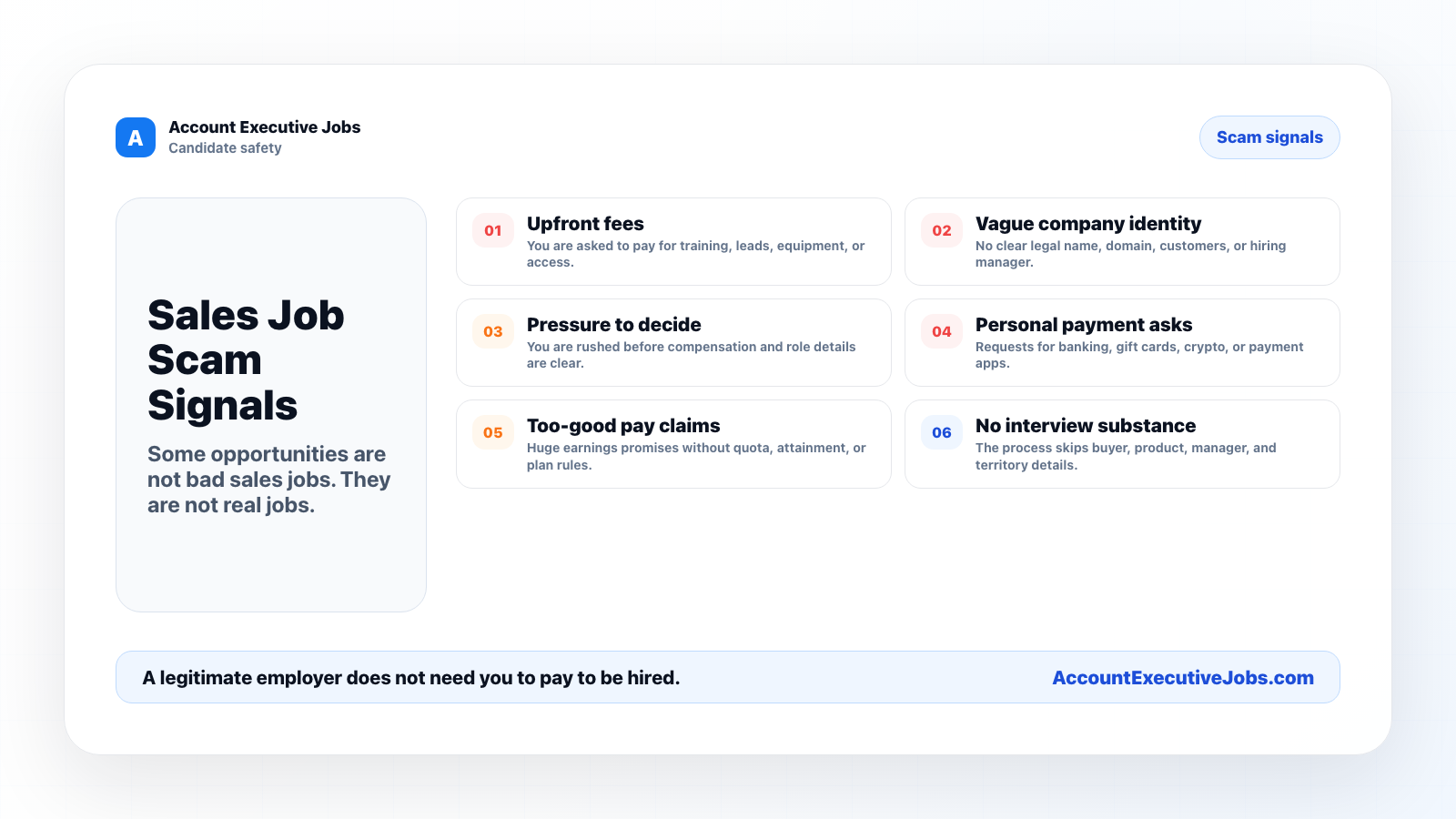
Scam Red Flags
Most sales jobs are real jobs with normal tradeoffs. Some are not real jobs.
The FTC job scams guide warns job seekers about fake checks, paying to get a job, and offers that are really attempts to get your money or personal information.
This is not a fringe problem. In March 2025, the FTC reported that job and employment agency scam reports in 2024 were nearly three times their 2020 level. Reported losses rose from $90 million in 2020 to $501 million in 2024. Reported losses are not the same as total losses, but the direction is clear: job seekers should verify the company, recruiter, domain, and payment process before sharing money or sensitive financial information.
Walk away or verify hard if:
- They ask you to pay to get the job.
- They send a check and ask you to send money back.
- They require gift cards, crypto, wire transfers, or payment apps.
- They want bank information before a real offer and verified payroll process.
- The recruiter cannot be verified through the company domain.
- The interview happens only by text or messaging app.
- The offer appears before any real conversation.
- The pay is huge for work that sounds too easy.
This is different from a normal sales-job red flag. Scam signals are not “ask better questions” signals. They are protect-yourself signals.
Use the Best Sales Job Boards guide to verify a role against the employer’s career page and build a safer search stack. A familiar job-board logo does not replace checking the company, recruiter, domain, and official application path.
Copy embed code
<a href="https://accountexecutivejobs.com/blog/sales-job-search/sales-job-red-flags">
  <img src="https://accountexecutivejobs.com/static-images/blog/sales-job-red-flags-scam-signals-inline.png" alt="Sales job scam signals checklist covering upfront fees, vague company identity, pressure to decide, personal payment asks, too-good pay claims, and no interview substance." width="1600" height="900">
</a>
Green Flags To Look For
Do not only hunt for problems. Look for proof that the role is real and well-run.
Good signs:
- The manager can explain the buyer, sales process, and first six months.
- The company gives a written comp plan before signing.
- Base, OTE, quota, and ramp are clear.
- Team attainment is discussed honestly.
- The territory is defined.
- The interview includes the direct manager.
- The company can explain why the role is open.
- The product has a clear buyer and reason to buy.
- References or rep conversations are allowed when appropriate.
- Your questions are treated as normal sales due diligence.
My favorite sign: the company can talk about tradeoffs without trying to hide them.
Every sales job has tradeoffs. Good companies know theirs.
How To Ask Without Sounding Defensive
Tone matters.
Do not say:
I heard companies lie about OTE. How do I know this is not fake?Say:
I want to understand the plan clearly. What quota and attainment history supports the OTE?Do not say:
Why did everyone quit?Say:
What happened with the last person in the role, and what would you want the next person to do differently?Do not say:
Is the territory any good?Say:
How is the territory built, and what pipeline or account history would I inherit?The goal is not to interrogate the company. The goal is to get enough truth to make a decision.
The Offer Review Checklist
Before accepting, you should know:
- Base salary.
- OTE.
- Quota.
- Ramp.
- Commission rate.
- Payout event.
- Payout timing.
- Caps or accelerators.
- Draws or clawbacks.
- Territory.
- Lead source.
- Manager.
- Team attainment.
- Why the role is open.
- What the first six months should look like.
If you cannot answer those, keep asking.
If they cannot answer after several chances, that is your answer.
For the quota itself, read How To Set A Realistic Sales Quota Using Funnel Math, then use the Sales Quota Feasibility Calculator to test the employer’s assumptions. A quota can be difficult and still be fair. The warning is a target that requires impossible lead volume, win rate, deal size, or selling capacity.
Copy embed code
<a href="https://accountexecutivejobs.com/blog/sales-job-search/sales-job-red-flags">
  <img src="https://accountexecutivejobs.com/static-images/blog/sales-job-red-flags-offer-review-checklist-inline.png" alt="Sales job red flags checklist covering OTE, quota, ramp, territory, manager, commission plan, and team health." width="1600" height="900">
</a>
FAQ
How can you tell if a sales job is a red flag?
A sales job becomes a red flag when the company cannot explain the role’s pay, quota, ramp, territory, manager support, team attainment, or commission rules. One missing answer may be a yellow flag. Repeated vague answers are the problem.
Is commission-only sales a red flag?
Not always. Some commission-only roles are legitimate. The risk is higher, so the questions should be sharper: lead source, average earnings, close rate, payout rules, expenses, training, territory, and legal classification.
Is high OTE a red flag?
High OTE is not the red flag. High OTE without quota, ramp, attainment, territory, and written commission details is the red flag.
What quota questions should I ask in a sales interview?
Ask what quota is, how it is set, what percentage of fully ramped reps hit it, how ramp works, how territory affects it, and what happens when reps miss.
What are job scam red flags?
Be careful with jobs that ask you to pay money, send money back from a check, use gift cards or crypto, give bank details too early, or accept an offer before a real interview. Verify the company and recruiter through official channels.
Should I reject a job because of one red flag?
Not usually. One red flag means pause and ask a better question. Reject the role when the answer stays vague, the risk is too high, or the company acts like normal diligence is a problem.
Sources And Review Notes
This article was built from DataForSEO keyword and SERP research pulled on May 27, 2026, manual review of social-heavy SERPs for sales job red flags and commission plan red flags, and official sources from the FTC, DOL, BLS, and O*NET. FTC loss figures are reported consumer losses, not an estimate of every job scam loss.
Reviewed by Will Gordon, founder of Account Executive Jobs. Will has worked as a sales rep, managed sales teams, was the #1 recruiter for a national staffing agency, and started Search Partners, a recruiting firm in San Francisco.
If you are comparing sales roles, browse account executive jobs with the checklist above. If you are hiring, post an account executive job with clear quota, OTE, territory, ramp, and commission details so strong candidates can qualify the role without guessing.