Here is the short answer: the best account executive interview questions make the sales work visible.
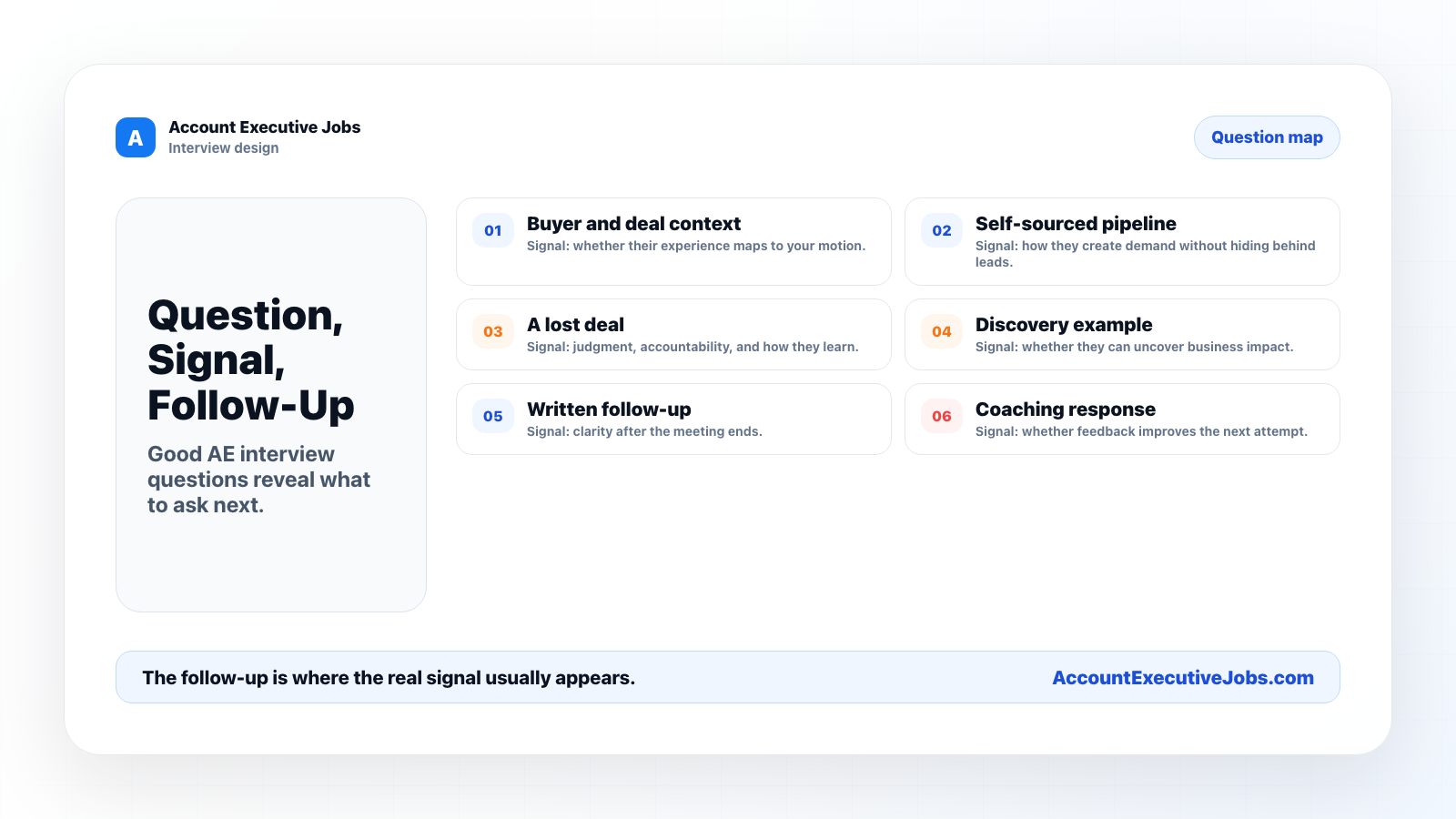
Do not ask questions that only let a polished AE perform. Ask questions that force evidence:
- Who did they sell to?
- What was the deal size?
- What was the sales cycle?
- What was the quota?
- How much pipeline did they create?
- What did they own personally?
- What changed because of their judgment?
- What proof can you check before offer?
If a question cannot change the hiring decision, cut it.
If it does not produce evidence, rewrite it.
The Short Version
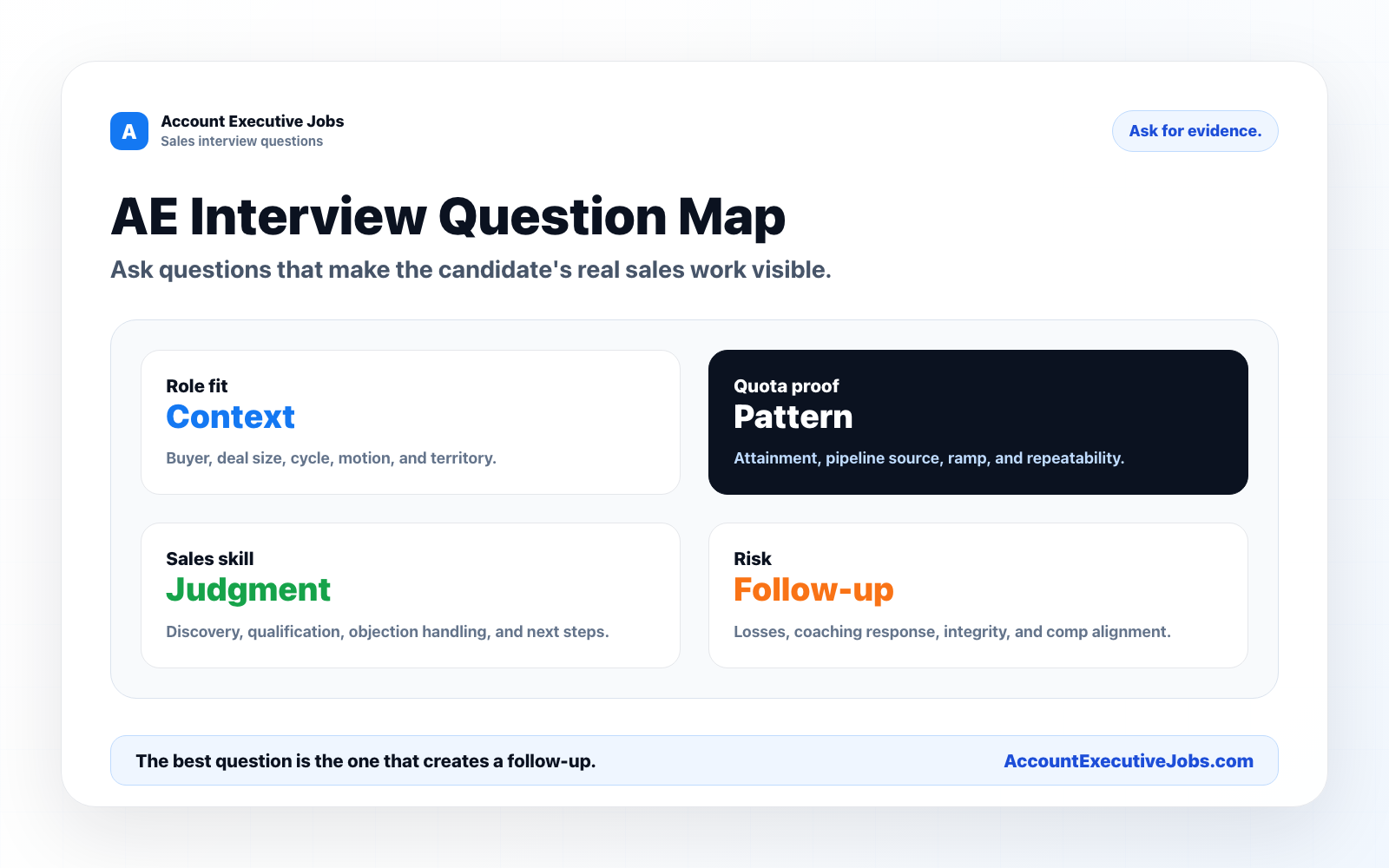
Start with these account executive interview questions:
| Question | What it tests | Listen for | Follow-up |
|---|---|---|---|
| Walk me through your current sales role using buyer, ACV, sales cycle, quota, attainment, lead source, and territory. | Role fit | Specific numbers and clear ownership | Which number did you own personally? |
| Tell me about a deal you won that was not supposed to close. | Deal judgment | Real obstacle, buyer detail, decision path | What changed after discovery? |
| Tell me about a deal you lost that you should have won. | Self-awareness | Owns the miss and names changed behavior | What would you do differently in the first call? |
| What percentage of your pipeline came from your own outbound? | Pipeline creation | Clear source breakdown | Show me a normal prospecting week. |
| Pick one quarter where you missed quota. What happened? | Honesty | Separates controllable and uncontrollable causes | What did your manager say during that quarter? |
| How do you decide whether an opportunity is real? | Qualification | Buyer, pain, consequence, process, timing | Tell me about a deal you disqualified. |
| What do you write in the follow-up after a discovery call? | Writing and next steps | Clear recap, business issue, next action | Send a sample after this interview. |
| I am going to give you feedback on that answer. Try again. | Coachability | Adjusts quickly without getting defensive | What did you change and why? |
That is enough to run a much better interview than most teams run.
The rest of the article shows how to structure the loop, what to ask at each stage, and how to connect answers back to a scorecard.
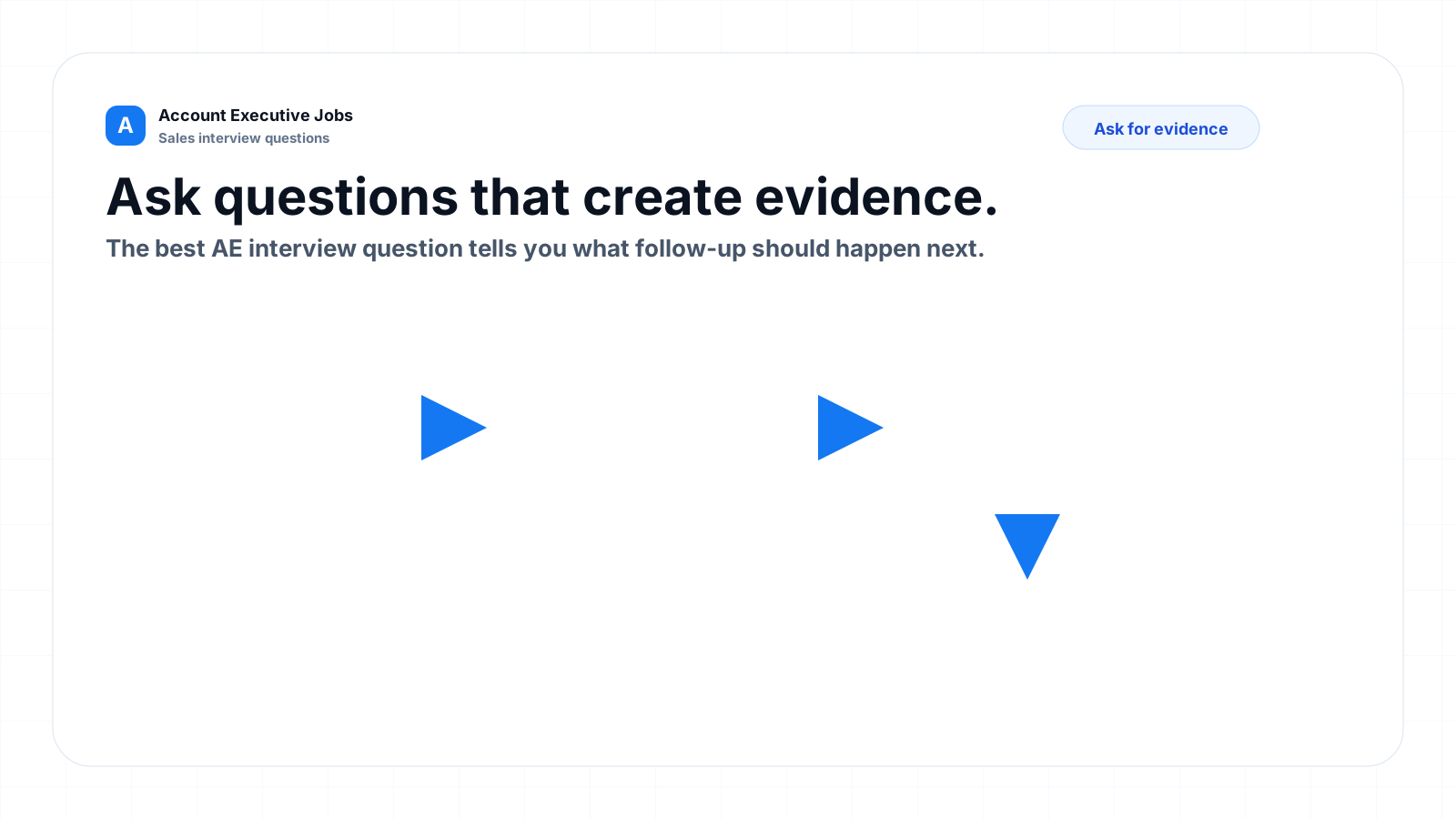
Copy embed code
<a href="https://accountexecutivejobs.com/blog/hiring-salespeople/account-executive-interview-questions">
  <img src="https://accountexecutivejobs.com/static-images/blog/account-executive-interview-questions-evidence-motion.svg" alt="Animated infographic showing how account executive interview questions should move from question to signal to follow-up to evidence." width="1600" height="900">
</a>
How To Use This Guide In A Real Interview
Do not copy every question into one giant script. Start with the work the AE will actually own, then choose questions that test that work.
Use this sequence:
- Write the job description. Define the buyer, average deal size, sales cycle, quota, ramp, territory, pipeline source, and manager support.
- Choose five must-have categories. For most AEs, use role fit, results proof, pipeline creation, discovery, and deal judgment.
- Assign each category to an interview stage. One person owns the evidence. Other interviewers do not need to repeat the same question.
- Ask the same core questions. Follow-ups can change, but every finalist should face the same main evidence bar.
- Score before the debrief. Each interviewer writes the evidence and score before hearing the rest of the panel.
- Verify the claims that matter. Use the final interview, work sample, and reference call to resolve specific risks rather than running another general conversation.
The workbook above turns that sequence into a printable plan. It is intentionally ungated. A hiring team should be able to use it immediately without entering an email address or sitting through a product pitch.
The interview can only be as good as the role definition. If the company has not settled the quota and ramp, use the Sales Quota Feasibility Calculator and Sales Ramp Plan Builder before asking candidates to prove they can succeed against assumptions the team has never tested.
Why Account Executive Interviews Go Wrong
Account executives are paid to communicate. Many can make average answers sound clean.
That is why weak interviews feel good in the room and age poorly after the hire.
The usual mistakes:
- The team asks different questions to every candidate.
- Interviewers score personality instead of work.
- Nobody defines the sales process before the interview.
- The hiring manager accepts quota claims without context.
- The panel confuses confidence with judgment.
- The role-play rewards a rehearsed pitch instead of discovery.
- The team averages away a clear risk because everyone liked the candidate.
This is why I like pairing interview questions with a sales hiring scorecard. The question collects evidence. The scorecard keeps the team honest.
Use A Structured Interview, Not A Vibe Check
The U.S. Office of Personnel Management describes structured interviews as a way to measure job-related competencies by asking consistent questions and scoring answers against planned criteria.
That matters in sales hiring.
You do not need a bureaucratic interview. You need a fair one. Ask the same core questions. Write down what a strong answer looks like before the interview. Score the answer after the candidate gives it, not after the debrief starts drifting toward who the team liked.
The EEOC’s selection procedure guidance is also a useful reminder: hiring methods should be tied to the job. For account executives, that means questions about sales process, customers, pipeline, discovery, quota, territory, follow-up, and judgment.
The clean rule:
Ask every finalist the same core questions, then add role-specific follow-ups based on the answer.That gives you structure without turning the interview into a script.
Copy embed code
<a href="https://accountexecutivejobs.com/blog/hiring-salespeople/account-executive-interview-questions">
  <img src="https://accountexecutivejobs.com/static-images/blog/account-executive-interview-questions-question-signal-follow-up-inline.png" alt="Question, signal, follow-up map for account executive interview questions." width="1600" height="900">
</a>
The Interview Stage Map
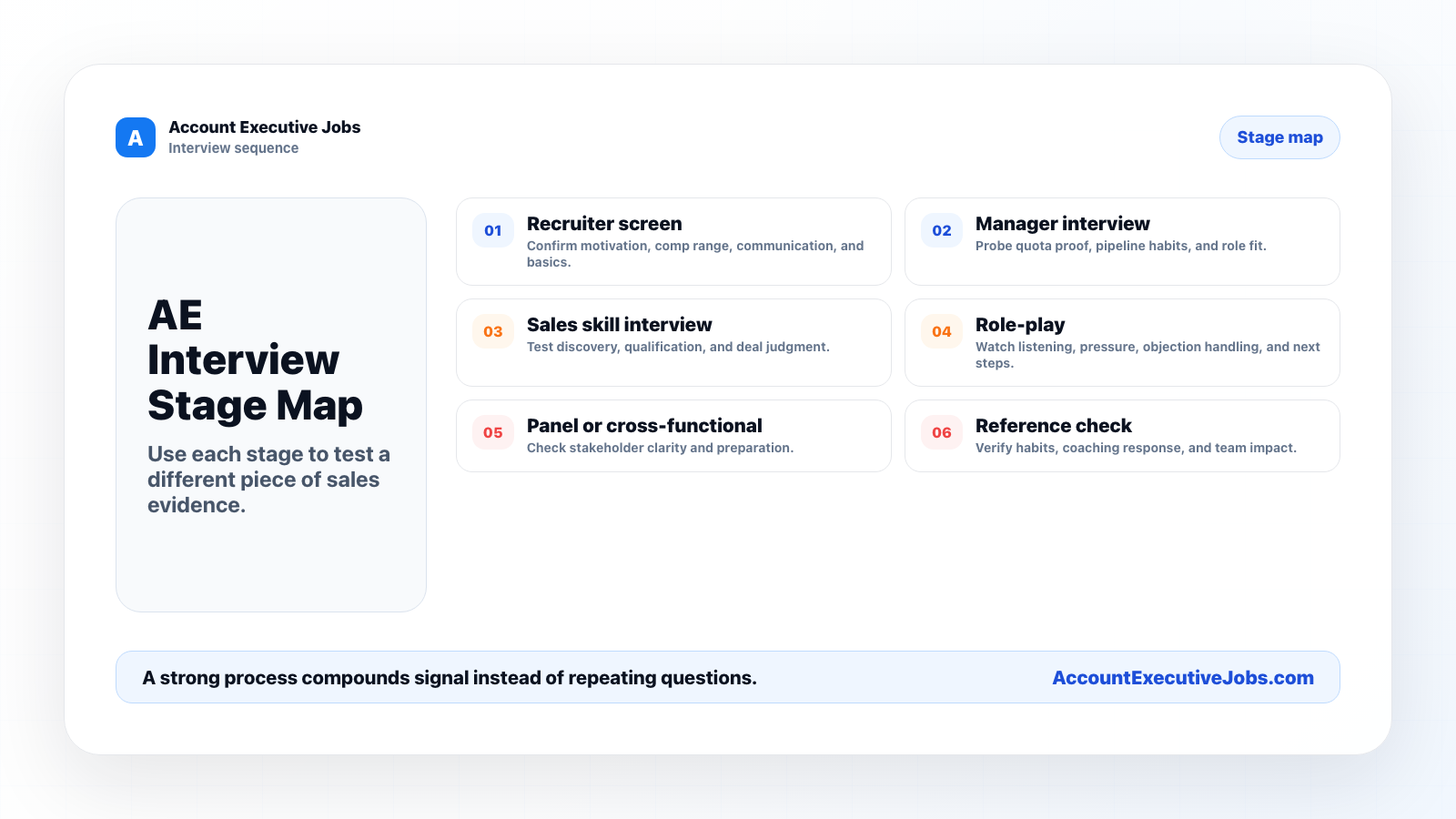
Do not ask every question in one meeting. Give each stage a job.
| Stage | Goal | Best question type | Owner |
|---|---|---|---|
| Recruiter screen | Check fit, pay, timing, sales process, and obvious mismatch | Context questions | Recruiter or hiring manager |
| Hiring manager interview | Test proof, judgment, and match to the role | Evidence questions | Hiring manager |
| Sales skill interview | Test discovery, qualification, and follow-up | Role-play or work sample | Hiring manager plus sales leader |
| Peer or panel interview | Test collaboration, handoff, and buyer empathy | Scenario questions | Sales peer, CS, marketing, or founder |
| Reference check | Verify claims and coaching patterns | Confirmation questions | Hiring manager |
Each stage should add new evidence. If three people ask, “Why are you interested in our company?” the process is wasting time.
Hiring cost should influence rigor, not create unnecessary rounds. The free Sales Hiring Cost Calculator shows the compensation, employer costs, recruiting expense, manager time, expected bookings, and payback attached to one hire. Use that economic context to design better evidence collection, not a longer obstacle course.
Copy embed code
<a href="https://accountexecutivejobs.com/blog/hiring-salespeople/account-executive-interview-questions">
  <img src="https://accountexecutivejobs.com/static-images/blog/account-executive-interview-questions-interview-stage-map-inline.png" alt="AE interview stage map covering recruiter screen, manager interview, sales skill interview, role-play, panel, and reference check." width="1600" height="900">
</a>
Recruiter Screen Questions
The screen is not where you decide whether someone can sell. It is where you prevent a bad fit from advancing.
Ask:
Walk me through your last role by buyer, ACV, average deal size, sales cycle, quota, lead source, territory, and attainment.Strong answer:
The candidate can explain the role in plain language. They know the buyer, the numbers, and what they owned.
Weak answer:
The candidate gives brand names and quota claims but cannot explain the sales process.
Ask:
What was your base, variable pay, and OTE structure?This protects both sides. If the candidate wants a $180,000 OTE and the role is a $95,000 OTE job, say so early. If your role has a good pay path, explain the plan clearly. For more context on pay language, use the account executive salary guide.
Ask:
What percentage of reps on your team hit quota last year?This gives context to attainment. A candidate at 92 percent on a team where almost nobody hit quota may be stronger than a 110 percent candidate in a rich inbound territory.
Ask:
What percentage of your pipeline was inbound, outbound, channel, expansion, or partner-sourced?This question matters if the new role requires pipeline creation. Do not hire an inbound closer for a self-sourced role unless the candidate can explain the gap and wants that work.
Other useful screen questions:
- Why are you looking now?
- What kind of sales process do you not want?
- What would have to be true for this role not to be a fit?
- What CRM did you use, and what did managers inspect weekly?
- What is your current notice period and compensation expectation?
Hiring Manager Questions
The hiring manager interview should test proof, judgment, and match to the actual job.
Start here:
Tell me about the best deal you closed in the last year. Start with how the opportunity was created.Listen for:
- How the deal entered the pipeline.
- Who the buyer was.
- What problem the buyer had.
- What the candidate did personally.
- What changed during the deal.
- Why the buyer moved now.
- What the next step was after each call.
Weak answers turn into celebration. Strong answers turn into a clear deal path.
Ask:
Tell me about a deal that looked strong but stalled.This shows whether the candidate can diagnose risk. Did they have access to the real buyer? Did they understand the business reason to act? Did they confuse activity with progress?
Ask:
What has your manager coached you on more than once?I like this more than “What is your weakness?” It is harder to fake. It also tells you what the next manager may inherit.
Ask:
Which sales metric do you trust least on a dashboard?Good AEs know numbers can hide reality. They may talk about stage aging, close dates, activity counts, demo volume, or pipeline coverage. The answer tells you how they think.
Ask:
What is the hardest product or service you have sold, and why?This exposes whether the candidate has sold through price, complexity, weak demand, bad timing, technical detail, a crowded market, or buyer skepticism.
Prospecting And Pipeline Questions
Pipeline questions are not optional if the role requires outbound.
Ask:
Describe a normal outbound week. How many accounts, touches, conversations, meetings, and opportunities?Do not reward activity by itself. The point is to see whether the candidate can turn targeted work into real pipeline.
Ask:
How do you pick accounts worth prospecting?Strong answers include account triggers, buyer fit, market timing, current tech stack, hiring signals, funding, expansion, known problems, or prior customer patterns.
Weak answers sound like:
- “I hit my activity numbers.”
- “I use Sales Navigator.”
- “Marketing gives me lists.”
- “I reach out to anyone with the title.”
Ask:
What do you do after the second no response?You are testing persistence with judgment. A good AE knows when to keep going, change angle, find another buyer, or stop.
Ask:
Give me an example of an outbound message that worked because it was specific.The word “specific” is doing work here. Generic outbound is easy to describe. Real outbound has a reason the account should care.
Discovery And Qualification Questions
The O*NET page for sales representatives of services includes tasks such as contacting customers, answering questions, describing products or services, and recommending options. For an account executive, that work has to start with understanding the buyer.
Ask:
What are the first three things you need to learn in discovery?Good answers usually include:
- What problem exists.
- Why it matters now.
- Who cares about it.
- What happens if nothing changes.
- How the buyer will decide.
- What the current process looks like.
Ask:
Tell me about a time discovery changed your deal strategy.This is a good question because it forces a real story. If discovery never changes the plan, the candidate may be pitching more than selling.
Ask:
What question do you ask when a prospect gives a vague problem statement?A weak AE accepts vague pain. A better AE asks the next question.
Useful follow-ups:
- What makes that problem expensive?
- Who else feels it?
- How are you handling it today?
- What breaks if it stays the same for six more months?
- Why look at this now?
Ask:
What does a weak champion sound like?This tests deal reality. A weak champion may like the product but lack power, urgency, credibility, or access. Good AEs can name the difference.
Deal Judgment And Closing Questions
Deal judgment is where strong AEs separate themselves.
Ask:
Tell me about a deal you walked away from.This is one of my favorite questions. Average reps chase everything. Good reps know when a deal is not real.
Ask:
What makes a forecast commit real?Listen for buyer action, not seller hope. A real commit has buyer confirmation, business reason, agreed process, timing, next step, and risk notes.
Ask:
Tell me about a deal where procurement or legal changed the plan.Late-stage sales work is not just persuasion. It is process management. This question shows whether the candidate can keep a deal alive when the room gets crowded.
Ask:
How do you build a close plan without pretending you control the buyer?This phrasing matters. The buyer controls the buyer’s side. The AE controls clarity, next steps, risk, and follow-up.
Ask:
When do you discount, and when do you hold price?You are testing business judgment. Discounting can be smart. Discounting can also be a habit that hides weak discovery.
Coachability Questions
Coachability should not be a personality label. Test it in the interview.
Ask:
I am going to give you feedback on that answer. Try again in half the time.Then actually give feedback.
Maybe the answer was too long. Maybe it lacked numbers. Maybe it skipped the buyer. See what happens.
Strong signal:
- The candidate listens.
- They adjust.
- They do not become defensive.
- The second answer is better.
Weak signal:
- They argue.
- They restart the same answer.
- They explain why the feedback is unfair.
- They become flat or irritated.
Ask:
Tell me about feedback you resisted at first but later realized was right.This question is better than asking, “Are you coachable?” Nobody says no.
Ask:
What sales skill are you working on right now?Good AEs can name a real skill. Weak answers drift into vague self-improvement talk.
Writing Exercise
Every AE role has writing inside it: follow-up emails, recap notes, mutual plans, internal handoffs, renewal context, or CRM notes.
Test it.
Prompt:
Pretend I am the buyer from this interview. Send me a follow-up email that summarizes the business issue, why it matters, the next step, and what you need from me.Score for:
- Clear subject line.
- Specific recap.
- Business issue, not just friendly tone.
- One clear next step.
- Date and owner.
- No sloppy errors.
- No fake enthusiasm.
Bad follow-up:
Great speaking today. I am excited about the opportunity. Let me know if you have any questions.Better follow-up:
Subject: Next step on pipeline quality discussion

Will,

Thanks for the conversation today. I heard three issues: your managers do not trust the current pipeline review, reps are logging activity without enough qualified opportunities, and the team does not have a shared definition of a real next step.

The next useful step would be a 30-minute call with you and the sales manager who owns the weekly forecast. I can bring a short scorecard for how I would inspect an opportunity.

Does Tuesday at 10:00 a.m. work?
That is not fancy. It is clear.
Account Executive Role Play Interview
Use a role-play only if it mirrors the job.
Bad role-play:
Sell me this pen.Better role-play:
Run the first 15 minutes of a discovery call with a VP Sales who says pipeline quality is weak but does not know whether the problem is leads, reps, managers, or the sales process.Set the scene:
- Buyer: VP Sales at a 120-person B2B company.
- Problem: pipeline quality is weak.
- Candidate goal: run discovery, not a pitch.
- Interviewer goal: test preparation, curiosity, qualification, and next-step control.
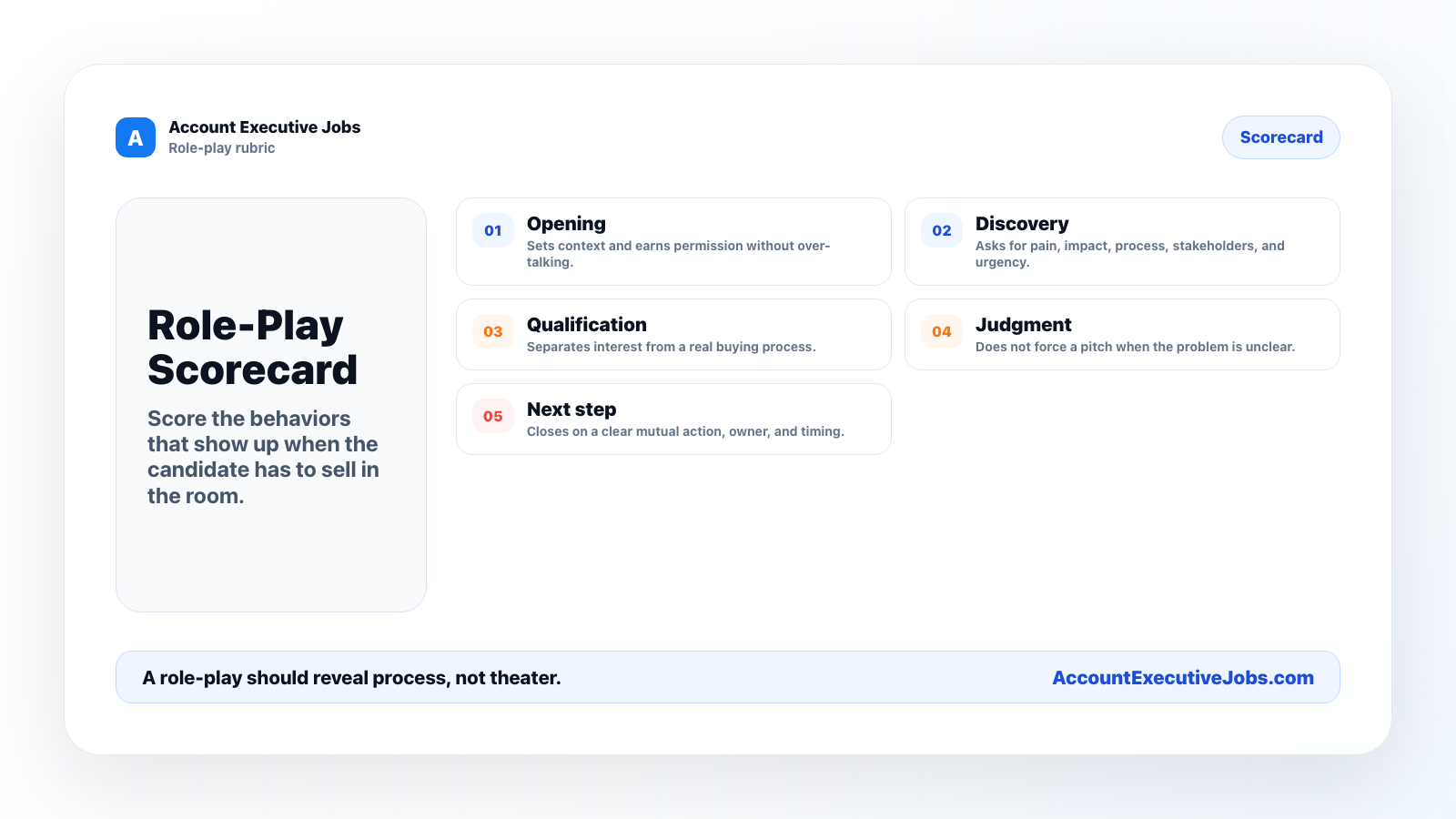
Score the role-play on:
| Area | Strong signal | Weak signal |
|---|---|---|
| Opening | Sets context and asks permission for an agenda | Starts pitching |
| Discovery | Asks business questions before solution talk | Accepts vague answers |
| Qualification | Tests urgency, buyer, process, and consequence | Treats interest as intent |
| Judgment | Adjusts when the buyer adds new information | Sticks to a script |
| Close | Ends with a useful next step | Asks for a fake close |
Do not reward theater. Reward the sales behavior you need in the job.
Copy embed code
<a href="https://accountexecutivejobs.com/blog/hiring-salespeople/account-executive-interview-questions">
  <img src="https://accountexecutivejobs.com/static-images/blog/account-executive-interview-questions-role-play-scorecard-inline.png" alt="Role-play scorecard for AE interviews covering opening, discovery, qualification, judgment, and next step." width="1600" height="900">
</a>
Enterprise And SaaS AE Variants
Enterprise and SaaS AE interviews need more detail around deal path, buying group, technical risk, and account planning.
Ask:
Tell me about a deal with more than five people involved. Who mattered most and why?Ask:
How did you identify the economic buyer?Ask:
Tell me about a deal where your champion was not strong enough.Ask:
How do you keep momentum across a long procurement cycle?Ask:
What changed in your account plan after discovery?For SaaS roles, add:
- What product category did you sell?
- Was demand already present or did you create it?
- What was the average contract value?
- How much technical help did you need from sales engineering?
- What objections came from security, finance, legal, or end users?
- How many reps hit quota?
The BLS sales occupation pages are broad, but they are useful for one reminder: sales roles vary a lot by product, buyer, and work setting. Your AE interview should reflect the actual job, not a generic sales stereotype.
Questions Candidates Should Ask The Interviewer
This article is written for hiring managers, but candidates are reading too.
Good. Strong candidates should interview the company back.
If you are a candidate, ask:
| Area | Ask this |
|---|---|
| OTE | What is the base, variable pay, and quota behind the OTE? |
| Quota | What percentage of fully ramped reps hit quota last year? |
| Ramp | What does quota and commission look like in months one through six? |
| Territory | What accounts, region, segment, or vertical would I own? |
| Pipeline | Where does most pipeline come from today? |
| Manager | Who will manage me, and how do they coach? |
| Team health | Why is this role open? |
| Commission | Can I review the written commission plan before accepting? |
| Risk | What would make someone fail in this role? |
If a company wants you to accept quickly, they should be able to answer clearly.
For more candidate-side due diligence, use the sales job red flags checklist.
Questions Not To Ask
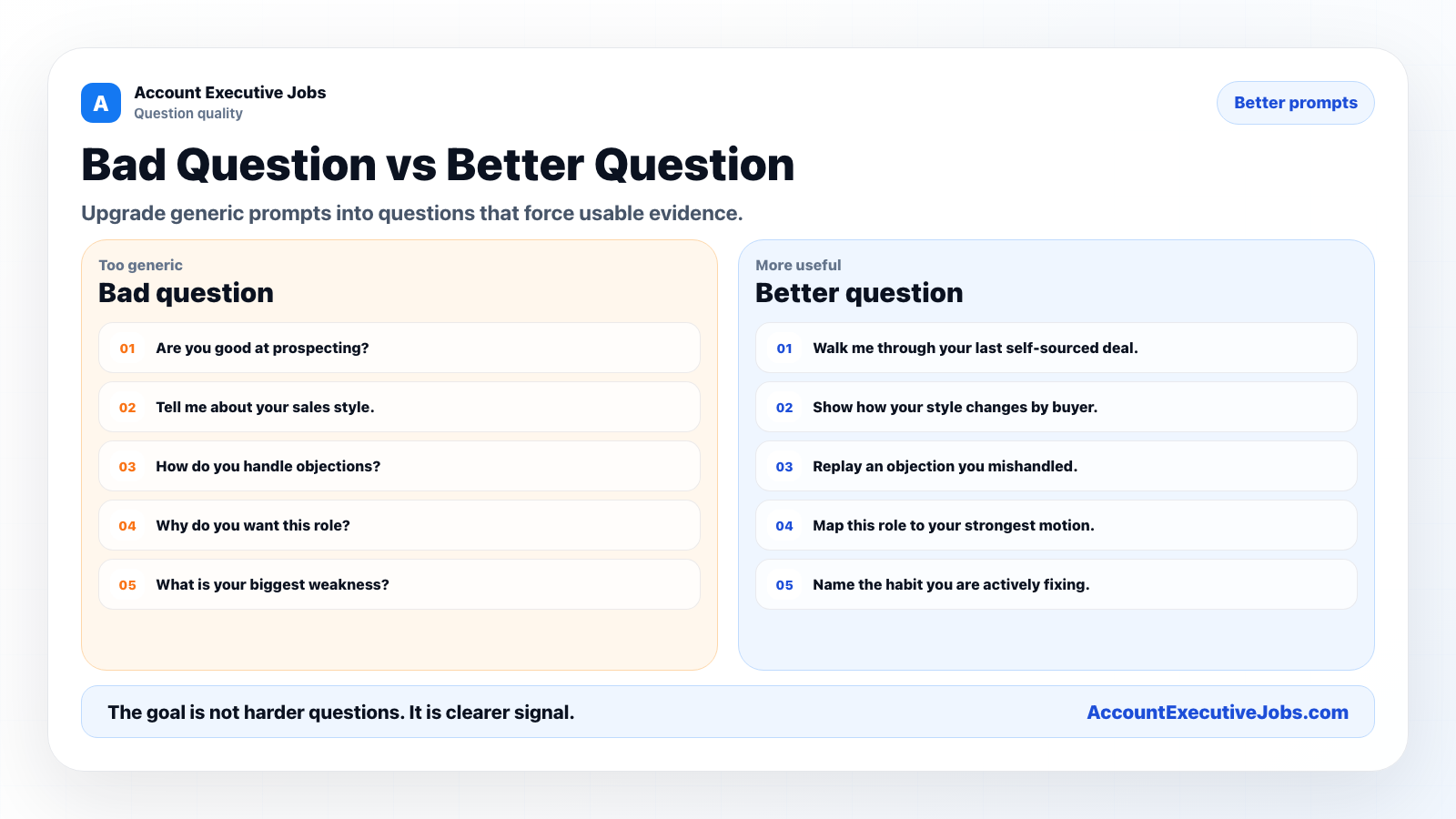
Do not ask questions that are not tied to the job.
Avoid:
- Family status, children, pregnancy, or childcare.
- Age, graduation year, or retirement plans.
- Health, disability, or medical history.
- Religion, national origin, or personal beliefs.
- Personal finances.
- Anything that turns “culture fit” into similarity bias.
This is not legal advice. It is a hiring discipline point. Ask about the work.
If the role requires travel, ask whether the candidate can meet the travel requirement. If the role requires work authorization, ask about authorization to work. If the role requires a territory schedule, explain the schedule. Keep the question tied to the job.
Copy embed code
<a href="https://accountexecutivejobs.com/blog/hiring-salespeople/account-executive-interview-questions">
  <img src="https://accountexecutivejobs.com/static-images/blog/account-executive-interview-questions-bad-question-vs-better-question-inline.png" alt="Bad question versus better question comparison for account executive interviews." width="1600" height="900">
</a>
Score The Answers
Use the questions above with a simple scoring system.
| Score | Meaning | Hiring note |
|---|---|---|
| 1 | No evidence | Do not advance unless the category is not needed for the role. |
| 2 | Thin evidence | Probe hard or verify before advancing. |
| 3 | Acceptable evidence | Candidate can likely handle this part of the role. |
| 4 | Strong evidence | Candidate has done this work well in a similar setting. |
| 5 | Rare evidence | Candidate can teach the team something useful here. |
Map the score to the work:
| Scorecard area | Interview evidence | Question to ask |
|---|---|---|
| Role fit | Buyer, ACV, cycle, lead source, territory | Walk me through your current sales process. |
| Results proof | Quota, attainment, rank, ramp context | What created your result? |
| Pipeline | Self-sourced meetings and opportunities | What percentage of pipeline came from outbound? |
| Discovery | Problem, consequence, buyer, urgency | What do you need to learn in discovery? |
| Deal judgment | Risk, tradeoffs, forecast reality | Tell me about a deal you walked away from. |
| Communication | Follow-up quality and next steps | Send a recap email after this interview. |
| Coachability | Response to feedback | Try that answer again with my feedback. |
| Risk | Gaps, vague claims, references | What should I verify before offer? |
Do not average away a must-have failure. A candidate can be charming, prepared, and wrong for the sales process.
FAQ
What are the best account executive interview questions?
The best account executive interview questions test role fit, quota context, pipeline creation, discovery, deal judgment, writing, coachability, and risk. The strongest opening question is: “Walk me through your current sales role using buyer, ACV, sales cycle, quota, attainment, lead source, and territory.”
How do I interview an account executive?
Use a structured interview. Define the role first, ask the same core questions to every finalist, use follow-up probes, require evidence, and score answers against the sales work the person will do.
Should an account executive interview include a role-play?
Yes, if the role-play mirrors the real job. A discovery call, follow-up writing task, or opportunity review is usually better than a generic pitch exercise.
What should I ask a senior or enterprise account executive?
Ask about complex deals, buyer access, account planning, champion strength, procurement, legal review, multi-person buying groups, forecast accuracy, and how the candidate keeps momentum across a long sales cycle.
What should candidates ask in an account executive interview?
Candidates should ask about base salary, OTE, quota, ramp, territory, pipeline source, manager support, team attainment, commission rules, and why the role is open.
What To Do Next
Before the next interview, choose the five categories that matter most for this AE role.
For most account executive jobs, I would start with:
- Role and sales process fit.
- Proof of sales results.
- Pipeline creation.
- Discovery and qualification.
- Deal judgment.
Then pick two questions for each category.
Use the sales hiring scorecard to score the answers. Use the Sales Ramp Plan Builder to define reasonable month-by-month expectations. Then write a job post that tells candidates the truth about the role and send serious candidates to browse account executive jobs so they see the kind of market you are hiring in.
If you are ready to hire, post your account executive job with the details good candidates actually want: base, OTE, quota, ramp, territory, buyer, and sales process.