
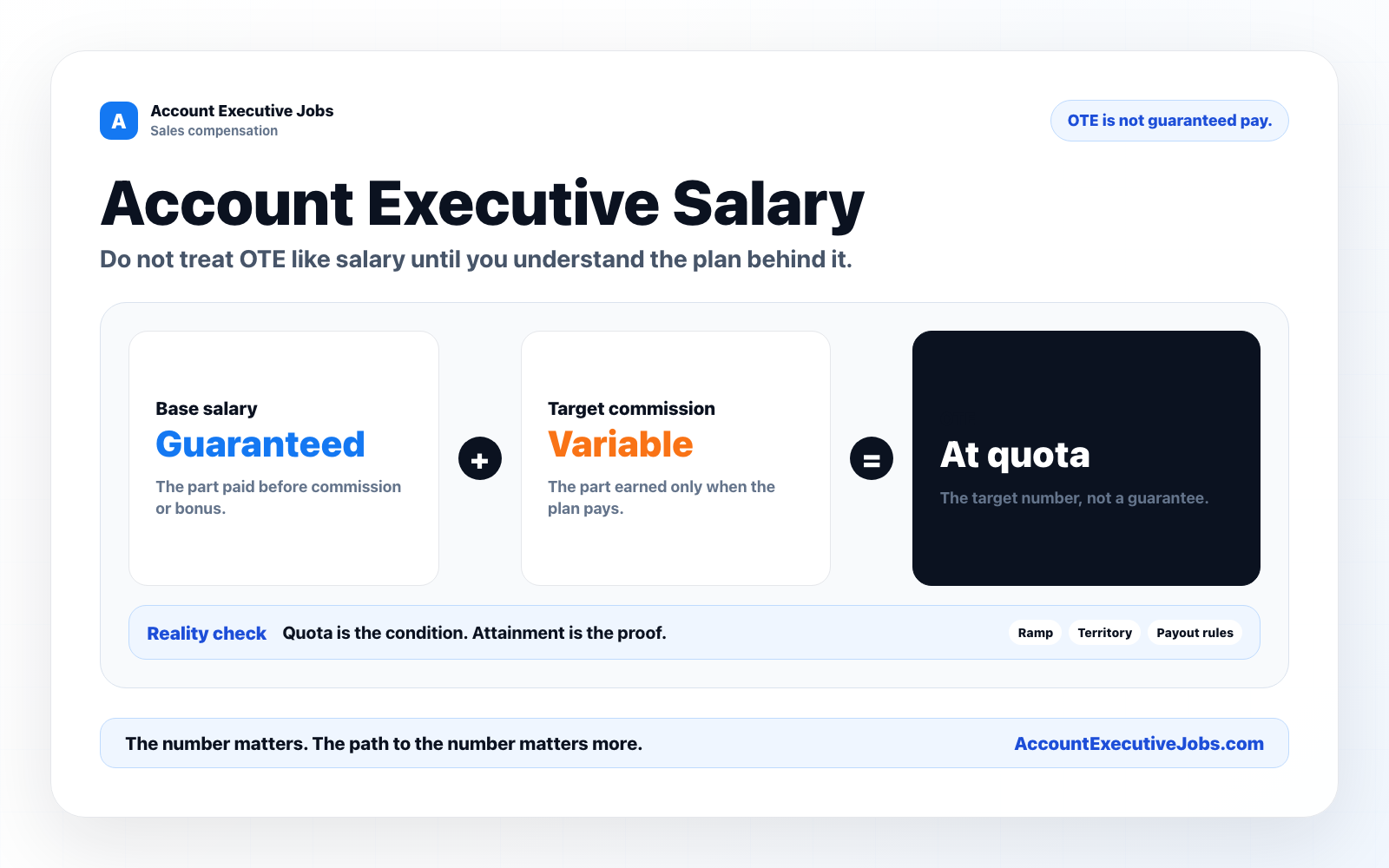
Account executive salary is only useful when you split the number into base pay, variable pay, and OTE.
OTE means on-target earnings. It is the amount a company says you can earn if you hit the sales target. It is not guaranteed pay.
The real question is not, “What is the account executive salary?” The better question is:
How much is guaranteed, what has to happen to earn the rest, and how many reps in this role actually get there?If you are a candidate, that question protects you from being sold a big number with weak odds behind it.
If you are hiring, that question helps you write a sales job that serious candidates can trust.
Use the free Account Executive OTE and Commission Calculator to model base, target variable, realistic attainment, accelerators, 2026 federal and state taxes, and estimated take-home pay while you read.
The Short Answer
Account executive pay usually has two pieces:
| Pay piece | What it means | What to check |
|---|---|---|
| Base salary | The guaranteed salary before commission or bonus | Is it enough to live on during ramp? |
| Variable pay | Commission, bonus, or other performance pay | What exactly triggers payout? |
| OTE | Base salary plus target variable pay | What quota, ramp, territory, and attainment support it? |
A $200,000 OTE can be a good plan. It can also be a recruiting headline.
The difference is the plan behind the number.
A real plan can answer:
- What is the base salary?
- What is the target commission?
- What quota produces that commission?
- What percentage of reps hit target?
- What happens during ramp?
- What territory, accounts, or lead sources come with the role?
- When is commission earned and paid?
- Are there clawbacks, draws, caps, or accelerators?
If a company cannot explain those things clearly, do not treat the OTE like salary.
Copy embed code
<a href="https://accountexecutivejobs.com/blog/sales-compensation/account-executive-salary">
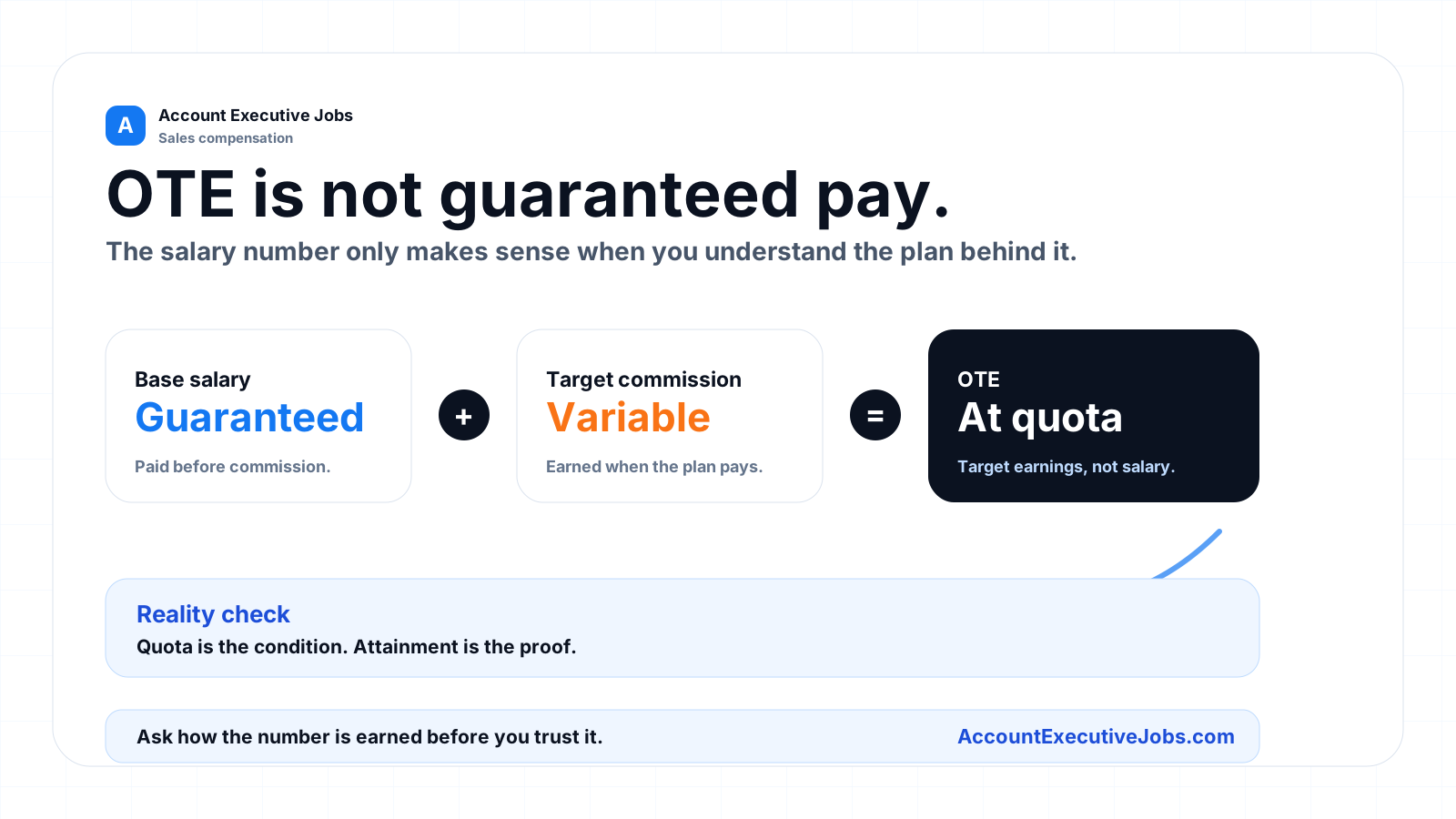
  <img src="https://accountexecutivejobs.com/static-images/blog/account-executive-salary-ote-motion.svg" alt="Animated account executive salary explainer showing base salary plus target commission equals OTE, with quota, ramp, territory, and payout rules as the reality check." width="1600" height="900">
</a>
Salary, Pay, Compensation, And OTE
These words get mixed together in job posts. That is where candidates get burned.
Salary usually means base salary. It is the amount paid regardless of closed revenue, assuming you remain employed and meet normal role expectations.
Pay is broader. A candidate asking about pay may mean salary, commission, bonus, equity, benefits, and total cash.
Compensation is the full package. For sales roles, that can include base salary, variable pay, equity, benefits, car allowance, travel reimbursement, spiffs, President’s Club, or other plan details.
OTE is the target number. If the base salary is $100,000 and target commission is $100,000, the OTE is $200,000.
The clean formula:
Base salary + target variable pay = OTE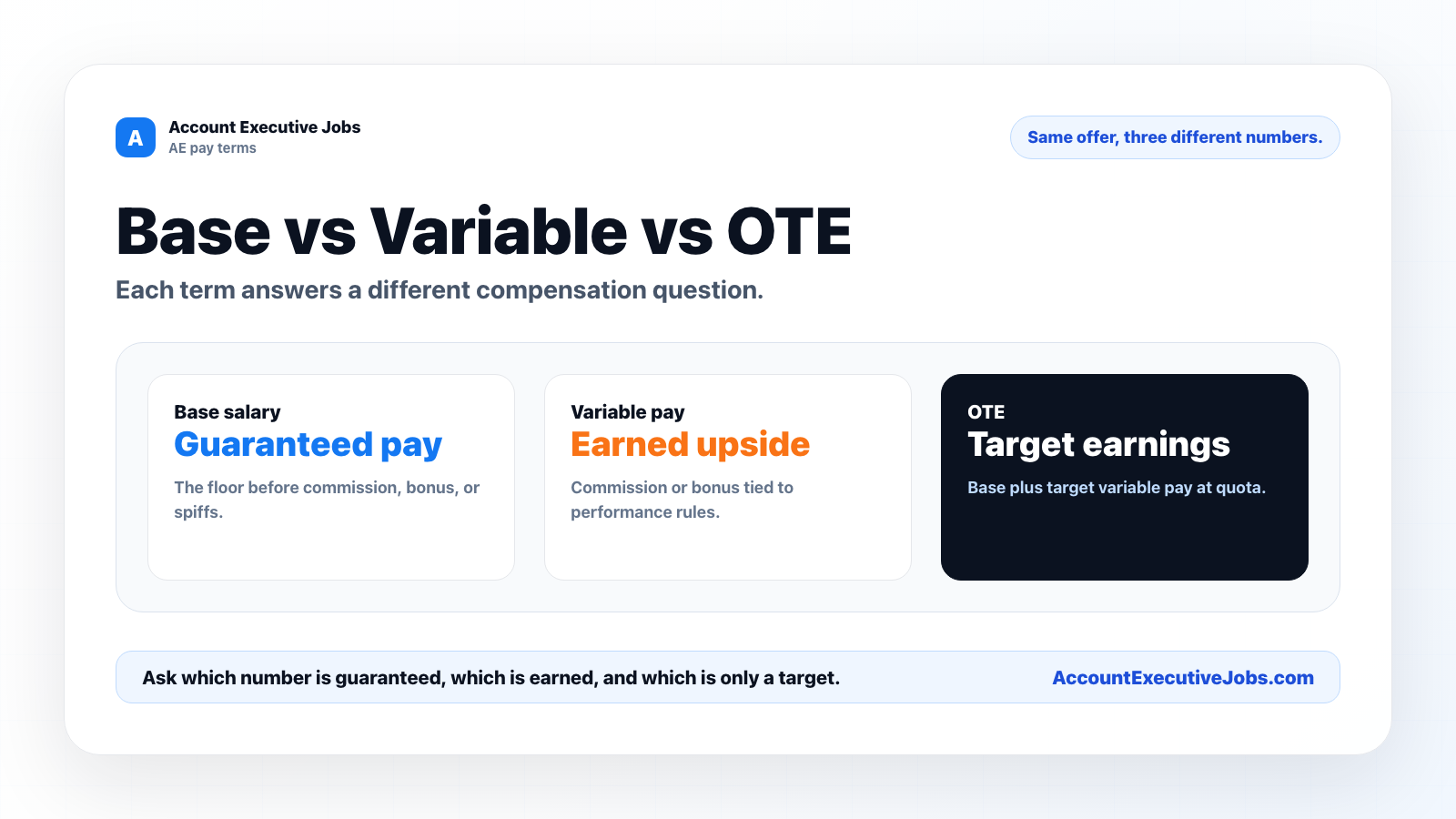
Copy embed code
<a href="https://accountexecutivejobs.com/blog/sales-compensation/account-executive-salary">
  <img src="https://accountexecutivejobs.com/static-images/blog/account-executive-salary-base-variable-ote-inline.png" alt="Comparison of base salary, variable pay, and OTE for account executive compensation." width="1600" height="900">
</a>
The part candidates miss is this: target variable pay has conditions attached.
You earn it only if the sales plan pays out. That means you need to know the quota, the commission rate, the ramp rules, and the actual odds of hitting the number.
Why Salary Sites Disagree
Salary sites are useful, but they are not the same as an offer letter.
One site may show base salary. Another may show total compensation. Another may blend salary, bonus, commission, and self-reported data from people with different industries, cities, seniority levels, and company sizes.
The BLS sales occupations table gives broad occupation wage context, but BLS does not give one clean “account executive” bucket that matches every SaaS, services, manufacturing, roofing, medical device, or financial sales role. Account executive is a business title, not one perfect government occupation.
That does not make BLS useless. It means you should use BLS for broad context, then use salary platforms and job posts as market checks, then use the written comp plan as the truth for the role in front of you.
The same title can mean very different jobs:
- SMB account executive closing smaller, faster deals.
- Mid-market AE selling to department heads.
- Enterprise AE selling to a buying committee over six to twelve months.
- Services AE selling custom work.
- Field sales rep managing a territory.
- Sales engineer paired with account executives on technical deals.
The O*NET page for sales representatives of services includes tasks such as contacting prospects, preparing proposals, explaining prices, negotiating details, and using customer relationship software. That is close to a lot of account executive work, but it still will not tell you whether this one AE role has fair quota and a real territory.
The offer has to tell you that.
Current Wage Benchmarks, Used Carefully
The newest national BLS wage table available for this review covers May 2025 and was released in May 2026. BLS does not publish a single national “account executive” occupation, so the closest useful categories depend on what the AE sells.
| Account executive-adjacent occupation | May 2025 national mean annual wage |
|---|---|
| Sales engineers | $130,140 |
| Technical and scientific wholesale or manufacturing sales representatives | $119,730 |
| Sales representatives of services outside selected categories | $82,430 |
| Nontechnical wholesale or manufacturing sales representatives | $82,530 |
These are national mean annual wages, not median base salaries and not OTE guarantees. The BLS technical notes say wage estimates include incentive pay such as commissions and production bonuses. They cover wage and salary workers but not self-employed workers, owners, or partners in unincorporated firms.
That makes the data useful for scale, but not precise enough to price one opening. A cybersecurity enterprise AE, construction-services rep, staffing account executive, and local advertising seller can all share the same title while carrying completely different base pay, deal economics, and commission risk.
For a more title-specific but less authoritative signal, RepVue’s mid-market account executive page reported a $90,000 median base salary, $175,000 median OTE, and 40.5 percent quota attainment with data labeled November 2025 when this guide was reviewed. That is self-reported platform data, not a government estimate or a promise for your market. The quota-attainment number is the important reminder: an OTE benchmark without attainment context can make expected pay look more certain than it is.
Use three layers in order:
- Official occupation data for broad market context.
- Current job posts and reputable salary platforms for role and segment context.
- The employer’s written plan, territory, ramp, and attainment evidence for the decision.
The OTE Reality Test
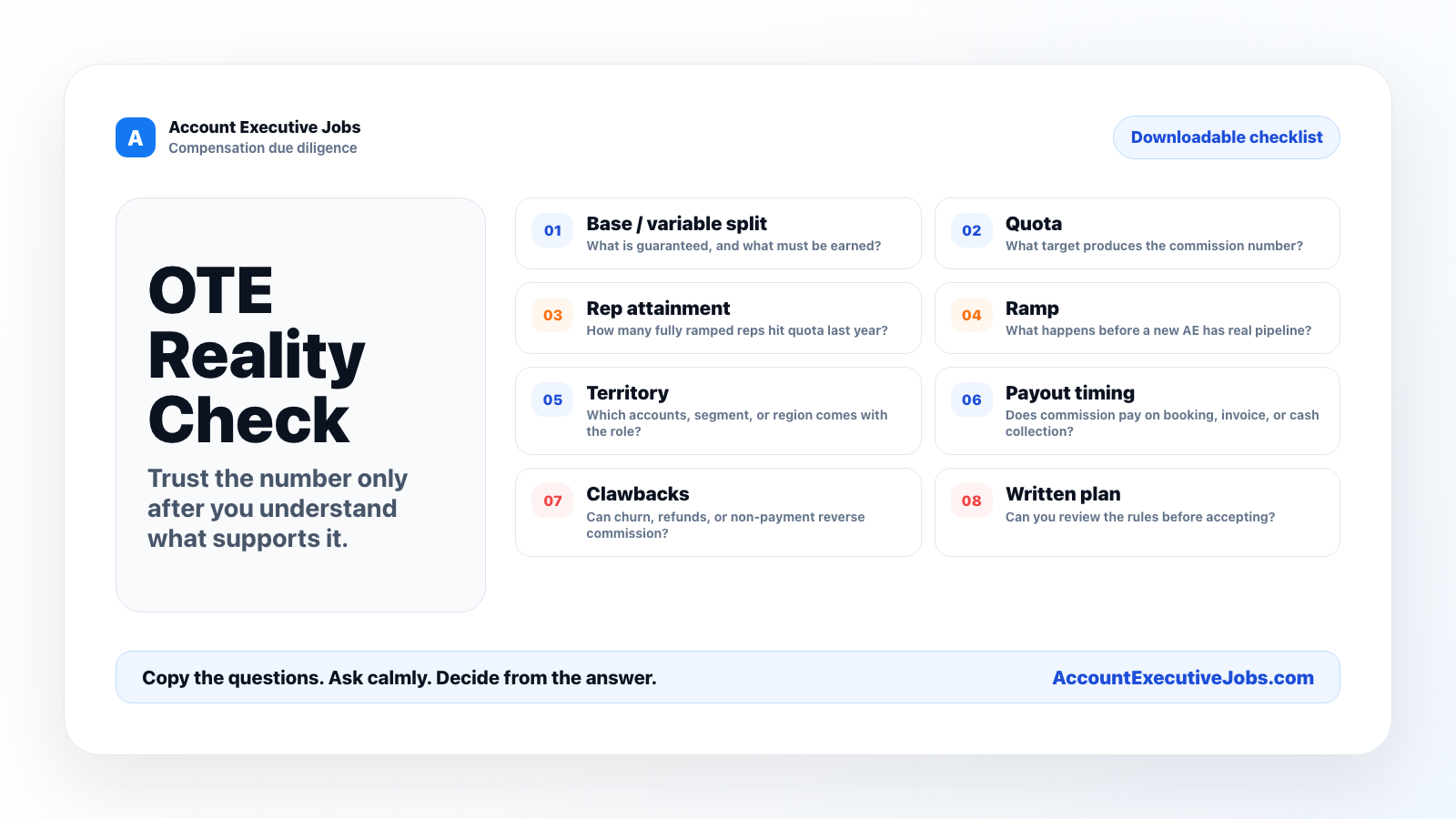
Use this before you accept an AE offer or publish an AE job.
| Question | Why it matters | Strong answer | Risk signal |
|---|---|---|---|
| What is the base/variable split? | Shows what is guaranteed vs earned at target. | The split is clear and written. | Only the total OTE is shared. |
| What quota supports the OTE? | OTE is tied to a sales target. | Quota, deal size, sales cycle, and win-rate context are explained. | Quota is vague or changed recently with no clear reason. |
| How many reps hit quota? | Shows whether the plan is real. | The company shares a range or team attainment context. | Only top-rep stories are offered. |
| What is the ramp plan? | New AEs need time to build pipeline. | Ramp quota, draw, and month-by-month expectations are clear. | Full quota starts immediately with no support. |
| What territory or lead source is included? | Pipeline access affects earning power. | Territory, accounts, inbound/outbound mix, and support are clear. | ”Unlimited upside” replaces real details. |
| When is commission earned and paid? | Cash timing matters. | Booking, invoicing, collection, and payout timing are written. | The plan is hard to read or not available before offer. |
| Are there caps, clawbacks, or draws? | These change the true risk of the plan. | Rules are plain and explained without defensiveness. | The company avoids written answers. |
Copy embed code
<a href="https://accountexecutivejobs.com/blog/sales-compensation/account-executive-salary">
  <img src="https://accountexecutivejobs.com/static-images/blog/account-executive-salary-ote-reality-check-inline.png" alt="OTE reality check for account executive salary covering base pay, quota, attainment, ramp, territory, payout timing, clawbacks, and the written plan." width="1600" height="900">
</a>
My opinion: a good AE should ask these questions. A good hiring manager should welcome them.
Serious salespeople do not only care about the headline number. They care about the machine behind it.
Use the Sales Quota Feasibility Calculator to test whether lead volume, conversion rates, average deal size, and sales capacity can support the target. The supporting guide explains how to set a realistic sales quota using funnel math. If the plan uses attainment bands, cliffs, or accelerators, read how sales commission tiers, cliffs, and accelerators change the curve, then use the Tiered Sales Commission Calculator to see how pay changes at 70, 90, 100, and 120 percent of quota.
High OTE Is Not The Red Flag
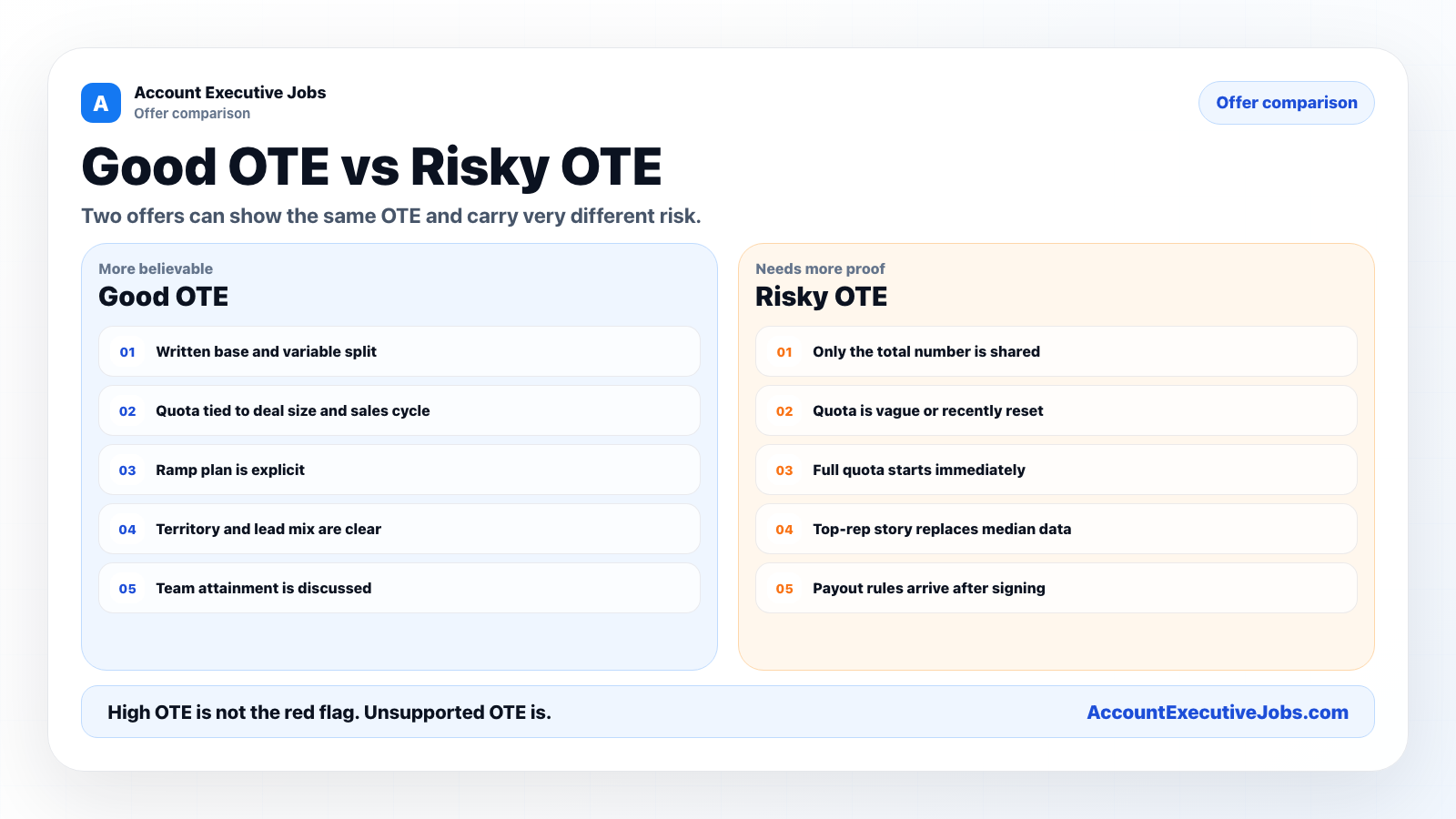
A high OTE by itself is not the problem.
The problem is high OTE with no proof.
A $300,000 OTE can be real in a role with large deal size, a proven market, a clean territory, strong support, and reps already hitting target. A $140,000 OTE can be fake if the quota is fantasy and the pipeline is empty.
Do not judge the offer by the number. Judge it by the path to the number.
Ask:
- What did the median rep earn last year?
- What percentage of reps hit 100 percent of quota?
- What percentage hit at least 80 percent?
- How many reps are still ramping?
- How many accounts will I own?
- What pipeline exists today?
- What does a normal first six months look like?
- What causes reps to miss?
You are not trying to trap the manager. You are trying to understand the job.
If the manager gets annoyed by normal compensation questions, that is useful information.
Copy embed code
<a href="https://accountexecutivejobs.com/blog/sales-compensation/account-executive-salary">
  <img src="https://accountexecutivejobs.com/static-images/blog/account-executive-salary-good-vs-risky-ote-inline.png" alt="Good OTE versus risky OTE comparison for account executive salary offers." width="1600" height="900">
</a>
What Candidates Should Ask Before Accepting
Use these questions in the recruiter screen, hiring manager interview, and offer call.
Base And OTE
What is the base salary, target variable pay, and total OTE?Is variable pay uncapped, capped, or paid with accelerators after quota?Can I review the written commission plan before I sign?Do not accept a verbal comp plan as the final answer. Sales compensation needs to be written.
Quota And Attainment
What annual quota supports this OTE?What percentage of reps hit quota in the last full year?How many reps are below ramp, on ramp, or fully ramped in that number?This is where many inflated OTEs fall apart. A plan can look fair until you learn that almost no one hits it.
Ramp
What quota and commission rules apply in months one through six?Is there a recoverable draw, non-recoverable draw, or guaranteed commission during ramp?How long does it normally take a new AE to close the first deal?Ramp matters because AE work has a time lag. If the sales cycle is six months and the role expects full quota in month two, you need a very good reason to believe that plan.
Territory And Lead Flow
What accounts, territory, segment, or vertical would I own?How much pipeline is inbound, outbound, partner-sourced, or inherited?What happened to the person who owned this territory before me?Territory can quietly decide your income. Two AEs with the same skill and the same OTE can have very different outcomes if one inherits warm expansion accounts and the other gets an empty patch.
Commission Rules
When is commission earned: booking, invoice, collection, or some other event?Are commissions subject to clawback if the customer churns, cancels, or does not pay?Can the plan change during the year?The Department of Labor’s commission page notes that the Fair Labor Standards Act does not require commissions, and DOL has separate guidance for some commission-paid employees. That is not a substitute for legal advice. It is a reminder to read the plan, ask questions, and get qualified help when a pay issue is serious.
What Hiring Managers Should Put In The Job Post
If you want better candidates, write a better pay section.
Do not write:
$300K OTE, uncapped commission, huge upside.Write something closer to:
Base salary: $110,000 to $130,000
OTE: $220,000 to $260,000
Quota: $1.1M to $1.3M annual new business
Ramp: 3-month ramp with reduced quota
Sales cycle: 90 to 180 days
Territory: named accounts in the Western US
Lead source: mixed outbound, partner, and expansion pipeline
That is not less attractive. It is more credible.
Good candidates will still ask questions. That is fine. You want candidates who understand quota, ramp, and territory. If someone only asks about upside and never asks how the number is earned, I would be more worried, not less.
Link the pay to the work:
- Who is the buyer?
- What is the average contract size?
- How long is the sales cycle?
- Does the AE self-source pipeline?
- Is there SDR or marketing support?
- Is the territory named, geographic, vertical, or open?
- How is quota set?
This also helps your hiring scorecard. Compensation and territory fit should be part of how you evaluate the candidate, not a rushed conversation at the end.
What A Good AE Salary Depends On
Title matters, but it is not enough.
If you are still deciding which sales path to pursue, start with the Highest Paying Sales Jobs guide. It compares career categories by income ceiling, reliability, and fit. This guide handles the next decision: whether one account executive compensation package is credible.
A better way to judge AE pay:
| Factor | Why it changes pay |
|---|---|
| Deal size | Bigger deals can support higher commissions, but often take longer to close. |
| Sales cycle | Longer cycles can mean higher pay and more ramp risk. |
| Buyer level | Executive buyers usually require stronger business judgment. |
| Product type | Technical products may require sales engineers or deeper training. |
| Market demand | Hot markets can raise pay, but they can also attract more competition. |
| Territory | Account quality and territory history can matter as much as skill. |
| Lead source | Inbound demand and partner channels can change the job completely. |
| Quota design | Pay only works if the target matches the sales process. |
| Manager quality | A good manager can improve ramp, forecast habits, and deal strategy. |
The BLS sales engineers page reports a 2024 median annual wage of $121,520 for sales engineers and describes the role as selling products or services that require technical skill. That is one reason technical sales can pay well: the sale depends on both buyer trust and product depth.
The BLS sales managers page reports a 2024 median annual wage of $138,060 for sales managers and notes that many sales managers have a salary plus commissions or bonus. Sales leadership can pay well, but it is not just a richer AE job. You inherit team number, hiring, coaching, forecasting, and missed targets you did not personally create.
That is why I do not like simple salary rankings. They hide the trade.
The Offer Math
Use this simple check.
OTE = base salary + target commission
Target commission = quota x commission rate
Say the offer is:
- $100,000 base salary.
- $200,000 OTE.
- $1,000,000 annual quota.
- 10 percent commission on closed revenue.
That works on paper:
$100,000 base + ($1,000,000 quota x 10%) = $200,000 OTENow the real questions start:
- Is the quota net new revenue, gross bookings, gross profit, or some other number?
- Does commission pay on closed-won, invoice, or collected cash?
- Does the commission rate change by product?
- Are renewals, services, discounts, refunds, or churn treated differently?
- What happens if procurement delays the signature past quarter-end?
- Can accelerators make up for a slow start?
- Can clawbacks erase commission later?
The formula is the easy part. The plan rules are where your income lives.
If you are choosing between two written offers, the Sales Job Offer Comparison Calculator compares modeled take-home, expected attainment, quota pressure, benefits, signing bonuses, and state taxes side by side. Use the math to expose the tradeoffs, then use the hiring-manager conversation to verify the inputs.
What To Do With A Vague Answer
Not every vague answer is bad intent. Sometimes the recruiter does not know. Sometimes a plan is being updated. Sometimes a small company has not learned how to write a clear sales comp plan yet.
Still, you should not accept confusion as your risk.
If the answer is vague, ask for the next source of truth:
Who can walk me through the written commission plan?Can we discuss team attainment with the hiring manager?Can I see the ramp terms before signing?Is the territory already assigned or still being built?The answer does not need to be perfect. It needs to be clear enough that you can make a grown-up decision.
One incomplete answer calls for a follow-up. A pattern of vague answers across quota, ramp, territory, and commission timing is different. Use the Sales Job Red Flags guide to separate a normal unanswered question from a role that keeps transferring risk to the candidate.
Candidate Checklist
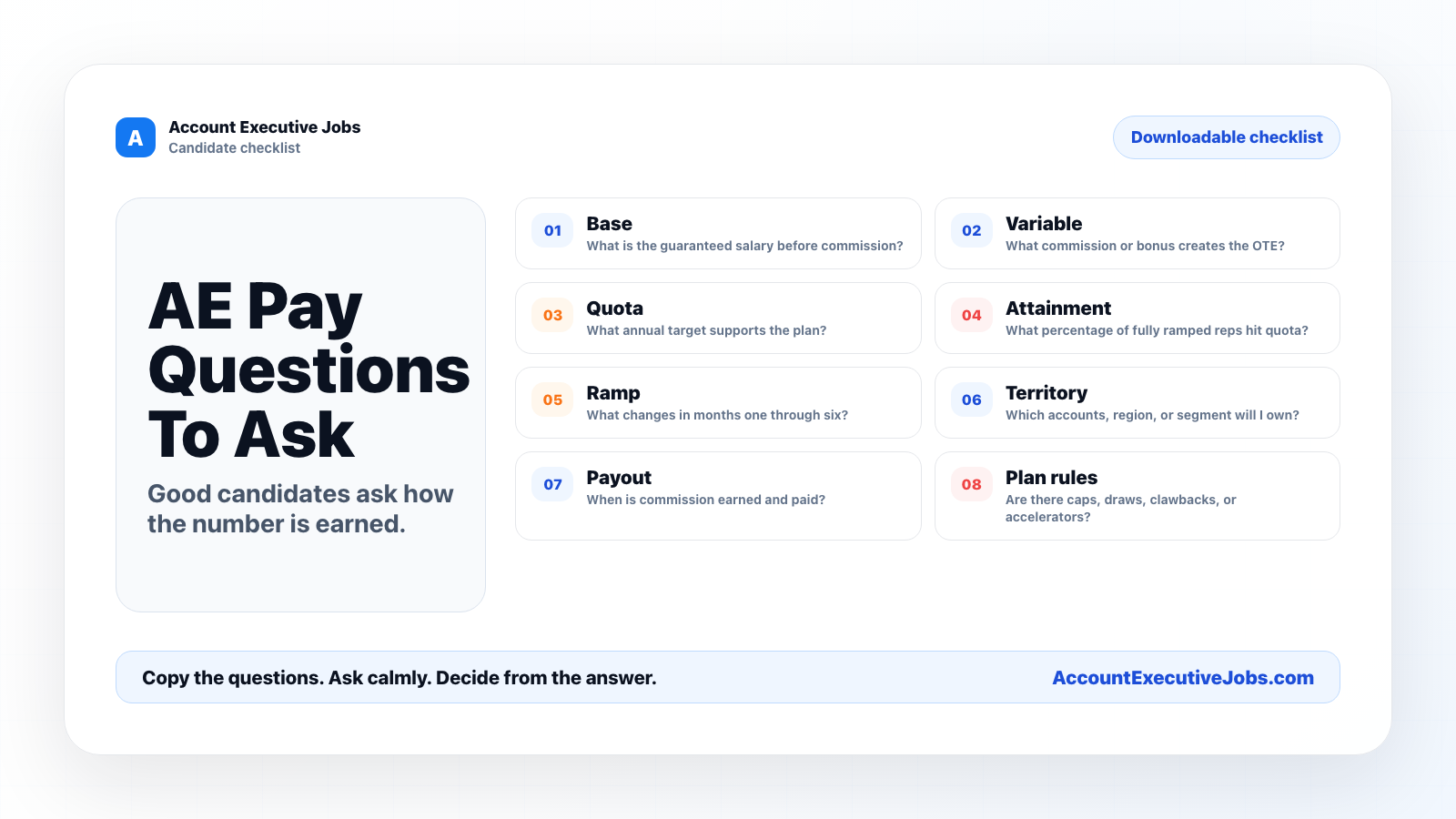
Before you accept an account executive offer, make sure you can answer these:
- I know the base salary.
- I know the target commission.
- I know the total OTE.
- I know the quota.
- I know the ramp schedule.
- I know when commission is earned.
- I know when commission is paid.
- I know whether there are caps, draws, clawbacks, or accelerators.
- I know the territory or account list.
- I know the lead-source mix.
- I know how many reps hit target.
- I know why the role is open.
- I know what a successful first six months looks like.
Copy embed code
<a href="https://accountexecutivejobs.com/blog/sales-compensation/account-executive-salary">
  <img src="https://accountexecutivejobs.com/static-images/blog/account-executive-salary-pay-questions-inline.png" alt="Account executive pay questions checklist covering base, variable pay, quota, attainment, ramp, territory, payout timing, and plan rules." width="1600" height="900">
</a>
If you cannot answer these, you are not done interviewing the company.
FAQ
What does OTE mean in sales?
OTE means on-target earnings. It is base salary plus the target amount of variable pay a salesperson can earn by hitting quota or another agreed target.
Is OTE guaranteed?
No. Base salary is the guaranteed part. OTE includes variable pay, which depends on the commission plan and performance against target.
What is a good account executive salary?
A good account executive salary depends on role level, market, deal size, sales cycle, location, company stage, base/variable split, quota, ramp, and territory. Do not judge the offer by one average number. Judge the comp plan.
Is a high OTE a red flag?
High OTE is not the red flag. Unsupported OTE is the red flag. If the company cannot explain quota, ramp, territory, attainment, and payout rules, slow down.
What should I ask before accepting an AE offer?
Ask for the base salary, target commission, quota, ramp plan, territory, team attainment, lead-source mix, commission timing, clawback rules, and the written comp plan.
Should employers post OTE in AE job descriptions?
Yes, if they can explain it. A compensation range with base, OTE, quota context, ramp, and territory details will attract better-fit candidates than a vague upside claim.
Sources And Review Notes
This article was built from DataForSEO keyword and SERP research pulled on May 27, 2026, the May 2025 BLS national wage estimates released in May 2026, plus official sources from BLS, O*NET, and the Department of Labor. RepVue is included as a clearly labeled self-reported industry signal, not the single source of truth. Salary samples, occupation mappings, quota populations, and total-comp definitions vary.
Reviewed by Will Gordon, founder of Account Executive Jobs. Will has worked as a sales rep, managed sales teams, was the #1 recruiter for a national staffing agency, and started Search Partners, a recruiting firm in San Francisco.
If you are comparing sales roles, browse account executive jobs and read the compensation section with the checklist above. If you are hiring, post an account executive role with clear base, OTE, quota, ramp, and territory details. The better you explain the pay, the better your candidate conversations will be.