
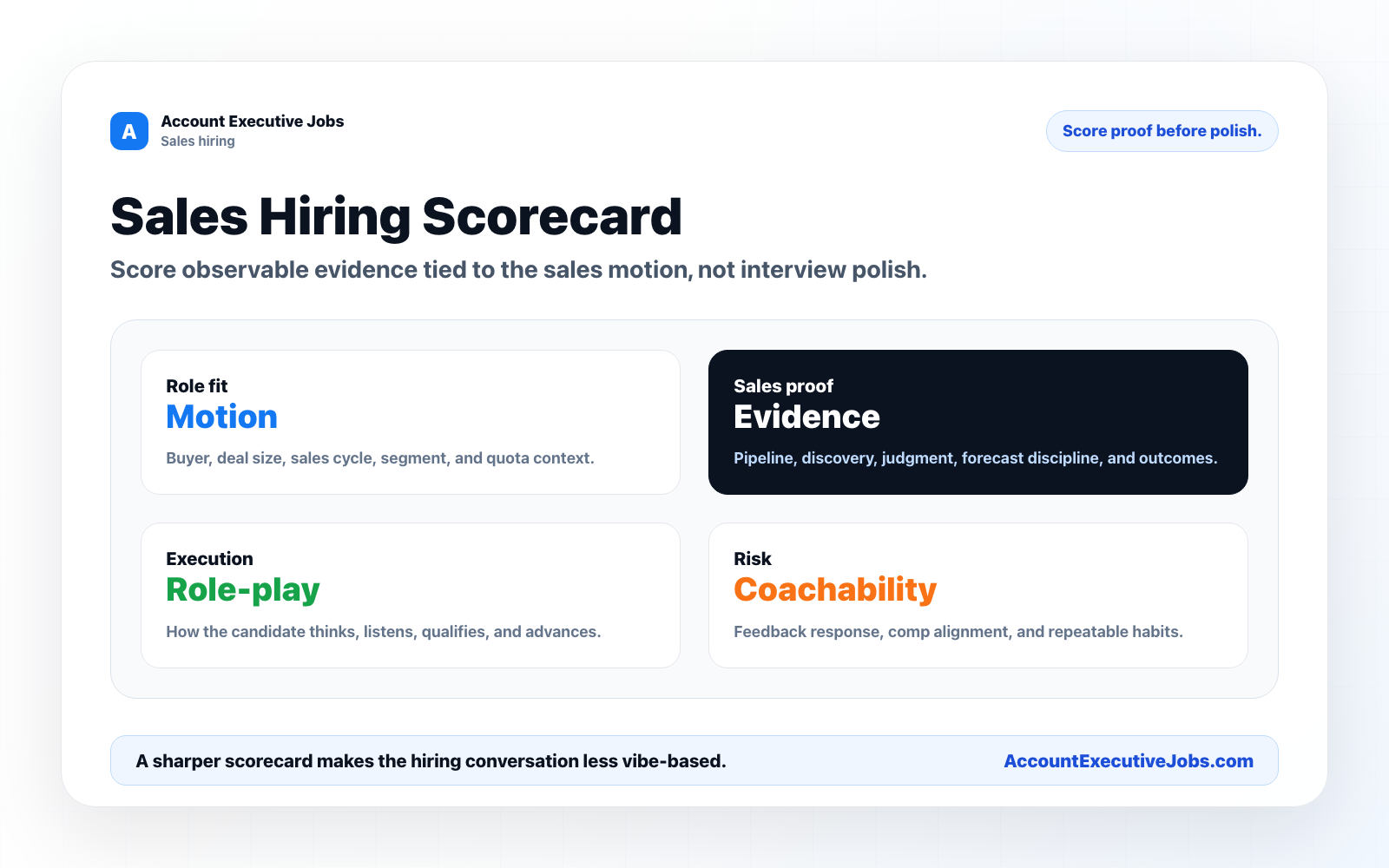
Use this sales hiring scorecard before you interview the next account executive. It gives every interviewer the same categories, the same 1 to 5 scoring scale, and the same evidence standard.
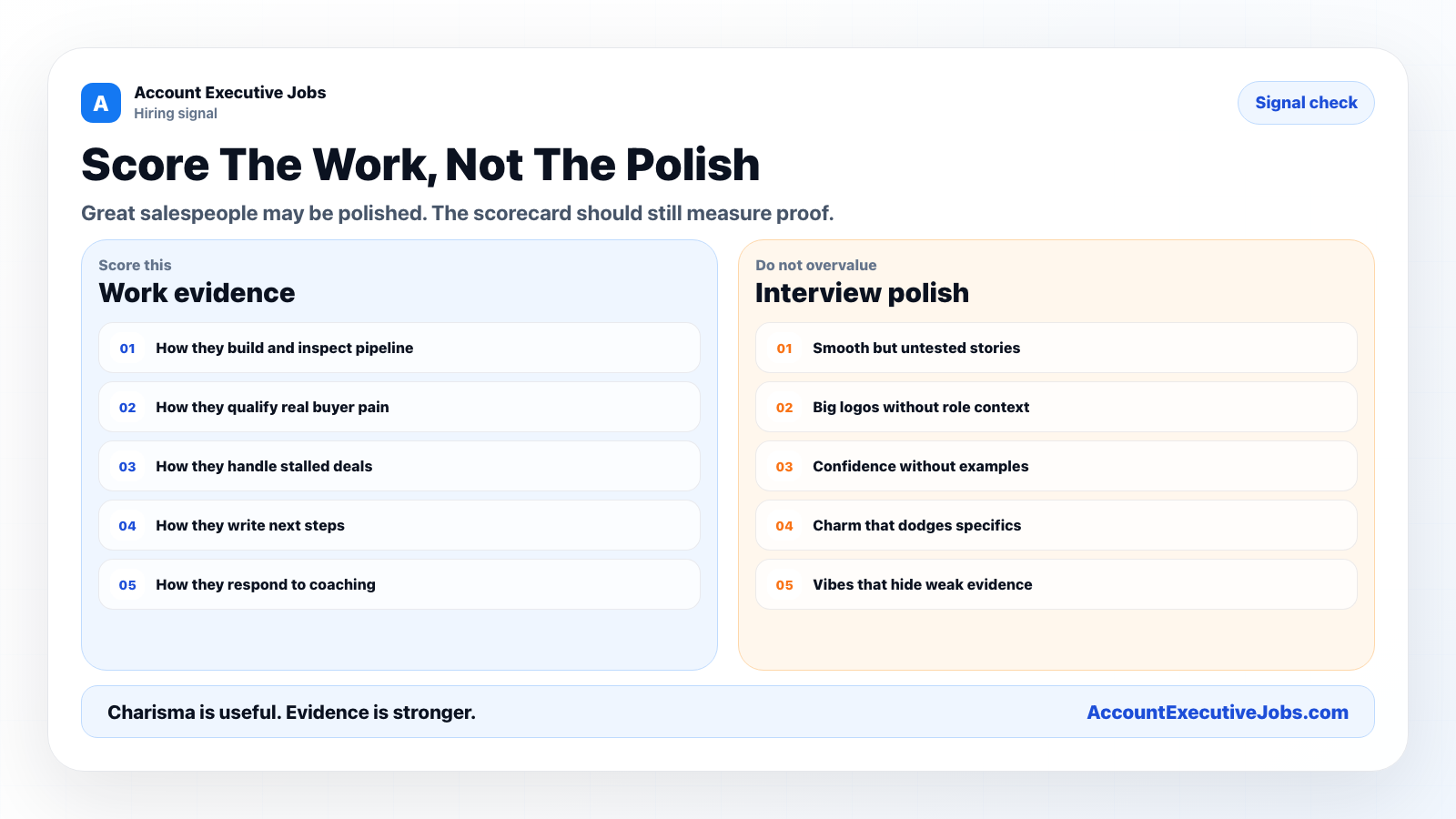
The point is not to turn hiring into math. The point is to keep the team from falling in love with polish and ignoring proof.
For an account executive, score these nine areas:
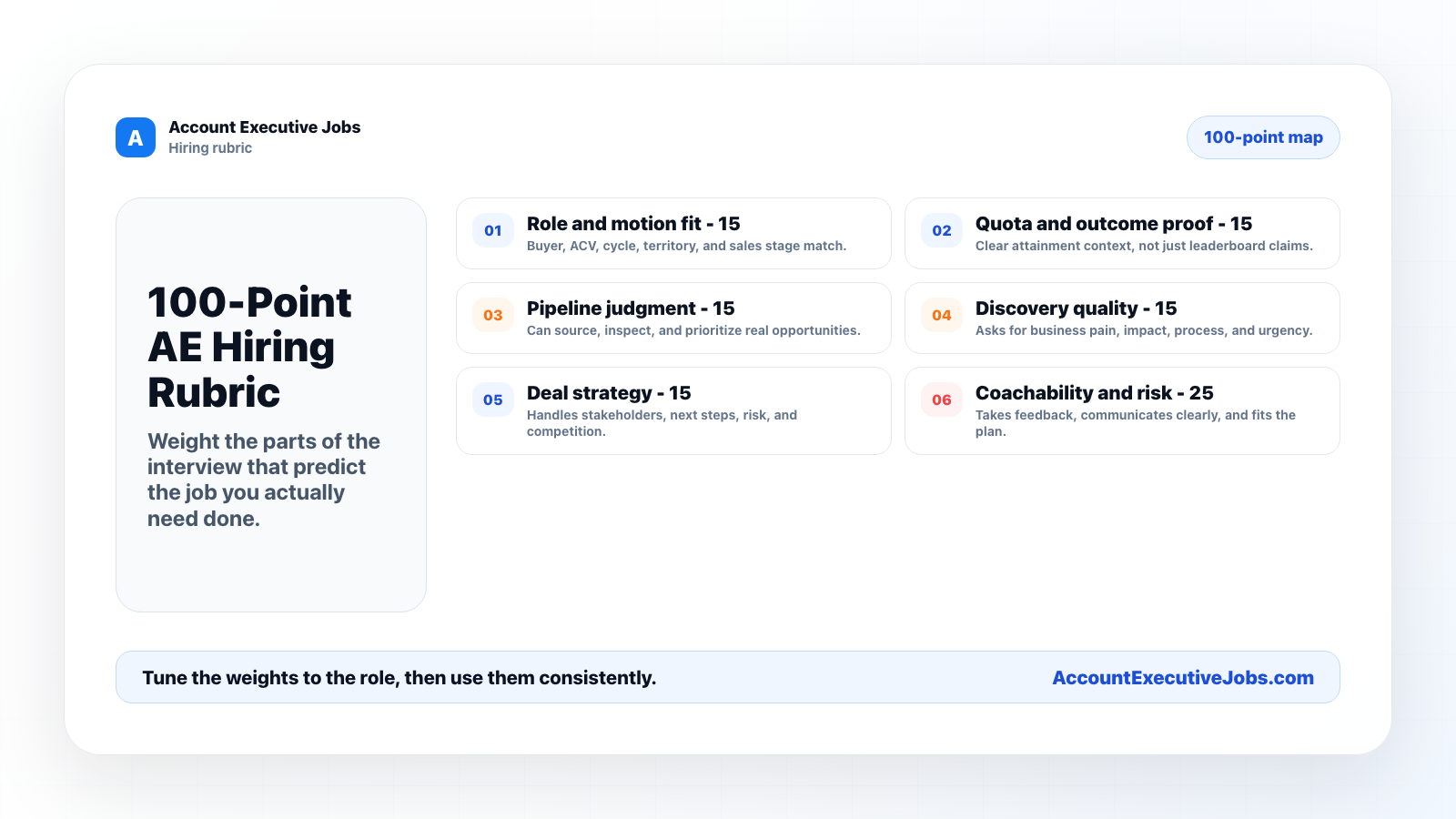
| Category | Weight |
|---|---|
| Role and sales process fit | 15 |
| Proof of sales results | 15 |
| Prospecting and pipeline creation | 15 |
| Discovery and qualification | 15 |
| Deal strategy and business judgment | 10 |
| Communication and follow-up | 10 |
| Coachability | 10 |
| Compensation and territory fit | 5 |
| Risk notes and references | 5 |
If a candidate scores high overall but misses badly on a must-have area, pause. Do not average away the thing the role actually needs.
Before opening the role, review the cost of hiring and replacing an account executive, then use the free Sales Hiring Cost and Ramp Calculator to connect compensation, ramp, employer payroll taxes, manager time, expected bookings, and payback to the scorecard.
The Short Version
A sales hiring scorecard is a shared scoring tool for interviews. It helps your team compare candidates against the sales work they will actually do.
For an AE role, that means:
- Can this person sell in our sales process?
- Can they prove past results?
- Can they create pipeline if the role requires it?
- Can they run discovery without rushing to pitch?
- Can they think through a deal like an owner?
- Can they write a clear follow-up?
- Can they take coaching?
- Do the quota, ramp, territory, and OTE match what they want?
- What needs to be checked before offer?
The scorecard should be built before interviews start. If you create it after meeting candidates, it usually becomes a story about the person you already like.
That is the mistake this tool is meant to prevent. A polished sales candidate is not the same as a proven one. Good AEs can usually interview well because selling themselves is part of the job. The interview still has to answer a harder question: can this person sell this offer, to this buyer, in this territory, with this ramp and quota?
Copy embed code
<a href="https://accountexecutivejobs.com/blog/hiring-salespeople/sales-hiring-scorecard">
  <img src="https://accountexecutivejobs.com/static-images/blog/sales-hiring-scorecard-proof-motion.svg" alt="Animated infographic showing a sales hiring scorecard that scores role fit, quota proof, pipeline judgment, discovery quality, deal strategy, and coachability before interview polish." width="1600" height="900">
</a>
Sales Hiring Scorecard Template
Use a 1 to 5 score in each category, then multiply by the weight.
(Score / 5) x Weight = Weighted score| Category | Weight | What You Are Scoring | Strong Evidence |
|---|---|---|---|
| Role and sales process fit | 15 | Segment, buyer, ACV, cycle length, inbound/outbound mix, territory, and deal ownership | The candidate has succeeded in a similar sales process or can explain the gap clearly. |
| Proof of sales results | 15 | Quota, attainment, rank, deal size, cycle length, ramp, and source of pipeline | The candidate can explain numbers, context, and how results were produced. |
| Prospecting and pipeline creation | 15 | Ability to create qualified opportunities | The candidate can describe sources, outreach, conversion points, and weekly habits. |
| Discovery and qualification | 15 | Ability to find pain, authority, urgency, budget, process, and next step | The candidate asks useful questions and avoids pitching too soon. |
| Deal strategy and business judgment | 10 | How the candidate thinks through buying committees, objections, risk, and next steps | The candidate can walk through a real deal with tradeoffs and clear decisions. |
| Communication and follow-up | 10 | Conversation, writing, recap, and internal handoff | The candidate sends a crisp follow-up and explains complex points simply. |
| Coachability | 10 | How the candidate responds to feedback and adapts | The candidate improves after feedback without becoming defensive. |
| Compensation and territory fit | 5 | OTE, base, quota, ramp, territory, travel, remote needs, and expectations | The candidate asks practical questions and understands tradeoffs. |
| Risk notes and references | 5 | Evidence that needs follow-up before offer | References, gaps, number mismatches, or manager concerns are written down. |
The weights above are built for an account executive or full-cycle sales rep. Change the weights if the role changes.
Copy embed code
<a href="https://accountexecutivejobs.com/blog/hiring-salespeople/sales-hiring-scorecard">
  <img src="https://accountexecutivejobs.com/static-images/blog/sales-hiring-scorecard-100-point-rubric-inline.png" alt="100-point AE hiring rubric covering role fit, quota proof, pipeline judgment, discovery quality, deal strategy, and coachability." width="1600" height="900">
</a>
For an SDR, weigh prospecting and coachability more heavily. For an enterprise AE, give more room to deal strategy, buying committee judgment, and account planning. For a first sales hire, make role fit and self-sourced pipeline harder to pass. A first sales hire should not need a perfect company machine to create conversations.
Before you use this, define the role. Write down the buyer, deal size, sales cycle, territory, quota, expected ramp, lead source, and manager support. If the role is vague, the scorecard will make confusion look organized.
Use the Account Executive Interview Questions guide to turn each category into a consistent question, signal, follow-up, and evidence standard. The scorecard and interview guide are designed to work together.
Copy embed code
<a href="https://accountexecutivejobs.com/blog/hiring-salespeople/sales-hiring-scorecard">
  <img src="https://accountexecutivejobs.com/static-images/blog/sales-hiring-scorecard-score-proof-not-polish-inline.png" alt="Comparison of work evidence versus interview polish for sales hiring scorecards." width="1600" height="900">
</a>
How To Score Each Category
Role And Sales Process Fit
This is where a lot of AE hiring goes sideways.
A candidate can be a good salesperson and still be wrong for your sales process. An inbound SMB closer may struggle in an outbound enterprise role. A relationship seller may struggle in a high-volume transactional sale. A rep who had a strong territory and warm demand may not know how to build a cold book.
Ask:
Walk me through the sales process where you have had the most success. Segment, buyer, deal size, sales cycle, lead source, and quota.Score high when the candidate can explain:
- Who they sold to.
- How deals entered the pipeline.
- How long deals took.
- What they owned vs what marketing, SDRs, managers, or partners owned.
- Where your role differs from their past role.
Score low when the candidate talks in broad wins but cannot explain the sales process.
Proof Of Sales Results
Sales resumes often look clean because the candidate knows the buyer: you.
Ask for context.
Tell me your quota, attainment, average deal size, sales cycle, and where you ranked on the team. What created the result?Strong answers include:
- Quota and attainment by period.
- Ramp context.
- Territory context.
- Inbound vs self-sourced pipeline.
- Team rank or peer context.
- What changed when performance improved or dipped.
Weak answers sound like this:
- “I crushed it.”
- “I was always near the top.”
- “The numbers are complicated.”
- “I do not remember quota.”
The issue is not that every candidate needs perfect numbers. The issue is whether they can explain the job they did.
Prospecting And Pipeline Creation
If the role requires outbound pipeline, this category should be a gate.
Ask:
Show me how you built pipeline in your last role. What did a normal week look like?Listen for:
- Account selection.
- Research habits.
- Outreach message quality.
- Follow-up rhythm.
- Conversion points.
- Self-sourced pipeline.
- How they handled no-response accounts.
O*NET’s sales representative summary includes sales work such as contacting customers, answering questions, recommending products, estimating terms, and supporting customers after sale. Those are work behaviors, not personality vibes.
Discovery And Qualification
Discovery is where you see whether the candidate can resist the urge to pitch.
Prompt:
Pretend I am a buyer who agreed to a first call. Run the first ten minutes.Score high when the candidate:
- Opens clearly.
- Sets an agenda.
- Asks about the buyer’s world before pitching.
- Finds the business reason for the conversation.
- Confirms process and next step.
Score low when the candidate:
- Talks too much.
- Pitches before understanding the problem.
- Asks only surface questions.
- Never finds authority, urgency, or process.
The first ten minutes tell you a lot. Does the candidate make it about the buyer, or do they rush to prove how much they know?
Deal Strategy And Business Judgment
Ask about a real deal, preferably a lost one.
Tell me about a deal you lost that you should have won. What did you miss?A strong candidate can explain tradeoffs. They know whether the issue was qualification, champion weakness, pricing, timing, competition, procurement, or their own mistake.
A weak candidate blames price, product, marketing, or the buyer every time.
You are listening for ownership, not confession. Good salespeople know what happened in a deal. They know what they controlled, what they missed, and what they would do next time.
Communication And Follow-Up
Sales is not only live conversation. AEs write recaps, mutual plans, internal notes, handoffs, and next-step emails.
Ask the candidate to send a short follow-up note after the interview.
Score it for:
- Accuracy.
- Brevity.
- Next step.
- Judgment.
- Tone.
You are not looking for a fancy note. You are looking for whether the candidate understood the conversation.
Coachability
Coachability is not whether the candidate says, “I love feedback.”
Test it.
Give one piece of feedback in the role-play, then ask them to redo the moment.
Redo the opener. Slow down, ask one better business question, and do not pitch before you understand the problem.Score high when they adjust quickly and can explain what changed.
Score low when they get defensive, repeat the same behavior, or perform the feedback in a wooden way without understanding it.
Compensation And Territory Fit
This is not only a money conversation. It is a truth conversation.
Ask:
What would you need to know about quota, ramp, territory, base, OTE, and lead flow before accepting this role?Good candidates ask practical questions. They want to know how the number works. That is a good sign, not a problem.
Use the Account Executive Salary guide to define the base, OTE, quota, ramp, and territory language before interviews begin. A scorecard cannot measure compensation fit consistently when the hiring team has not agreed on what the offer actually means.
Weak fit looks like this:
- Candidate wants enterprise OTE but has never worked a long-cycle deal.
- Candidate needs warm inbound volume but the role is cold outbound.
- Candidate wants remote flexibility but the territory needs field work.
- Candidate wants a short ramp but the product has a long learning curve.
If you are still writing the role, pair this with a clear job post. The next related guide should be an account executive job description template, since the scorecard only works when the role is defined.
Risk Notes And References
Do not use this section as a dumping ground for vague concerns. Write down what needs to be checked.
Useful risk notes:
- Quota numbers changed across interviews.
- Candidate could not explain pipeline source.
- Manager reference must confirm ramp and forecast habits.
- Role-play showed weak discovery but strong coachability.
- Compensation expectations may not match the role.
The note should point to the next action: follow-up interview, reference check, role-play, or pass.
The 1 To 5 Rubric
Do not let every interviewer invent their own meaning for “good.” Use the same scale.
| Score | Meaning | Evidence Standard |
|---|---|---|
| 1 | No evidence | Candidate avoided the question, gave unsupported claims, or showed a mismatch for this role. |
| 2 | Weak evidence | Candidate gave a partial answer, but examples were thin, mismatched, or hard to verify. |
| 3 | Usable evidence | Candidate meets part of the bar. Needs more probing or support. |
| 4 | Strong evidence | Candidate gave specific proof that maps to the role. |
| 5 | Rare evidence | Candidate showed tight role match, clear proof, and strong judgment under follow-up. |
Here is the rule I would use: if an interviewer cannot write down the evidence, they should not give a 4 or 5.
The U.S. Office of Personnel Management structured interviews page says structured interviews use rules for eliciting, observing, and evaluating responses, and that more structure is tied to better validity and rater agreement. That is the spirit of this scorecard: same role, same criteria, same evidence standard.
You can still use judgment. You should. Just make the judgment visible enough that another hiring manager can understand it.
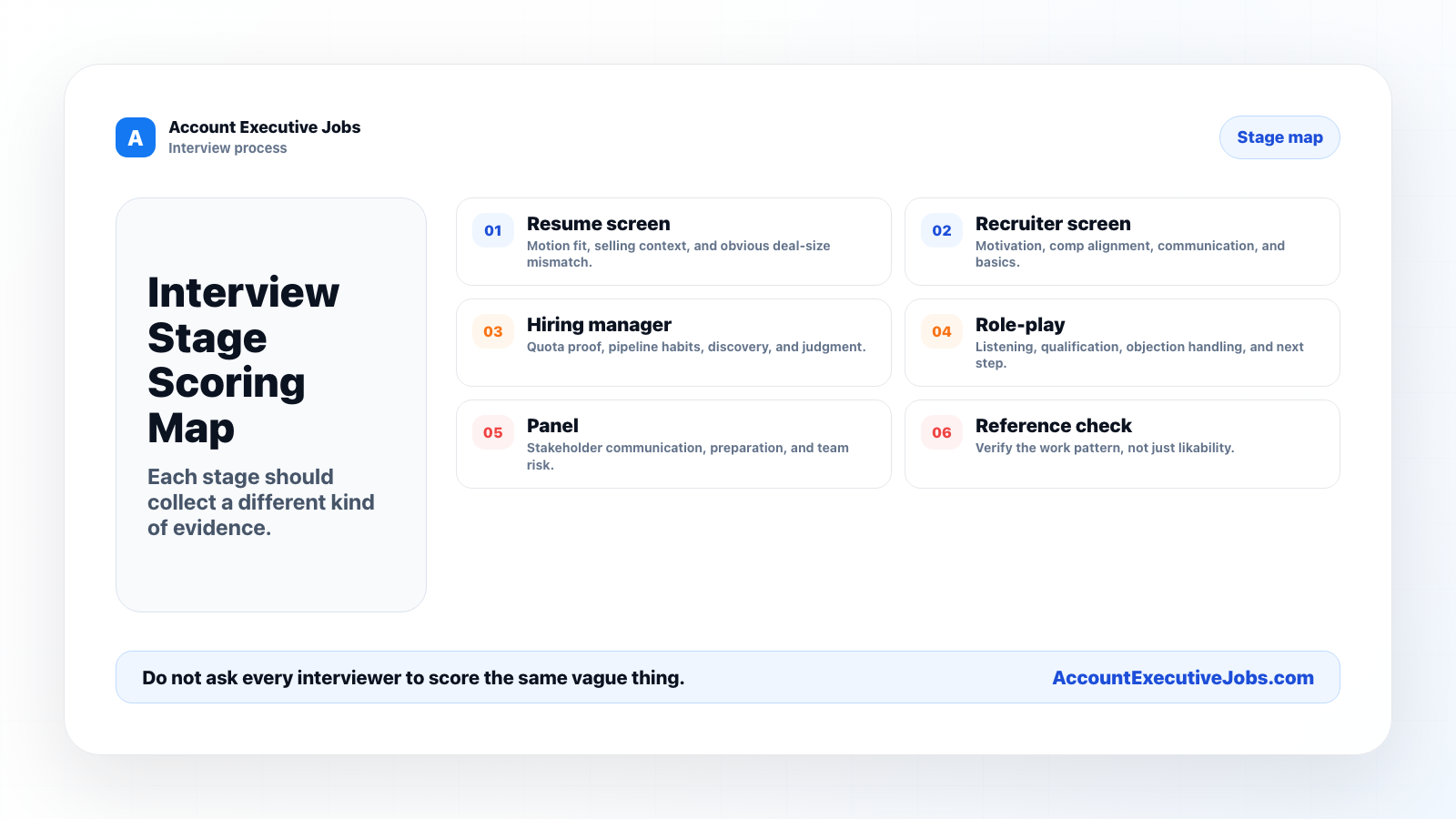
When To Score Each Part
Not every interview stage can score every trait.
| Stage | Score Now | Do Not Score Yet |
|---|---|---|
| Resume screen | Sales process fit, proof clues, role match | Coachability, discovery, deal judgment |
| Recruiter screen | Motivation, comp fit, territory fit, initial proof | Final sales skill |
| Hiring manager interview | Proof, pipeline, discovery, deal judgment | Final decision before role-play |
| Role-play or work sample | Discovery, qualification, coachability, communication | Past results without reference support |
| Panel interview | Cross-functional communication, judgment, risk notes | New criteria that were never agreed on |
| References | Proof, manager style, risk notes | New concerns that were never tested |
Copy embed code
<a href="https://accountexecutivejobs.com/blog/hiring-salespeople/sales-hiring-scorecard">
  <img src="https://accountexecutivejobs.com/static-images/blog/sales-hiring-scorecard-interview-stage-scoring-map-inline.png" alt="Interview stage scoring map for sales hiring covering resume screen, recruiter screen, hiring manager, role-play, panel, and references." width="1600" height="900">
</a>
The OPM Structured Interview Guide recommends tying ratings to behavioral examples and notes, then comparing panel ratings after interviewers have scored independently. That is useful for sales hiring too.
The debrief should start with evidence, not “I liked them.”
Run it this way:
- Each interviewer scores before group discussion.
- Each high or low score needs written evidence.
- Discuss only major score gaps.
- Separate must-have misses from coachable gaps.
- Decide the next step: advance, targeted follow-up, reference check, or pass.
If everyone liked the candidate but no one can explain the pipeline score, that is the point of the debrief. The scorecard is doing its job.
Example Candidate Score
This is a composite example.
The candidate is polished. They have a clean AE resume, they sound confident, and they have a good story about exceeding quota. The first interview feels strong.
Then the scorecard slows the process down.
| Category | Weight | Score | Weighted Score | Notes |
|---|---|---|---|---|
| Role and sales process fit | 15 | 3 | 9 | Prior role was mostly inbound SMB. New role is outbound mid-market. |
| Proof of sales results | 15 | 4 | 12 | Clear attainment history, but quota context needs reference check. |
| Prospecting and pipeline creation | 15 | 2 | 6 | Could not explain self-sourced pipeline clearly. |
| Discovery and qualification | 15 | 3 | 9 | Asked decent questions, pitched too early. |
| Deal strategy and business judgment | 10 | 3 | 6 | Good deal story, light on buyer process. |
| Communication and follow-up | 10 | 4 | 8 | Follow-up was clear and useful. |
| Coachability | 10 | 4 | 8 | Improved after feedback in role-play. |
| Compensation and territory fit | 5 | 3 | 3 | OTE expectations may be workable. |
| Risk notes and references | 5 | 2 | 2 | Must verify pipeline ownership and ramp. |
| Total | 100 | 63 | Targeted follow-up or pass for outbound-heavy role. |
Without the scorecard, this candidate might win the room. With the scorecard, the team sees the real question: do we believe they can create pipeline in this sales process?
If the role has strong inbound demand, maybe they stay in the process. If the role is outbound-heavy, do not talk yourself into it without more proof.
That is the part sales teams need to be honest about. You are not hiring the person who can make the best first impression. You are hiring the person who can do the sales job after the interview ends.
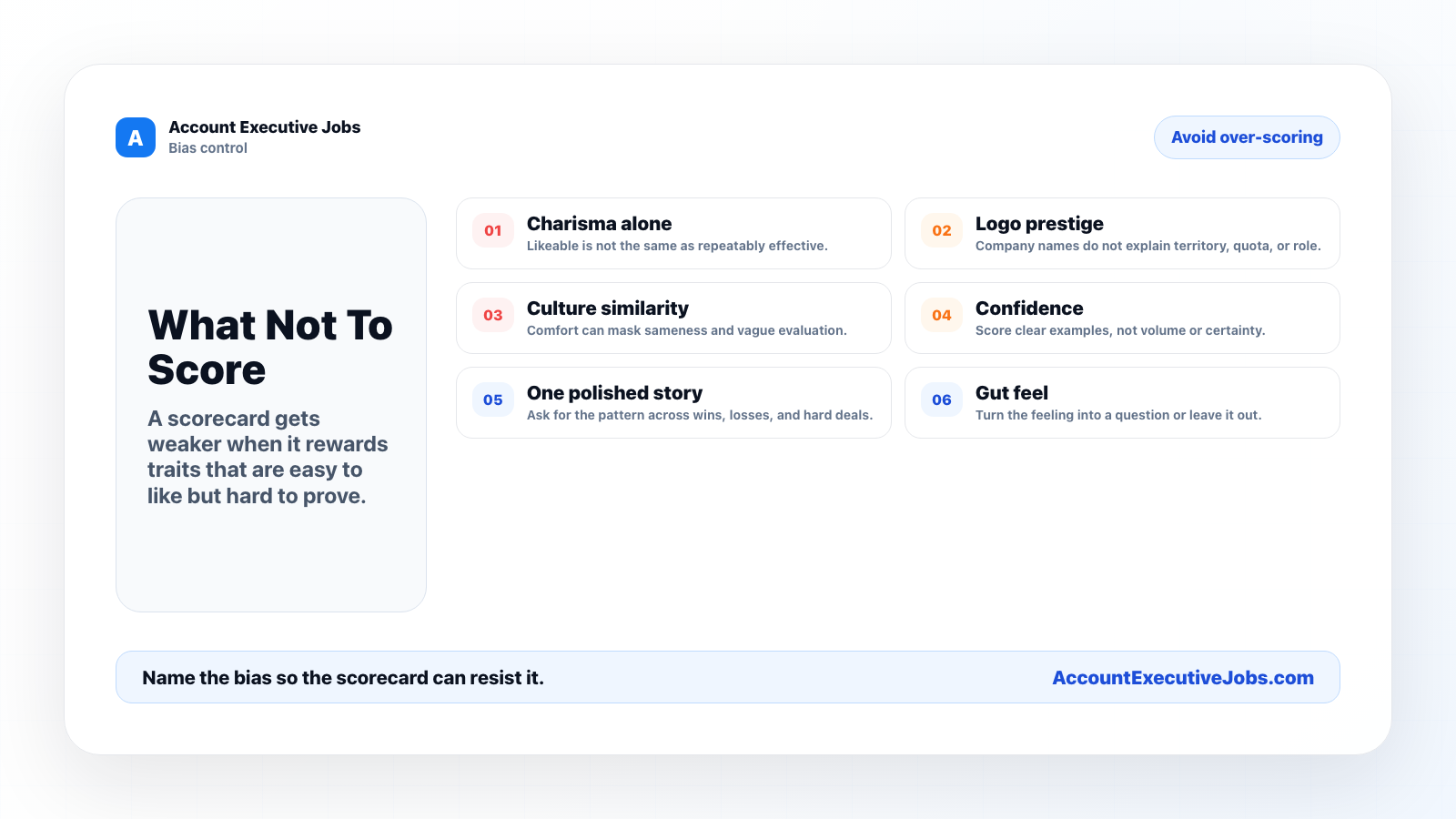
What Not To Score
Some things should not be in the scorecard.
Do not score:
- Age.
- Disability.
- Religion.
- National origin.
- Family status.
- Commute assumptions.
- Personal similarity to the hiring manager.
- Degree prestige unless the job truly requires it.
- “Culture fit” as a vague feeling.
The EEOC employment tests and selection procedures guidance explains that selection procedures can create legal risk if they disproportionately exclude protected groups and are not job-related and consistent with business necessity. Keep the scorecard tied to the work.
Safer categories:
- Preparation.
- Job-related communication.
- Follow-up quality.
- Work sample performance.
- Evidence from past sales work.
- Ability to explain numbers and decisions.
This is a hiring tool, not legal advice. If you need legal guidance, review your process with qualified counsel.
Copy embed code
<a href="https://accountexecutivejobs.com/blog/hiring-salespeople/sales-hiring-scorecard">
  <img src="https://accountexecutivejobs.com/static-images/blog/sales-hiring-scorecard-what-not-to-score-inline.png" alt="What not to score in sales hiring including charisma, logo prestige, culture similarity, confidence, one polished story, and gut feel." width="1600" height="900">
</a>
What This Scorecard Can And Cannot Do
The scorecard can make the decision more consistent. It cannot make a poorly defined role valid, turn an interview into perfect prediction, or prove that every difference between candidates matters.
Use it as a decision aid with three limits:
- The criteria must match the job. An enterprise AE, local field seller, inbound SMB closer, and first sales hire should not carry identical weights.
- A number is only as good as the evidence beneath it. A 4 without a written example is a feeling wearing a number.
- The final decision still needs judgment. The hiring manager must decide which gaps are coachable, which are role-breaking, and which claims need verification.
The most useful test is simple: if two interviewers disagree, can each point to the answer, work sample, or reference evidence behind the score? If not, the next step is better evidence, not a louder debrief.
Also check the operating environment around the hire. A good candidate can still fail under an impossible quota or an unrealistic ramp. Model the funnel in the Sales Quota Feasibility Calculator, map month-by-month expectations in the Sales Ramp Plan Builder, and understand the downside of a miss with the Sales Rep Turnover Cost Calculator.
FAQ
What is a sales hiring scorecard?
A sales hiring scorecard is a structured tool for evaluating sales candidates against the same job-related criteria. For an account executive, the criteria should include sales process fit, proof of results, pipeline creation, discovery, deal judgment, communication, coachability, compensation fit, and risk notes.
What should a sales interview scorecard include?
It should include role details, scoring categories, weights, a 1 to 5 rubric, evidence notes, interview stage, interviewer name, total score, and next step.
How do you score a sales candidate?
Score evidence, not impressions. Ask the same main questions, write down proof, use the same 1 to 5 scale, and avoid averaging away a weak score in a must-have category.
Should I use the same scorecard for SDRs, AEs, and VP Sales candidates?
No. Keep the structure, but change the weights. An SDR scorecard should weigh prospecting and coachability more heavily. An enterprise AE scorecard should give more room to deal strategy, buyer process, and account planning. A VP Sales scorecard is a different tool.
Is a hiring scorecard the same as a sales performance scorecard?
No. A hiring scorecard helps you evaluate candidates before you hire them. A sales performance scorecard tracks an employee’s activity, pipeline, and results after they join.
Should a scorecard replace manager judgment?
No. It should discipline manager judgment. A hiring manager still has to decide which gaps are coachable, which gaps are fatal, and which proof matters most for the role.
Can I make this a PDF?
Yes. Download the free printable scorecard near the top of this guide. The full framework also remains on the page so readers can evaluate it before downloading and use it without filling out a form.
Sources And Review Notes
This article was built from DataForSEO keyword and SERP data pulled on May 27, 2026, manual review of ranking scorecard and sales interview pages, and official sources from OPM, EEOC, BLS, and O*NET. The weighting is an Account Executive Jobs editorial framework for AE and full-cycle sales hiring. It is not a validated employment test and should be adapted to the actual role.
The broad sales-role context comes from the BLS wholesale and manufacturing sales representatives page, which describes sales work that includes contacting customers, explaining products, negotiating prices and terms, answering questions, and following up with customers.
Reviewed by Will Gordon, founder of Account Executive Jobs. Will was the #1 recruiter for a national staffing agency, managed sales teams, and founded Search Partners in San Francisco.
Hiring an account executive? Post the role on Account Executive Jobs so sales candidates can see the quota, OTE, territory, and sales process clearly. Candidates can also compare active account executive jobs to see how the market describes pay and role expectations.